1. Government Finance: Class 10 Economics Notes | Unit 3 Chapter 1
Importantedunotes.com
Back to Economics Notes

Welcome to the complete study guide on Chapter 1 Government Finance under Macroeconomics. This is Chapter 1 of Unit 3 for Class 10 Economics students in Nepal preparing for their SEE board exams.

Here you will find summarized theoretical notes, clear breakdowns of the budget formulation process in Nepal, and fully solved textbook exercises along with additional and numerical problems.

Explore our complete study list here: Class 10 Economics Notes.

1. Theoretical Notes Summary

(A) Introduction to Government Finance

Government Finance (Public Finance) is an important branch of economics that studies the government’s income, expenditure, loans, grants, and the policies and laws related to revenue and expenditure. It examines the sources from which the government earns its income and the heads under which it spends that income.

Key Definitions:

Adam Smith: “Government Finance is the study of the nature and principles of state income and expenditure.”

Dalton and Findlay Shirras: “Government Finance is the science related to the income and expenditure of public bodies.”

(B) Importance of Government Finance

In every welfare state, government finance is crucial for maintaining economic stability and the welfare of citizens. Its key roles are as follows:

(i) To achieve economic growth and stability through direct investment in agriculture, industry, and infrastructure development.
(ii) To maintain social justice by reducing the gap between the rich and the poor through progressive taxation and targeted welfare programs.
(iii) To ensure smooth delivery of essential public services such as education, health, and law and order.
(iv) To develop long-term physical and economic infrastructure such as roads, bridges, and hydropower projects.
(v) To create new employment opportunities through development projects and agricultural and industrial promotion programs.
(vi) To create an investment-friendly environment for both domestic and foreign private investors through sound tax policy and strategic infrastructure development.

(C) Sources of Government Revenue

The main sources of government income can be classified into three broad categories:

(i) Tax Revenue: The amount that an individual or institution is legally obliged to pay to the government, without being entitled to claim any direct benefit in return. It is divided into two parts:
1. Direct Tax: The tax liability and burden fall on the same person (e.g., income tax, property tax).
2. Indirect Tax: The tax burden can be shifted to another person (e.g., Value Added Tax – VAT [currently 13% in Nepal], customs duty, excise duty).
(ii) Non-Tax Revenue: Income collected by the government from sources other than taxes, in exchange for administrative or business services. Examples include: fees and charges (licenses, passports), dividends from public enterprises, fines and penalties, royalties from natural resources, and sale of government assets.
(iii) Miscellaneous Receipts: Various incomes such as recovery of audit irregularities and refund of advances from the previous fiscal year.

(D) Classification of Government Expenditure

The total expenditure made by the government for public welfare is mainly classified into three categories:
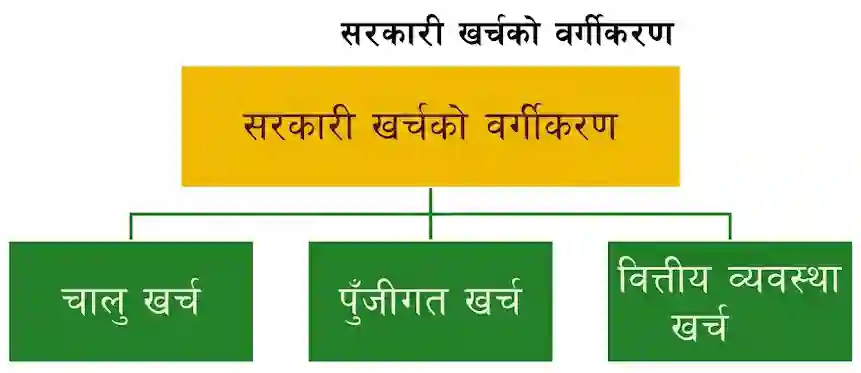
(i) Recurrent Expenditure: Regular and repetitive expenditure incurred every year for the daily operation of administration. Examples include: employee salaries, pensions, office supplies, and service charges.
(ii) Capital Expenditure: Non-repetitive expenditure incurred to create long-term assets and build capital, such as roads, buildings, and hydropower projects.
(iii) Financing Expenditure: Expenditure allocated to repay the principal and interest on domestic and foreign loans, and to invest in shares or loans in public enterprises.

(E) Government Budget and Nepal’s Budget Formulation Process

A budget is a financial plan that outlines the government’s estimated income and proposed expenditure for the upcoming fiscal year. Nepal began presenting budgets from B.S. 2008 (1951 AD). The main types of budget are:

1. Surplus Budget: When estimated income is greater than proposed expenditure.
2. Balanced Budget: When estimated income and proposed expenditure are exactly equal.
3. Deficit Budget: When proposed expenditure exceeds estimated income (developing countries like Nepal use this most often).

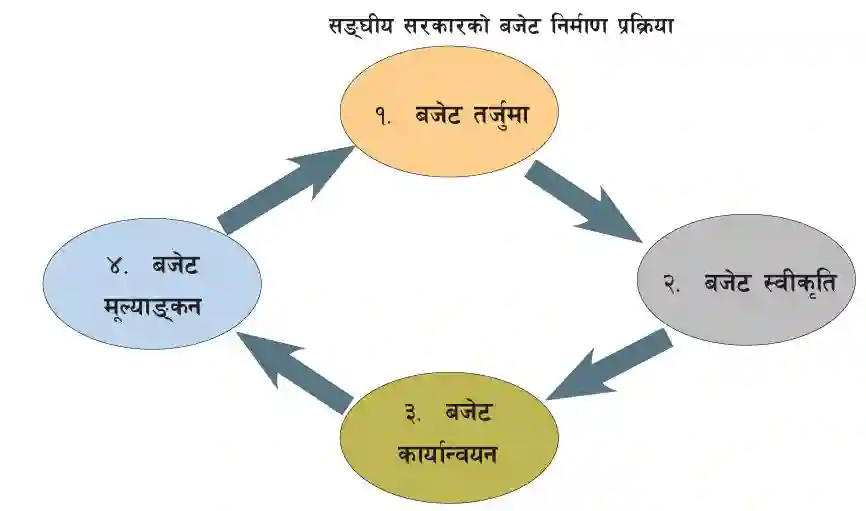
Four Main Stages of Federal Budget Formulation:

1. Budget Formulation: Pre-estimation of resources by the end of Magh (mid-February), sending guidelines and ceilings to ministries by Falgun 15 (late February), preparing proposals, and obtaining Cabinet approval.
2. Budget Approval: Presented by the Finance Minister in Parliament on Jestha 15 (late May), discussed thoroughly, passed by vote, and certified by the President. (Provincial governments must present their budget by Ashadh 1 and local governments by Ashadh 10.)
3. Budget Execution: Ministries and government bodies begin work according to their annual work plan and procurement plan.
4. Budget Evaluation: Internal audit by the Financial Comptroller General’s Office (FCGO) and final audit by the Office of the Auditor General (OAG).

2. Exercise — With Solutions
Very Short Answer Questions [1 Mark]

a. Define Government Finance.
Answer: The branch of economics that conducts a detailed study of the government’s income, expenditure, loans, grants, and the policies and financial management related to revenue and expenditure is called Government Finance (Public Finance).
b. Write any two importances of Government Finance.
Answer: Two importances of Government Finance are:
1. It helps maintain economic growth and stability in the country.
2. It ensures social justice by enabling equitable distribution of wealth and income.
c. What is Tax Revenue?
Answer: The amount that individuals, businesses, or institutions are legally obliged to pay to the government under prevailing law, without being entitled to claim any direct benefit in return, is called Tax Revenue.
d. Give any two examples of indirect taxes.
Answer: Two examples of indirect taxes are: Value Added Tax (VAT) and Excise Duty.
e. Under which type of revenue does the fee charged by the government for providing a public service fall?
Answer: The fee charged by the government for providing a public service falls under Non-Tax Revenue.
f. What is the income received by the government for allowing the use of natural resources called?
Answer: The income received by the government for allowing the use of natural resources (such as stone, sand, and mines) is called ‘Royalty’.
g. What is Foreign Grant?
Answer: Financial assistance received from foreign governments or international donor agencies for the country’s economic and social development, which does not need to be repaid, is called a Foreign Grant.
h. Write any two reasons why the government’s recurrent expenditure has been increasing in recent years.
Answer: Two reasons for the increase in recurrent expenditure are:
1. The expansion of the government’s scope and role in accordance with the concept of a welfare state.
2. A continuous increase in the liabilities related to employee salaries, allowances, and social security (pensions, etc.).
i. What types of expenditures fall under Recurrent Expenditure?
Answer: Regular and repetitive expenses incurred every year for the daily operation of administration — other than capital and financing expenditure — such as employee remuneration and office running costs, fall under Recurrent Expenditure.
j. What is Capital Expenditure?
Answer: Expenditure made to create long-term assets and build capital (such as road and hospital construction) that is non-repetitive in nature is called Capital Expenditure.
k. Write the meaning of Budget.
Answer: A detailed statement of estimated income and proposed expenditure prepared by the government for the upcoming fiscal year is called a Budget.
l. What type of budget is called a Deficit Budget?
Answer: A budget in which the government’s proposed expenditure (spending) exceeds its estimated income (revenue) is called a Deficit Budget.

3. Exercise: Short Answer Questions [5 Marks]

a. Give an introduction to Government Finance. 5 Marks
Government Finance is an important branch of economics that studies the government’s income and expenditure. It is also known as Public Finance. It covers topics related to government revenue, expenditure, loans, grants, and the policies, laws, and financial administration governing them.

According to Adam Smith, “Government Finance is the study of the nature and principles of state income and expenditure.” In the context of Nepal, all three tiers of government — federal, provincial, and local — each maintain their own Consolidated Fund and manage and mobilize public finance through their annual budgets.

b. What are the sources of Tax Revenue for the government? Describe them. 5 Marks
Tax Revenue is the amount that citizens or institutions are legally obliged to pay to the government. The government’s tax revenue sources can be described by dividing them into two parts:
1. Direct Tax: This is a tax that must be paid by the very person or institution on whom it is levied; its burden cannot be shifted to anyone else. Examples include: personal and corporate income tax, and property tax.
2. Indirect Tax: This is a tax levied on the consumption of goods and services. Its burden shifts from the producer through to the final consumer. The following taxes fall under this category:
– Value Added Tax (VAT): A tax levied on the value added at each stage from production to consumption (13% in Nepal).
– Excise Duty: A tax levied on luxury goods or goods that affect human health (such as alcohol and cigarettes) produced or imported within the country.
– Customs Duty: A tax levied on the import and export of goods.

c. Briefly discuss the sources of Non-Tax Revenue. 5 Marks
Revenue collected by the government from sources other than taxes is called Non-Tax Revenue. Its main sources are as follows:
1. Fees and Charges: Administrative fees charged for government services (such as passports, citizenship certificates, licenses) and charges for other public services (such as electricity and drinking water).
2. Income from Public Enterprises: Dividends or share returns received by the government from the profit earned by government-owned enterprises.
3. Fines, Penalties, and Forfeiture: Fines imposed for violating laws, penalties charged for not paying dues on time, and income from seizing illegally imported goods.
4. Rent and Royalties: Income from leasing government land or buildings, and royalties received for the extraction of natural resources such as stone, sand, and mines.
5. Sale of Government Property: Income from the sale of old vehicles, equipment, and government land and buildings.

d. What is a Budget? Write the types of budget based on income and expenditure. 5 Marks
Meaning of Budget: A budget is the detailed statement of estimated income and proposed expenditure prepared by the government for the upcoming fiscal year, outlining what activities will be carried out, how much they will cost, and from which sources the required funds will be raised.
Based on the balance between income and expenditure, a budget is divided into three types:
1. Surplus Budget: A budget in which the government’s estimated income is greater than its proposed expenditure. Such a budget helps control inflation.
2. Balanced Budget: A budget in which the government’s estimated income and proposed expenditure are exactly equal.
3. Deficit Budget: A budget in which the government’s proposed expenditure exceeds its estimated income. Developing countries like Nepal frequently present deficit budgets to pursue greater economic development and cover the shortfall through domestic or external borrowing.

4. Long Answer Questions [8 Marks]

a. Explain the importance of Government Finance in point form. 8 Marks
Government Finance plays an extremely significant role in making the overall development and economy of a country dynamic. Its importances can be explained under the following points:
1. Economic Growth and Stability: Through public finance, the government makes direct investments in productive sectors such as agriculture, industry, and hydropower, which supports economic growth. Additionally, by properly managing taxes and expenditure during economic recessions or periods of high inflation, it maintains economic stability.
2. Maintaining Social Justice: Government Finance plays a key role in bridging the gap between the rich and the poor. The government collects progressive taxes from the wealthy and spends that money on targeted programs for the benefit of the poor, marginalized, and disadvantaged, thereby maintaining social justice.
3. Delivery of Public Services: The state uses public finance (money raised through taxes) to make essential and basic public services such as law and order, education, health, and drinking water conveniently available to citizens.
4. Infrastructure Development: Building large roads, transport networks, communications, hydropower projects, and hospitals — which are considered the pillars of national development — requires huge capital, which is only possible through government finance (the budget).
5. Employment Creation: When the government invests in agriculture, industry, the service sector, and large infrastructure projects, millions of employment opportunities are created for citizens, both directly and indirectly (e.g., the Prime Minister’s Self-Employment Program).
6. Creating an Investment-Friendly Environment: By setting appropriate tax rates, granting tax exemptions, and building the necessary basic infrastructure, the government creates an environment that attracts both domestic and foreign private investment.

b. What is Government Expenditure? Classify it. 8 Marks
Government Expenditure: All expenditure made by the government and its various bodies for public interest, welfare, and the all-round development of the country is called Government Expenditure. The state incurs this expenditure to deliver public services, develop infrastructure, maintain law and order, and protect citizens’ property. Due to the concept of the welfare state, government expenditure has been continuously increasing.

In the context of Nepal, government expenditure is mainly classified into three categories:
Classification of Government Expenditure — Government Finance Chapter
Classification of Government Expenditure in Nepal
1. Recurrent Expenditure: This is the regular and repetitive expenditure incurred every year for the daily operation of administration. Although it does not directly create capital, it is indispensable for running the state. Examples include: employee salaries, allowances, pensions, office running costs, utility bills (water and electricity), and monitoring and travel expenses.
2. Capital Expenditure: Expenditure incurred to create long-term assets and build the country’s capital is called Capital Expenditure. It is non-repetitive in nature and directly supports the country’s economic and social development over the long term. Examples include: expenditure on building roads, bridges, hydropower projects, hospitals, and school buildings, and the purchase of machinery and equipment.
3. Financing Expenditure: Expenditure allocated to repay the principal and interest on domestic and external loans taken for development and construction, and to invest in shares and loans in public enterprises, is called Financing Expenditure. It manages the government’s financial obligations.

c. Explain the stages of the Federal Budget Formulation Process in Nepal. 8 Marks
All the activities from initial budget preparation to final evaluation are collectively called the Budget Formulation Process. In Nepal, the federal government’s budget formulation process is completed in mainly four stages, which are explained below:
Budget Formulation Process of Nepal
Federal Budget Formulation Process in Nepal
1. Budget Formulation: This is the first and most important stage of budget preparation, involving the following activities:
– Resource Estimation and Ceiling: By the end of Magh (mid-February), the National Planning Commission estimates the resources available and sets the expenditure ceiling for the government.
– Budget Ceiling and Guidelines: By Falgun 15 (late February), the Ministry of Finance sends budget ceilings and guidelines to all subject ministries.
– Proposals and Discussions: Ministries consult with their subordinate bodies, prepare programs, and send proposals to the Ministry of Finance and the Planning Commission.
– Principle Discussion: At least 15 days before the budget is presented, the Finance Minister presents the principles and priorities to Parliament for discussion and the collection of suggestions. Finally, the Ministry of Finance gives the budget its final shape and gets it approved by the Cabinet.
2. Budget Approval: According to the Constitution, the Finance Minister presents the budget for the upcoming fiscal year at a joint session of the Federal Parliament on Jestha 15 (late May) every year. The budget is discussed thoroughly in both Houses of Parliament. After discussion, Parliament passes the budget. Once certified by the President, the budget receives legal status and is considered approved.
3. Budget Execution: The implementation of the approved budget into practice takes place at this stage. Various ministries of the government and their subordinate bodies prepare annual work plans and procurement plans and begin the development, construction, and administrative activities specified in the budget. Monthly and quarterly reviews are also conducted to assess its effectiveness.
4. Budget Evaluation: At the end of the fiscal year, the process of checking whether the budget was effective and whether the targeted achievements were met is called evaluation. The Financial Comptroller General’s Office (FCGO) conducts an internal audit and the Office of the Auditor General (OAG) conducts the final audit. The suggestions and lessons learned are then used to improve the following year’s budget.

5. Additional Questions & Solved Numericals
(Extra Q&A and Numerical Problems)

Section ‘A’: Very Short Answer Questions

1. Define a Balanced Budget.
Answer: A budget in which the total estimated expenditure of the government and the total estimated income are exactly equal is called a Balanced Budget.
2. Write any two merits of the Proportional Tax system.
Answer: Two merits of the Proportional Tax system are: (a) It is very easy to calculate and compute, and (b) it is simple and applies equally to all taxpayers.
3. Write any two headings that fall under the government’s tax revenue sources.
Answer: Two headings under government tax revenue are: (a) Value Added Tax (VAT), and (b) Income Tax.
4. Mention the two main expenditure heads of government spending.
Answer: The two main heads under which government expenditure is classified are: (a) Recurrent Expenditure (administrative expenditure), and (b) Capital Expenditure (development expenditure).
5. Write any two sources through which the government covers a deficit budget.
Answer: Two sources to cover the deficit created when government expenditure exceeds income are: (a) Domestic Borrowing, and (b) Foreign Loans or Grants.
6. Give two examples of Direct Tax.
Answer: Two examples of Direct Tax are: (a) Personal Income Tax, and (b) Corporate Profit Tax or Property Tax.
7. Write any two components of a Budget.
Answer: Two components of a government budget are: (a) An actual statement of the actual expenditure and income of the previous fiscal year, and (b) An estimated statement of income and expenditure for the upcoming fiscal year.
8. Name any two principles of taxation.
Answer: Two principles of the tax system are: (a) The Principle of Equality, and (b) The Principle of Convenience.
9. Write the difference between Progressive Tax and Regressive Tax.
Answer: A tax system in which the rate (percentage) of tax increases progressively as a person’s income or wealth increases is a Progressive Tax, whereas a system in which the tax rate decreases as income or wealth increases is a Regressive Tax.
10. Why is a Progressive Tax system more suitable than other tax systems?
Answer: In this system, higher earners pay more and lower earners pay less tax. Since this helps reduce economic inequality in society and maintain a fair distribution of wealth, it is considered more suitable.
11. Define Tax.
Answer: The amount that citizens or institutions are legally required to pay to the government under law — without expecting any specific or direct benefit in return from the state — is called Tax.
12. What is a Progressive Tax?
Answer: A tax system in which the rate (percentage) of tax that a taxpayer must pay also increases progressively as their income or wealth increases is called a Progressive Tax.
13. Write any two importances of Government Expenditure.
Answer: Two importances of Government Expenditure are: (a) To maintain law and order, rule of law, and good governance in the country, and (b) To build social and economic infrastructure such as education, health, and transportation.
14. Define Direct Tax.
Answer: A tax that must be paid only by the person or institution in whose name it is levied under law, and whose financial burden cannot be transferred (shifted) to anyone else, is called a Direct Tax.
15. What are the domestic sources of government loans?
Answer: The domestic sources from which the government borrows within the country include: ordinary citizens, commercial banks, the central bank, and other private and public financial institutions.
16. Write any two disadvantages of Indirect Tax.
Answer: Two disadvantages of Indirect Tax are: (a) Since it imposes a greater burden on the poor compared to the rich, it is regressive in nature, and (b) The amount of revenue it will generate is uncertain because it depends on fluctuations in consumer demand.
17. Define Proportional Tax.
Answer: A tax levied on all taxpayers at the same fixed rate or percentage, regardless of the level of their income or wealth, is called a Proportional Tax.
18. Describe any two demerits of Direct Tax.
Answer: Two demerits of Direct Tax are: (a) Taxpayers may conceal their income and submit false statements to evade tax, and (b) The process of paying taxes and maintaining accounts is cumbersome and complicated.
19. Show the difference between Recurrent Expenditure and Capital Expenditure.
Answer: Regular expenditure on consumable activities such as running the daily administration, employee salaries, and pensions is ‘Recurrent Expenditure’, whereas expenditure on creating long-term assets and infrastructure such as roads, buildings, and hydropower is ‘Capital (Development) Expenditure’.
20. What is Indirect Tax?
Answer: A tax that is legally levied on one person (a producer or seller), but who then recovers the entire amount by adding it to the price of the goods or services charged to the final consumer (i.e., the burden can be shifted to another person), is called an Indirect Tax.
21. Write any two advantages of Indirect Tax.
Answer: Two advantages of Indirect Tax are: (a) Since it is included in the price of the product, it is convenient for consumers to pay it in small installments without any hassle, and (b) Since it covers all sections of society (rich and poor alike), the tax base is broad.
22. What is a Regressive Tax system?
Answer: A tax system in which the rate (percentage) of tax that a taxpayer must pay decreases as their income increases is called a Regressive Tax system.
23. What is Government Revenue?
Answer: The total income received by the government from various sources — such as taxes, non-tax revenue, loans, and grants — for operating governance, providing services to citizens, and carrying out development activities, is called Government (or Public) Revenue.

Section ‘B’: Short and Long Answer Questions

1. Identify and explain the sources of Government Revenue in the context of Nepal.
The government requires substantial capital for running state administration and development activities. In the context of Nepal, the sources of Government (Public) Revenue can be studied by classifying them into two main categories:

i. Tax Revenue: Tax is the amount that citizens must pay to the government without expecting any direct benefit in return. It is the largest source of income for the Government of Nepal. Tax revenue is further divided into two parts:
– Direct Tax: A tax that must be paid by the very person on whom it is imposed. Examples include ‘Income Tax’ on the earnings of individuals or companies, ‘Land Revenue’ (Malpot) on land and property, ‘Registration Fee’ on buying and selling real estate, and vehicle tax.
– Indirect Tax: A tax whose burden can be shifted to another person. Examples include ‘Customs Duty’ levied at border checkpoints on imported or exported goods, ‘Value Added Tax (VAT)’ on the purchase of goods and services, ‘Excise Duty’ on alcohol and tobacco products, and entertainment tax.

ii. Non-Tax Revenue: Revenue received by the government from sources other than taxes, through administrative or commercial activities, is called Non-Tax Revenue. Its sources include:
– Fees and Charges: Administrative fees charged by the government for issuing passports, citizenship certificates, and licenses.
– Fines and Penalties: Funds received from financial penalties imposed on individuals or institutions that violate laws or traffic rules.
– Income from Public Enterprises: Profit or dividends received by the government from government-invested enterprises (such as Nepal Telecom and the Nepal Electricity Authority).
– Gifts, Grants, and Others: Financial assistance or grants received from foreign nations or donor agencies, and income from property that comes under state control due to having no legal heir (unclaimed property).

2. What is Government Expenditure? Present your perspective on its importance for the overall economic development of the country.
All expenditure made by the government and its agencies to run the state machinery, provide basic services to citizens, and achieve all-round national development is called ‘Government Expenditure’ (Public Expenditure).

Government expenditure plays an enormously important role in the overall economic development of underdeveloped and developing countries, which can be clarified under the following points:
– Strengthening Security and Administration: The first prerequisite for development is peace. Only by spending on the army, police, judiciary, and administration can the government guarantee the rule of law and create an environment that is conducive to investment.
– Building Economic and Social Infrastructure: Large road networks, hydropower projects, irrigation, drinking water, schools, and hospitals — which the private sector is not immediately willing to invest in but which the country badly needs — require massive capital expenditure from the government.
– Rapid Economic Growth: When the government directly invests in and provides subsidies and concessions to productive sectors such as agriculture, industry, tourism, and technology, the country’s Gross Domestic Product (GDP) increases and the economic growth rate rises.
– Employment Creation: When the government implements large development projects, millions of citizens find employment. As employment increases, the purchasing power of the people rises, which generates market demand and helps industries thrive.
– Equity and Balanced Development: Through the budget, the government can eliminate regional imbalances by allocating more funds to remote and underdeveloped areas like Karnali. Similarly, by collecting higher taxes from the wealthy and spending on social security allowances for the poor (e.g., old-age allowances), it can promote equitable income distribution.
– Utilization of Natural Resources: Government investment is necessary for the exploration and scientific use of the country’s mines, forests, and water resources.

3. What are the main components of a Budget? Explain.
A government budget is not merely a list of numbers; it is a policy document. A complete budget typically includes the following main components:
– Review of Economic Progress: At the beginning of the budget, an honest review is presented of how the economy performed in the previous year, how many of the government’s targets were achieved, and what shortcomings remained.
– Budget Objectives and Priorities: The budget clearly states which sectors (such as agriculture, health, or employment) the government will focus on in the coming year and in which direction it intends to take the country.
– Estimates of Government Expenditure: This section contains the details of all the programs the government plans to implement in the coming year and an estimate of the funds required. Expenditure is mainly divided into three parts: Recurrent Expenditure (administrative), Capital Expenditure (development and construction), and Financing Expenditure (debt repayment).
– Revenue Proposals: This section outlines the plan for raising the funds needed to cover the government’s large expenditure. It presents new tax rates, exemptions from existing taxes, estimates of non-tax revenue, and the framework for income from foreign grants.
– Sources to Cover the Fiscal Deficit: In underdeveloped countries, government budget expenditure always exceeds revenue income. The budget clearly outlines how the resulting shortfall (deficit budget) will be covered through domestic borrowing, foreign loans, or existing reserves.

4. 45 students of a school have planned to spend Rs. 90,000 for an educational tour. Based on this, prepare a Balanced Budget. 5 Marks
A sample balanced budget (where total income equals total expenditure) prepared for the educational tour of 45 students, with a total budget of Rs. 90,000, is presented below:
S.N. Estimated Expenditure Heads Allocated Amount (Rs.)
1.Bus / Transportation Expenses30,000
2.Hotel / Accommodation Expenses20,000
3.Main Meals (Breakfast / Dinner)15,000
4.Snacks and Dry Food Expenses5,500
5.Entry Fees / Taxes at Tourist Sites4,000
6.Tour Guide and Driver Allowance5,000
7.Accompanying Teachers’ Allowance4,500
8.First Aid and Medicine Kit1,500
9.Entertainment and Cultural Programs2,500
10.Miscellaneous / Contingency Expenses2,000
Total Estimated Expenditure90,000

(Note: Since the total income collected from students is Rs. 90,000 and the total expenditure above is also Rs. 90,000, this is a Balanced Budget.)


5. Define Progressive Tax and mention its merits and demerits.
Progressive Tax: A tax system in which the rate (percentage) of tax that a taxpayer must pay also increases progressively as their income level or the amount of their wealth increases is called a Progressive Tax. In this system, the poor or low earners pay a lower percentage, while the wealthy or high earners must pay a higher percentage.

Merits of Progressive Tax:
– Equality and Justice: Since it collects more from the wealthy and less from the poor, it helps reduce economic inequality and promotes a fair distribution of wealth in society.
– Productive and Elastic: As the incomes of citizens in the country rise, the government’s revenue automatically increases, making this system more productive.
– Relief for the Poor: Since citizens with low incomes pay little or no tax, there is no adverse effect on their standard of living.
– Economical: Since this tax is relatively easy to collect and the state can raise large amounts of revenue at low cost, it is economical.

Demerits of Progressive Tax:
– Obstacle to Capital Formation: The fear of paying more tax when earning more can discourage people from working hard, earning more, and investing.
– Tendency for Tax Evasion: Since higher income attracts higher tax, people are more likely to conceal their actual income, present false accounts, and accumulate black money.
– Instability: Since tax rates may change from time to time, there is no stability in the tax system, which can discourage investors.

6. What are the qualities necessary for a good tax system? Explain them.
Although taxation is essential for running the state, the tax system must be scientific and people-friendly. Based on the principles put forward by the famous economist Adam Smith, a good tax system should have the following qualities:
– Principle of Equality: The tax system must be just. All citizens should be taxed not an equal amount, but according to their ‘ability to pay’. There should be a progressive arrangement where the rich pay more and the poor pay less.
– Principle of Certainty: The amount, time, place, and manner of tax payment must be clearly stated in the law. Tax should not be arbitrarily decided at the discretion of a tax officer.
– Principle of Convenience: The time and method of tax collection should cause minimum inconvenience to the taxpayer. For example, arranging for farmers to pay tax at harvest time, or for employees to pay at salary time.
– Principle of Economy: The administrative cost of collecting taxes must be kept to a minimum. The cost of collection must not exceed the amount collected.
– Principle of Productivity: The tax system should generate sufficient revenue for the government without discouraging productive sectors of the economy such as agriculture, industry, and trade.
– Principle of Elasticity: The system should be flexible enough that a modest increase in tax rates during a national crisis (such as war or earthquake) can quickly generate sufficient funds for the government.
– Principle of Simplicity: Tax rules and forms should be simple enough for ordinary citizens to understand easily, so that no lawyer or expert is needed to pay taxes.

7. What is Indirect Tax? Explain the advantages and disadvantages of this system.
Indirect Tax: A tax whose legal liability falls on one person or entity (such as a producer or trader), but whose actual economic burden is shifted to another person (the final consumer) by adding it to the price of the goods or services, is called an Indirect Tax. Value Added Tax (VAT), Customs Duty, and Excise Duty are examples of this.

Advantages of Indirect Tax:
– Highly Convenient: Since it is built into the price of goods, consumers pay the tax in small, imperceptible amounts when purchasing items. There is no hassle of going to a tax office or maintaining records.
– Broad Base: Since every citizen consumes some goods, this tax reaches all sections of society and the revenue collection base is wide.
– Virtually Impossible to Evade: Since this tax must be paid when purchasing goods, it is difficult to conceal and evade it the way a direct tax can be.
– Control of Harmful Goods: The government can discourage the consumption of goods harmful to society — such as alcohol and tobacco — by imposing high indirect taxes (excise duty) on them.

Disadvantages of Indirect Tax:
– Regressive in Nature: A rich person and a poor person both pay the same tax when buying a bar of soap. While that amount is negligible relative to the rich person’s income, it represents a significant financial burden for the poor. Therefore, it is not considered fair.
– Uncertainty in Revenue: When prices rise, people may reduce their purchases. Since demand fluctuates, it is difficult for the government to accurately estimate how much revenue will be collected.
– Causes Inflation: As traders add tax at every stage, the overall price level of goods and services in the market rises sharply, which fuels inflation.
– Uneconomical and Unproductive: Monitoring millions of shops and checkpoints in the market requires many government employees and machinery, making the cost of collecting this tax very high.

8. Explain Direct Tax along with its advantages and disadvantages.
Direct Tax: A tax that the person or institution on whom the law imposes it must pay from their own pocket, and whose burden cannot be transferred (shifted) to anyone else, is called a Direct Tax. Personal income tax, real estate tax, and vehicle tax are examples of this.

Advantages of Direct Tax:
– Based on Justice and Equality: It is based on a person’s ability to pay tax. Since the wealthy pay more and the poor pay less or receive an exemption, it promotes equality in society.
– Certainty: Taxpayers know exactly how much tax they need to pay and when, while the government can also be sure of how much revenue will be collected throughout the year, making it easier to formulate the budget.
– Increases Civic Awareness: When citizens directly pay a large sum from their own pockets to the government, it motivates them to monitor and take an interest in where the state is spending their money.
– Economical: Since collection happens directly at the source (e.g., deducted from salary), the government does not incur heavy administrative costs to collect it.

Disadvantages of Direct Tax:
– Inconvenient: Having to maintain detailed accounts of income, fill out forms, and visit tax offices creates significant mental and technical difficulties for taxpayers.
– Tendency for Tax Evasion: Since people are reluctant to hand over their earnings directly to the government, the likelihood that they will conceal income, submit false reports, and engage in corruption is very high.
– Reduces Investment and Motivation: A policy that demands more tax for working harder and earning more can discourage people from working extra, saving capital, and opening new businesses.
– Narrow Base: Since the poor and those with low incomes do not fall within the direct tax bracket, only a small portion of the country’s population pays this tax.

9. Discuss the characteristics of Direct Tax and Indirect Tax.
These two main forms of the tax system each have their own distinct characteristics:

Characteristics of Direct Tax:
– Non-Transferable Burden: Its most important characteristic is that both the legal liability and the economic burden of the tax fall on the same person; it cannot be shifted to anyone else.
– Progressive Nature: It is directly linked to a person’s income and wealth. Since the tax rate increases as income rises, it is progressive in nature.
– Certainty and Productivity: The amount of tax to be collected is certain. As the country’s economy and citizens’ incomes grow, revenue automatically increases.
– Awareness-Building: Paying tax directly from one’s own pocket creates civic awareness and a sense of responsibility towards the running of the state.

Characteristics of Indirect Tax:
– Transfer of Tax Burden: Its primary characteristic is that the tax burden can be easily shifted to the final consumer.
– Wide and Broad Base: Since every citizen uses some daily consumer goods, this tax reaches one hundred percent of the country’s citizens.
– Hidden Tax: Since this tax is hidden within the price of goods, the taxpayer does not feel the direct psychological pressure of paying tax to the state.
– Inflationary: Since this tax directly raises the market price of goods, it inherently tends to create inflation in the economy.

10. Give an introduction to Proportional Tax, Progressive Tax, and Regressive Tax with examples.
Based on the relationship between income and tax rate, the tax system is classified into the following three types:

1. Proportional Tax: If the tax rate (percentage) remains the same for everyone regardless of how low or high their income is, it is called a Proportional Tax.
Example:
Income (Rs.) Tax Rate (%) Tax Amount Payable (Rs.)
10,00010%1,000
40,00010%4,000

(Here, even though income is different, the tax rate is always 10%.)

2. Progressive Tax: A system in which the tax rate (percentage) increases progressively as a person’s income or wealth increases is called a Progressive Tax. It places a greater burden on the wealthy and a lesser burden on the poor.
Example:
Income (Rs.) Tax Rate (%) Tax Amount Payable (Rs.)
10,0005%500
40,00035%14,000

(Here, as income increases, the tax rate has risen from 5% to 35%.)

3. Regressive Tax: A system in which the tax rate (percentage) decreases as a person’s income increases is called a Regressive Tax. This makes the poor even poorer.
Example:
Income (Rs.) Tax Rate (%) Tax Amount Payable (Rs.)
10,00010%1,000
40,0007%2,800

(Here, as income increases, the tax rate has fallen from 10% to 7%.)


11. What is a Budget? Explain its importance.
Budget: A detailed financial plan or document prepared by the government outlining from which sources it will collect how much revenue (income) and how much it will spend under which heads for the development and administration of the country in the upcoming fiscal year is called a Budget.

Importance of Budget: Especially for developing nations like Nepal, the budget is not a mere set of accounts but rather the primary driver of the country’s all-round economic development. Its importances are as follows:
– Optimal Allocation of Resources: The budget helps prioritize which sector of the economy (such as agriculture, health, or roads) should receive investment of the country’s limited resources to yield the greatest return.
– Poverty Alleviation and Reduction of Inequality: Through the budget, the government collects progressive taxes from the wealthy and spends the proceeds on the welfare of the poor and marginalized (e.g., free education, health insurance, employment programs) to reduce inequality.
– Infrastructure Development: Large roads, bridges, irrigation projects, and hydropower — structures considered the backbone of the country — cannot be built without budget management.
– Balanced Regional Development: The budget is essential for the equal development of all parts of the country by allocating greater funds to geographically remote districts and provinces that have fallen behind.
– Economic Stability and Crisis Management: The budget contains built-in provisions for controlling market inflation and for emergency relief and rescue during natural disasters such as floods, landslides, and epidemics.
– Self-Reliance and Roadmap: The budget provides a clear roadmap for encouraging the country’s agriculture and industry to reduce dependence on foreign aid and for implementing long-term economic plans successfully.

📚 Also Read: Class 10 SEE Notes

Compulsory Subjects

Optional Subjects

Scroll to Top