
Class 10 Economics
Chapter 4 Theory of Factor Pricing
For SEE board exam preparation: Complete theoretical notes, graphs, fully solved textbook exercises and additional questions
Welcome to the complete study guide on the Chapter 4 Theory of Factor Pricing under Microeconomics. This is Chapter 4 of Unit 2 for Class 10 Economics students in Nepal preparing for their SEE board exams.
Here you will find structured notes on Rent (including the Ricardian Theory of Rent), Interest (including the Classical Theory of Interest), Wages (including the Subsistence Theory of Wages), and Profit (including the Risk Bearing Theory of Profit) — along with clear diagrams, fully solved exercises, and additional questions.
Explore our complete study list here: Class 10 Economics Notes.
1. Theoretical Concepts
Introduction
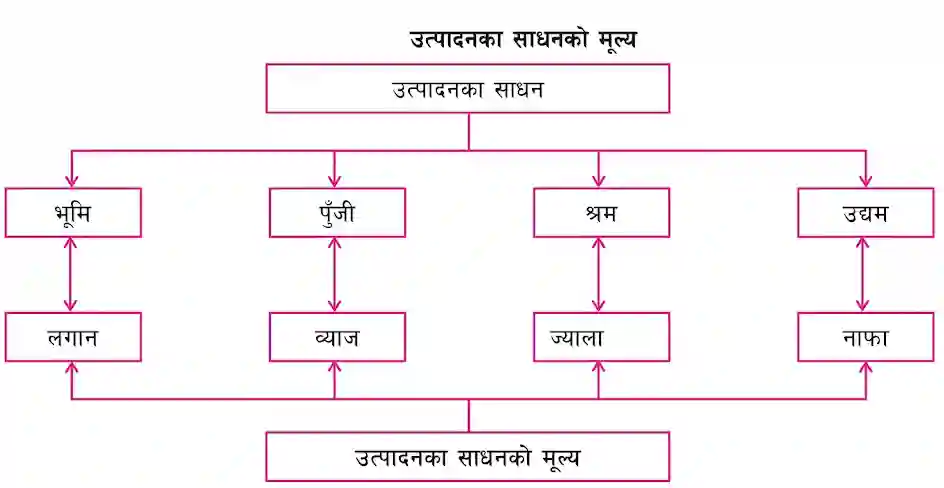
Various factors of production are used to produce goods and services. Land, capital, labour, and enterprise (organisation) are the four main factors of production. A payment or compensation must be provided to each of these factors for their contribution to the production process. For using land, capital, labour, and organisation in production, the respective rewards paid are Rent, Interest, Wages, and Profit. This chapter studies the concept of the rewards received by each factor of production and the various theories that explain how these factor prices are determined. The concept of factor pricing is illustrated in Chart 4.1 below:
Chart 4.1: Factors of Production and Their Rewards
(A) Rent
In the ordinary sense, rent refers to a fixed charge or payment made for the use of factors such as land, buildings, or machinery. According to classical economists, rent refers specifically to the payment made to the owner of land for its use.
According to classical economist David Ricardo, rent is derived only from land. In his view, rent is the payment made by a tenant (farmer) to the landlord for using the original and indestructible powers of the soil. In other words, it is the payment (in money or kind) made by a tenant to a landlord for utilising the natural fertility of the land.
Rent is primarily divided into two types: Economic Rent and Gross Rent (Contract Rent).
(i) Economic Rent
In the classical view, economic rent refers to the payment made exclusively for the use of the original and indestructible powers of land. The landowner receives this economic benefit simply by virtue of owning the land.
In the modern view, the concept of economic rent is broader. According to this view, economic rent is not limited to land but can arise from any factor of production. According to Prof. Boulding: “Economic rent is a payment to a factor of production in excess of the minimum amount needed to keep it in its current use.”
Example: If a worker needs a minimum daily wage of Rs. 1,500 to remain in their current job, but actually receives Rs. 2,000 per day, then the extra Rs. 500 earned above the minimum is the worker’s economic rent.
(ii) Gross Rent (Contract Rent)
Gross Rent is also called Contract Rent. It is determined by the agreement or contract between the owner of a factor and the user of that factor. The payment made by a user to a building owner for a building, to a landowner for land, or to a machine owner for a machine is called Gross Rent.
Example: If a landlord and a tenant agree to a monthly rent of Rs. 5,000 for a room, that amount is the Gross Rent.
The differences between Economic Rent and Gross Rent are shown in Table 4.1 below.
| Table 4.1: Differences Between Economic Rent and Gross Rent | ||
|---|---|---|
| S.N. | Economic Rent | Gross Rent (Contract Rent) |
| 1. | Economic rent is the payment made solely for using the original and indestructible powers of the land. | Gross rent is determined by the agreement between the owner and user of the factor of production. |
| 2. | Economic rent depends on the productivity of the land. | Gross rent depends on the bargaining power of the owner and user of the factor. |
| 3. | It is a theoretical and conceptual idea. | It is a practical and real-world concept. |
| 4. | It arises due to differences in the fertility of land. | It arises due to the scarcity of the factor of production. |
| 5. | It is not received from all types of land (not from marginal land). | It is received from all types of land and factors. |
Ricardian Theory of Rent
The theory of rent formulated by classical economist David Ricardo is known as the Ricardian Theory of Rent. He presented this theory in his 1817 book On the Principles of Political Economy and Taxation. It is also called the Classical Theory of Rent.
Ricardo argued that rent is derived only from land. According to him: “Rent is that portion of the produce of the earth, which is paid to the landlord for the use of the original and indestructible power of the soil.”
Thus, rent is the payment made by a tenant to the landlord for using the land, and it arises from land alone.
The Ricardian Theory of Rent is based on the following key assumptions:
- Rent arises only from land.
- Land is a free gift of nature.
- The supply of land is fixed and perfectly inelastic.
- The theory is based on long-run concepts.
- Land has its own original and indestructible powers.
- Land is used only for cultivation — it has no alternative use.
- There are differences in the fertility of land.
- The most fertile land is cultivated first.
- The law of diminishing returns applies to agricultural land.
- The market is perfectly competitive.
Ricardo explained his theory of rent through two cultivation systems: Extensive Cultivation and Intensive Cultivation.
Extensive Cultivation System:
Under the extensive cultivation system, the most fertile land is cultivated first; then progressively less fertile land is brought under cultivation. Ricardo imagined plots of land of equal size in the same area, each with different levels of fertility, on which equal units of capital and labour are applied. He classified the land plots into four grades — A, B, C, and D — in descending order of fertility:
$$A > B > C > D$$
According to Ricardo, Grade A land is cultivated first. As the population grows, cultivation extends to Grades B, C, and D. Grade D land is the Marginal Land, where total production equals total cost and no surplus (rent) is generated. Land that yields more output than marginal land is called Intra-marginal (Extra-marginal) Land.
The formula for calculating rent based on land fertility is:
$$\text{Rent} = \text{Output of Intra-marginal Land} – \text{Output of Marginal Land}$$
Criticisms of the Ricardian Theory of Rent:
- Land does not have truly indestructible powers — its fertility can be increased or reduced through human effort.
- Land is not used only for cultivation; it has many alternative uses (for buildings, industries, etc.).
- The assumption of rent-free (zero-rent) marginal land is unrealistic in the real world.
- The assumption of perfect competition is unrealistic — real markets are imperfect.
- The law of diminishing returns does not always apply; modern technology can increase output even with the same inputs.
- Rent is not derived from land alone — in the short run, other man-made factors (such as machinery) can also earn a form of quasi-rent.
- Rent arises not only because of differences in soil fertility but also because of the scarcity of resources.
(B) Interest
In the ordinary sense, interest is the additional payment made by a borrower to a lender for using their money or capital over a specified period of time. It is the extra amount paid for using capital in the production process.
According to economist Thomas Mayer: “The price for the use of loanable funds is called interest.”
According to economist J. M. Keynes: “Interest is the reward for parting with liquidity for a specific period of time.”
In summary, interest is the additional payment made by the borrower (user of capital) to the lender (owner of capital) for using the capital over a given period. Interest is primarily divided into two types: Gross Interest and Net Interest.
(i) Gross Interest
The total amount paid for the use of capital or money is called Gross Interest. It is the total payment made by the borrower to the lender for using the capital for a fixed period. In everyday usage, the word “interest” generally refers to Gross Interest.
Gross Interest includes the following elements:
$$\text{Gross Interest} = \text{Net Interest} + \text{Risk Premium} + \text{Management Premium} + \text{Inconvenience Premium}$$
where:
- Net Interest = the pure price for using the capital.
- Risk Premium = compensation for the lender’s risk that the money may not be returned or a loss may be incurred.
- Management Premium = compensation for the lender’s effort in managing, administering, and recovering the loan.
- Inconvenience Premium = compensation for the discomfort or difficulty the lender faces in lending out their capital.
Example: If you lend money to a friend at 10% interest, composed of 5% net interest + 2% risk premium + 2% management premium + 1% inconvenience premium, the total 10% is the Gross Interest.
(ii) Net Interest
The pure price paid for the use of capital or money — excluding all additional elements — is called Net Interest (also called Pure Interest). It does not include the risk premium, management premium, or inconvenience premium. Therefore, it is only a part of Gross Interest.
$$\text{Net Interest} = \text{Gross Interest} – (\text{Risk Premium} + \text{Management Premium} + \text{Inconvenience Premium})$$
Example: If the total 10% gross interest on a loan consists of 2% risk premium + 2% management premium + 1% inconvenience premium, the remaining 5% is the Net Interest.
The differences between Gross Interest and Net Interest are shown in Table 4.3 below.
| Table 4.3: Differences Between Gross Interest and Net Interest | ||
|---|---|---|
| S.N. | Gross Interest | Net Interest |
| 1. | The total amount paid for the use of capital or money is called Gross Interest. | The pure amount paid for the use of capital or money is called Net Interest. |
| 2. | The interest we commonly use and refer to in everyday life is Gross Interest. | This is a theoretical concept and is generally not used alone in everyday practice. |
| 3. | The Gross Interest rate varies by time, location, and circumstances (such as risk and management costs). | The Net Interest rate is generally the same everywhere under the same conditions. |
| 4. | It includes not only Net Interest but also risk premium, management premium, and inconvenience premium. | It is only the pure return for using capital. Other elements are deducted from Gross Interest to calculate it. |
| 5. | It is a broader concept. | It is a narrower concept. |
Classical Theory of Interest
The theory of interest developed by classical economists (including Adam Smith, David Ricardo, and J. B. Say) is known as the Classical Theory of Interest. According to this theory, interest is the reward for saving. The rate of interest is the price of capital, determined by the interaction of the demand for capital and the supply of capital. Here, the demand for capital means the demand for investment, and the supply of capital means the supply of saving.
This theory is also called the Real Theory of Interest and is popular under the name “Theory of Demand for and Supply of Saving.” Its key assumptions include:
- Interest is the price (reward) of saving.
- Saving depends on the rate of interest.
- It is based on the assumption of full employment.
- There is an inverse relationship between demand for investment and the interest rate, and a direct relationship between the supply of saving and the interest rate.
- Money acts only as a medium of exchange (neutrality of money).
- The level of income is constant.
i. Demand for Investment (Demand for Capital):
Entrepreneurs and investors demand capital to invest in capital goods. When the interest rate in the market is high, the demand for capital for investment is low; when the interest rate is low, the demand is high. Therefore, there is a negative (inverse) relationship between the demand for capital and the interest rate.
$$\text{Interest Rate} \uparrow \implies \text{Demand for Investment} \downarrow$$
$$\text{Interest Rate} \downarrow \implies \text{Demand for Investment} \uparrow$$
ii. Supply of Saving:
Saving is the income left over after deducting consumption expenditure. Savers supply savings in the hope of receiving interest. When the market interest rate is high, the supply of saving increases; when it is low, the supply of saving decreases. Thus, there is a positive (direct) relationship between the supply of saving and the interest rate.
$$\text{Interest Rate} \uparrow \implies \text{Supply of Saving} \uparrow$$
$$\text{Interest Rate} \downarrow \implies \text{Supply of Saving} \downarrow$$
iii. Determination of the Rate of Interest:
According to the Classical Theory of Interest, the equilibrium rate of interest is determined by the interaction of the demand for investment and the supply of saving — at the point where the two are equal.
Criticisms of the Classical Theory of Interest:
- According to Keynes, interest is not the price of saving but the reward for giving up liquidity.
- The theory assumes that saving depends only on the interest rate, but in reality, saving also depends on the level of income.
- The assumption of full employment is incorrect — full employment rarely exists in the real world.
- The interest rate and the level of income are mutually dependent, which this theory ignores.
- The source of investment is not only saving — it can also come from inherited wealth, dividends, etc.
- Saving is made not only for investment but also for precautionary motives and speculation.
(C) Wages
Generally, wages refer to the payment given to a worker for performing physical or mental work. Such payment is made by agreement on the basis of hours worked, daily, monthly, or some other basis.
According to Prof. Benham: “A wage may be defined as the sum of money paid under contract by an employer to a worker for services rendered.”
Wages are primarily divided into two types: Nominal (Money) Wages and Real Wages.
(i) Nominal Wages (Money Wages)
The wages received by a worker in the form of money or cash for the work performed are called Nominal Wages or Money Wages. These are measured in monetary units. For example, if a teacher receives a monthly salary of Rs. 50,000 for teaching, that amount is nominal wages.
(ii) Real Wages
The total quantity of goods and services that a worker’s money wages can purchase is called Real Wages. These are evaluated based on the purchasing power of money. For example, the goods and services that a teacher can buy with their Rs. 50,000 monthly salary represent their real wages. Additional non-cash benefits (fringe benefits or employee benefits) received along with nominal wages are also considered part of real wages.
The formula for calculating the Real Wage Rate is:
$$\text{Real Wage Rate} = \frac{\text{Money Wages}}{\text{Price Level}} \times 100$$
Factors Determining Real Wages:
The main factors that determine real wages are:
- The price level of goods in the market (in Nepal, the price level is measured by the Consumer Price Index – CPI).
- The money wages received by the worker.
- Additional benefits and perquisites, such as:
- Housing and clothing allowances.
- Medical, healthcare, education, transport, and insurance benefits.
- Regularity, security, and nature of the job.
- Potential for additional income and the work environment.
- Career development and promotion prospects, and the social prestige of the job.
- Timely salary payment, and employment opportunities for family members.
The differences between Nominal Wages and Real Wages are shown in Table 4.5 below.
| Table 4.5: Differences Between Nominal Wages and Real Wages | |
|---|---|
| Nominal (Money) Wages | Real Wages |
| Wages received by a worker in the form of money or cash. | Wages determined on the basis of the purchasing power of the money wages received. |
| They ignore the welfare of the worker. | They take the welfare of the worker into account. |
| This is a narrow concept. | This is a broader concept. |
| The objective is to compensate for the work done by the worker. | The objective is to maintain wages in light of the purchasing power of money. |
| Only the cash component is included; no other elements are covered. | In addition to cash wages, other incentives and non-cash benefits are also included. |
Subsistence Theory of Wages (Iron Law of Wages)
The Subsistence Theory of Wages was formulated by David Ricardo and other classical economists. German socialist philosopher Ferdinand Lassalle named it the “Iron Law of Wages.” According to this theory, the wages paid to workers should be just enough to meet their basic necessities of life. The minimum wage needed to cover workers’ basic needs is called the subsistence wage.
If wages rise above the subsistence level, workers become more prosperous, marry earlier, and have more children. This leads to population growth, an increase in the supply of labour, competition among workers for jobs, and ultimately wages fall back to the subsistence level:
$$\text{Wages rise} \rightarrow \text{Workers prosper, marry, have more children} \rightarrow \text{Population grows} \rightarrow \text{Labour supply increases} \rightarrow \text{Competition among workers} \rightarrow \text{Wages fall back to subsistence level}$$
If wages fall below the subsistence level, workers face hardship and poverty, disease and famine reduce the population, the supply of labour decreases, employers compete to hire workers, and wages rise back to the subsistence level:
$$\text{Wages fall} \rightarrow \text{Workers face poverty, disease, death} \rightarrow \text{Population falls} \rightarrow \text{Labour supply decreases} \rightarrow \text{Employers compete for workers} \rightarrow \text{Wages rise back to subsistence level}$$
In this way, whether wages are above or below the subsistence level, they will always return to the subsistence level in the long run.
Criticisms of the Subsistence Theory of Wages:
- This theory focuses only on the supply of labour and completely ignores the demand side.
- The argument that workers should receive only subsistence-level wages encourages the exploitation of labour.
- The theory ignores wage differences based on the division of labour and specialisation of skills.
- It overlooks the role of trade unions in wage determination.
- There is no empirical evidence to show a direct correlation between wage levels and population growth; in many developed nations, wages are high but population growth rates are low.
- This theory cannot motivate workers to perform better or be more productive.
(D) Profit
In general terms, profit is the income received by an entrepreneur for their entrepreneurial activity. It is also the reward for the entrepreneur as a factor of production. An entrepreneur earns profit as compensation for bearing the risk in production or business. In a capitalist economy, profit is the primary motivating force for entrepreneurs.
According to Henry Grayson: “Profit may be considered as a reward for making innovations, a reward for accepting risk and uncertainties, and market imperfections.”
According to Jacob Oser: “Profit is the residual income of the business after all explicit and implicit wages, interest, and rent have been met.”
Legitimate profit is regarded as the return for the entrepreneur’s hard work and enterprise. Profit is what remains after paying all other factors of production. Unlike rent, interest, and wages — which are fixed and always positive — profit is not predetermined. It can be positive, zero, or even negative. A negative result is called a loss.
Profit is divided into two types: Gross Profit and Net Profit.
(i) Gross Profit
Gross Profit is what is commonly meant when the word “profit” is used in business. It is also called Business Profit. It is the income remaining after deducting all direct (explicit) costs from Total Revenue. The formula is:
$$\text{Gross Profit} = \text{Total Revenue (TR)} – \text{Explicit Cost}$$
Explicit Costs are the direct payments made by an entrepreneur for factors of production not owned by them (e.g., rent, hired labour wages, interest on borrowed capital).
(ii) Net Profit
In economics, profit specifically refers to Net Profit. It is the difference between Gross Profit and Implicit Costs. Implicit Costs are the costs of using factors of production owned by the entrepreneur — for which no direct cash payment is made (e.g., the rent value of the entrepreneur’s own land, the interest value of their own capital). Net Profit is also called Pure Profit or Economic Profit.
$$\text{Net Profit} = \text{Gross Profit} – \text{Implicit Cost}$$
The differences between Gross Profit and Net Profit are shown in Table 4.6 below.
| Table 4.6: Differences Between Gross Profit and Net Profit | |
|---|---|
| Gross Profit | Net Profit |
| The income remaining after deducting all direct (explicit) costs from production is Gross Profit. | The income remaining after deducting both direct (explicit) and indirect (implicit) costs is Net Profit. |
| Estimating the business profit is its main objective. | Determining the performance of the business is its main objective. |
| It is the difference between Total Revenue and Explicit Costs. | It is the difference between Gross Profit and Implicit Costs. |
| Gross Profit is a broader concept. | Net Profit is a narrower concept. |
| Gross Profit is the return for the entrepreneur’s risk-taking as well as for coordination and organisation. | Net Profit is purely the return for the entrepreneur’s risk-bearing alone. |
Risk Bearing Theory of Profit
This theory was formulated by American economist F. B. Hawley in 1893. According to Hawley: “The profit of an undertaking is not the reward of management or coordination but of the risk and responsibility.”
According to this theory, bearing risk is the primary and most important function of the entrepreneur. If an entrepreneur does not take risks, there will be no profit. Entrepreneurs take risks in anticipation of high profits. Higher risk means a greater possibility of profit, while lower risk means a lower possibility of profit.
Criticisms of the Risk Bearing Theory of Profit:
- Profit is earned not only from bearing risk but also from the entrepreneur’s organisational and coordination activities.
- Profit is a reward not just for bearing risk but also for reducing risk successfully — lower risk can also lead to profit.
- According to economist F. H. Knight, insurable risks do not generate profit.
- There is no empirical evidence to conclusively show that riskier enterprises always earn higher profits.
2. Exercise (With Solutions)
Very Short Answer Questions [1 Mark]
3. Short Answer Questions [5 Marks]
- 1. Meaning: Economic rent is the payment made solely for using the original and indestructible powers of the land, whereas Contract Rent is determined by an agreement between the owner and user of the factor.
- 2. Basis: Economic rent depends on the productivity of the land, whereas Contract Rent depends on the bargaining capacity of the owner and user.
- 3. Nature: Economic rent is a theoretical and conceptual idea, whereas Contract Rent is a practical, real-world concept.
- 4. Cause: Economic rent arises due to differences in the fertility of land, whereas Contract Rent arises because of the scarcity of the factor of production.
- 5. Applicability: Economic rent is not received from all types of land (not from marginal land), whereas Contract Rent is received from all types of land and factors.
- Gross Interest: The total amount paid for using capital or money is Gross Interest. In everyday usage, this is what is commonly meant by “interest.” It includes Net Interest plus the risk premium, management premium, and inconvenience premium.
- Net Interest: The pure price paid exclusively for using the capital — excluding risk, management, and inconvenience premiums — is Net Interest. It is calculated by deducting these three elements from Gross Interest. Net Interest is therefore only one component of Gross Interest.
Five Points of Criticism:
- According to Keynes, interest is not the price of saving but the reward for giving up liquidity.
- Saving depends not only on the interest rate but also on the level of income — a factor the theory ignores.
- The assumption of full employment on which this theory is based does not exist in the real world.
- Investment funds can come from sources other than saving — such as inherited wealth or dividends from shares.
- The mutual dependence between the rate of interest and the level of income is completely ignored by this theory.
Factors that determine Real Wages:
- The price level of goods in the market (when prices rise, real wages fall).
- The nominal wages received by the worker (when cash wages increase, real wages rise).
- Additional non-cash benefits (such as housing, clothing, healthcare, and transport allowances).
- The nature of the job, its regularity, and security.
- Career development opportunities and the social prestige of the profession.
If wages rise above the subsistence level, workers prosper and have more children; the population grows, labour supply increases, workers compete for jobs, and wages fall back to the subsistence level. Conversely, if wages fall below the subsistence level, workers face poverty, disease, and high mortality; the population falls, the labour supply decreases, employers compete for workers, and wages rise back to the subsistence level. In this way, whether wages are above or below the subsistence level, they always return to it in the long run.
- Meaning: Gross Profit is what remains after deducting all direct (explicit) costs from Total Revenue, while Net Profit is what remains after deducting both direct (explicit) and indirect (implicit) costs.
- Scope: Gross Profit is a broader concept, while Net Profit is a narrower concept.
- Formula: Gross Profit = Total Revenue − Explicit Costs. Net Profit = Gross Profit − Implicit Costs.
- Return represents: Gross Profit is the return for all of the entrepreneur’s activities — including risk-taking, coordination, and organisation — while Net Profit is purely the return for the entrepreneur’s risk-bearing alone.
Bearing risk is the primary and most important function of an entrepreneur. If an entrepreneur does not take risks, there will be no profit. Entrepreneurs willingly take risks in expectation of higher profits. A high-risk venture offers a greater possibility of profit, while a low-risk venture offers a lower possibility of profit. Therefore, profit is the reward received by an entrepreneur for successfully bearing the risks and uncertainties of business.
4. Long Answer Questions [8 Marks]
Key Assumptions: Rent is derived only from land; the supply of land is fixed; there are differences in the fertility of land; and the law of diminishing returns applies to agriculture.
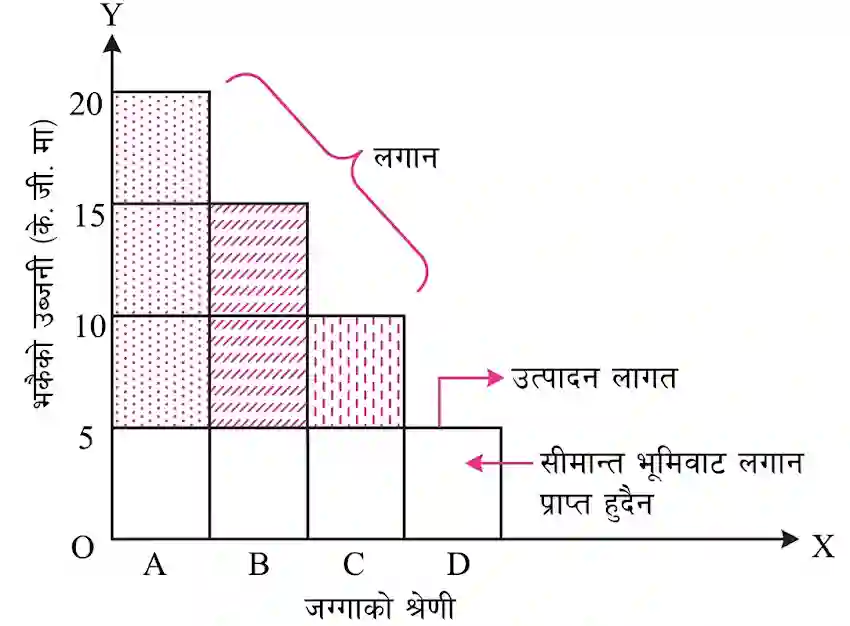
Explanation through the Extensive Cultivation System and Table: According to Ricardo, farmers first cultivate the most fertile land. As the population grows, cultivation must extend to less fertile land. He classified land into four grades — A, B, C, and D — in descending order of fertility. Grade D is the Marginal Land, where output equals cost and rent is zero. Grades A, B, and C are intra-marginal lands that generate rent.
$$\text{Rent} = \text{Output of Intra-marginal Land} – \text{Output of Marginal Land}$$
| Grade of Land | Total Output (Production) | Output of Marginal Land (Cost Equivalent) | Rent (Surplus Output) |
|---|---|---|---|
| A | 20 kg | 5 kg | 20 − 5 = 15 kg |
| B | 15 kg | 5 kg | 15 − 5 = 10 kg |
| C | 10 kg | 5 kg | 10 − 5 = 5 kg |
| D | 5 kg | 5 kg | 5 − 5 = 0 (Rent-free) |
Explanation of the Diagram: With land grades (A, B, C, D) on the X-axis and output (in kg) on the Y-axis, the output of Marginal Land D is 5 kg, which just covers the cost of production. The output above this level — 15 kg for Grade A, 10 kg for B, and 5 kg for C — represents the rent earned from those grades of land. This surplus is shown as the shaded area in the diagram. Grade D (Marginal Land) earns no rent at all.
Nature does not endow every piece of land with the same level of fertility. Some land possesses a high natural capacity to produce abundant crops — this is its “original power.” Since this natural productive capacity cannot be completely destroyed by human activity (it cannot be truly eliminated), Ricardo called it “indestructible.” When a farmer (tenant) cultivates highly fertile land, they can produce significantly more output than on less fertile land (marginal land) with the same amount of labour and capital. That surplus output is the direct result of the land’s natural fertile power — its “original and indestructible” quality. The landowner demands a share of this surplus output — or its monetary equivalent — as payment precisely because their land possesses this superior natural quality. Thus, the additional payment that a tenant makes to a landowner for using land that is more fertile than marginal land (where output just equals cost) — the payment for that natural productive quality — is what constitutes rent. It is the reward for nature’s gift of superior fertility, and Ricardo argued that it originates from this original and indestructible power of the soil alone.
- Demand for Investment: Investors demand capital to invest in capital goods. Higher interest rates reduce demand for investment; lower interest rates increase it (inverse relationship).
- Supply of Saving: People save in expectation of earning interest. Higher interest rates encourage more saving; lower rates reduce saving (direct relationship).
| Interest Rate (%) | Demand for Investment (Rs. ‘000) | Supply of Saving (Rs. ‘000) | Market Condition |
|---|---|---|---|
| 2% | 250 | 50 | Demand > Supply |
| 4% | 200 | 100 | Demand > Supply |
| 6% | 150 | 150 | Demand = Supply (Equilibrium) |
| 8% | 100 | 200 | Demand < Supply |
| 10% | 50 | 250 | Demand < Supply |
At a 2% interest rate, demand (250) far exceeds supply (50), pushing the rate up. At 10%, supply (250) greatly exceeds demand (50), pushing the rate down. At 6%, both demand and supply are equal at Rs. 150,000 — therefore, 6% is the equilibrium rate of interest.
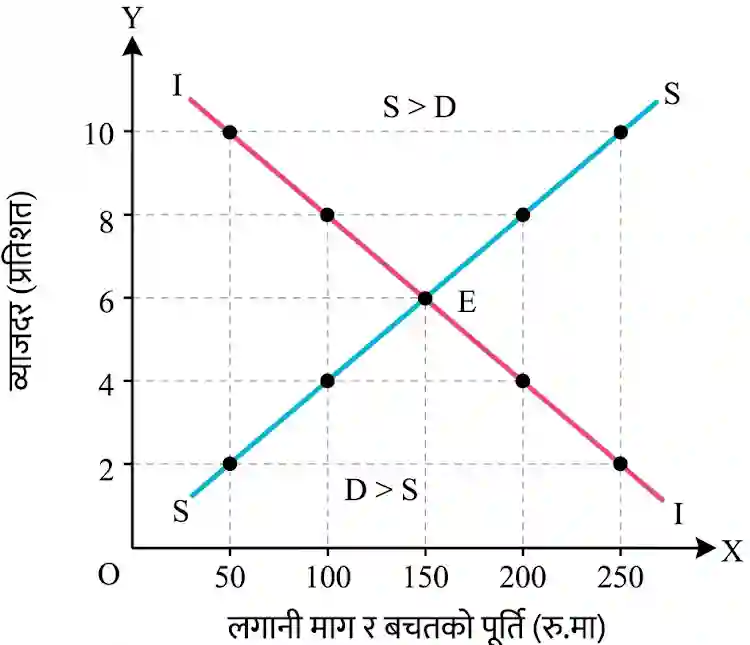
Explanation of the Diagram: With the amount of investment demand and saving supply on the X-axis and the interest rate on the Y-axis, the downward-sloping investment demand curve (II) and the upward-sloping saving supply curve (SS) intersect at equilibrium point E. This point determines the equilibrium rate of 6% and the equilibrium amount of Rs. 150,000.
- If wages rise above the subsistence level: Workers become prosperous, marry early, and have more children. This increases the population, grows the labour supply, creates competition among workers for jobs, and ultimately drives wages back down to the subsistence level.
- If wages fall below the subsistence level: Workers face hardship, poverty, disease, and high death rates. The population falls, the labour supply decreases, employers compete to hire the scarce workers, and wages rise back up to the subsistence level.
Criticisms of the Subsistence Theory of Wages:
- Ignores the Demand Side: The theory focuses only on the supply of labour and completely neglects the demand for labour and the productivity of workers.
- Encourages Exploitation: The argument that workers should receive only enough wages to sustain themselves provides a justification for the extreme exploitation of the working class by capitalists.
- Cannot Explain Wage Differences: Since workers differ in skill, qualification, and occupation, the theory fails to explain why a doctor, engineer, and unskilled labourer receive different wages.
- Wrong Relationship Between Wages and Population: The claim that higher wages automatically lead to higher birth rates is false. In many developed nations, wages are high but population growth rates are very low.
- Ignores Trade Unions: In the modern era, trade unions can exert pressure to raise wages above the subsistence level — a reality this theory completely disregards.
5. Additional Exercises
Conceptual Questions
Section A: Very Short Answer Questions
Section B: Short and Long Answer Questions
| Basis of Comparison | Nominal (Money) Wages | Real Wages |
|---|---|---|
| 1. Meaning | The wages received by a worker in the form of cash or money. | The total goods and services and additional benefits that the money wages can purchase. |
| 2. Measurement | Measured directly in monetary units (e.g., Rupees). | Measured based on the purchasing power of money. |
| 3. Concept | A narrow concept of wages. | A broader concept of wages. |
| 4. Living Standard | Cannot truly reflect the worker’s actual standard of living. | Accurately reflects the worker’s real standard of living and well-being. |
| 5. Additional Benefits | Includes only the cash component; no other benefits are covered. | Includes housing, food, transport, and other non-cash fringe benefits in addition to cash wages. |
According to this theory, an entrepreneur earns profit not for bearing ordinary (insurable) risk but for facing uncertainty — the unknown and unpredictable aspects of business. Prof. Knight divided business risk into two categories:
- 1. Insurable Risk: Risks such as fire, theft, or accident whose probability can be calculated in advance and for which insurance can be obtained. Since the entrepreneur can transfer this risk to an insurance company, it does not generate profit.
- 2. Non-insurable Risk (Uncertainty): Unforeseen and unpredictable events such as sudden changes in market demand, emergence of new technology, intense competition, or changes in government policy — risks that cannot be predicted or insured against. It is for successfully facing this true uncertainty that the entrepreneur earns profit.
- Profit is not from uncertainty alone: In reality, an entrepreneur also earns profit through organisational skill, innovation, and effective market management — not just by bearing uncertainty.
- Ignores other sources of profit: Profit is also influenced by the entrepreneur’s personal capabilities, managerial efficiency, and monopoly power in the market — factors this theory overlooks.
- No direct relationship between uncertainty and profit: The theory claims that greater uncertainty leads to higher profit. However, this is not always true — in many cases, bearing high uncertainty can result in a heavy loss rather than profit.
📚 Also Read: Class 10 SEE Notes
Compulsory Subjects
 English
 Nepali
 Social Studies
 C. Mathematics
 Science
Optional Subjects
 Computer
 Accounting
 Economics
 Optional Math