
Interference
Class 12 Physics Notes • NEB Syllabus 2083
Syllabus, 10 solved multiple choice questions, step-by-step numericals and derivations, handwritten and typed PDF notes and frequently asked questions on coherent sources and Young’s double-slit experiment.
1. Syllabus
Unit: Waves and Optics
Chapter 11: Interference (5 hours)
These notes follow the NEB Class 12 Physics syllabus (+2 Physics, Nepal). Practise the multiple choice questions first, then work through the numericals, and finish with the PDF notes for quick revision.
2. Multiple Choice Questions
Question 1. What is required for two light sources to be coherent?
- a) Same frequency
- b) Same amplitude
- c) Same wavelength and constant phase difference
- d) Same colour
Correct Answer: c) Same wavelength and constant phase difference
Reason: Coherent sources emit light waves of the same frequency (and so the same wavelength in a given medium) and keep a constant phase difference with respect to each other over time.
Question 2. What is the phase difference between two waves at the \(n\)th bright fringe in a double-slit experiment?
- a) \(n\pi\)
- b) \(n\lambda\)
- c) \(2n\pi\)
- d) \(0\)
Correct Answer: c) \(2n\pi\)
Reason: For a bright fringe the path difference is \(\Delta x=n\lambda\), and the phase difference is
Question 3. What is the correct relation between the path difference (\(\Delta x\)) and the phase difference (\(\Delta\phi\))?
- a) \(\Delta x=\dfrac{\Delta\phi}{2\pi}\)
- b) \(\Delta x=\dfrac{\Delta\phi\,\lambda}{2\pi}\)
- c) \(\Delta x=\dfrac{\Delta\phi}{\lambda}\)
- d) \(\Delta x=\Delta\phi\)
Correct Answer: b) \(\Delta x=\dfrac{\Delta\phi\,\lambda}{2\pi}\)
Reason: The general relation is \(\Delta\phi=\dfrac{2\pi}{\lambda}\Delta x\). Rearranging:
Question 4. Which one is the best alternative for two light sources to be coherent?
- a) They are of the same frequency and intensity
- b) They have a constant phase difference over time
- c) They emit light of the same wavelength
- d) They have the same polarization
Correct Answer: b) They have a constant phase difference over time
Reason: Having the same frequency or wavelength is a prerequisite, but the defining requirement of coherence is a strictly constant phase difference over time.
Question 5. What is the path difference at the first dark fringe in Young’s double-slit experiment?
- a) \(\dfrac\lambda4\)
- b) \(\dfrac\lambda2\)
- c) \(\lambda\)
- d) \(\dfrac{3\lambda}{2}\)
Correct Answer: b) \(\dfrac\lambda2\)
Reason: A dark fringe needs an odd multiple of half wavelengths:
For the first dark fringe \(n=1\), so \(\Delta x=\dfrac\lambda2\).
Question 6. What is the phase difference between two coherent light waves if their path difference is \(\dfrac\lambda2\)?
- a) \(0^\circ\)
- b) \(90^\circ\)
- c) \(180^\circ\)
- d) \(360^\circ\)
Correct Answer: c) \(180^\circ\)
Reason:
Question 7. What happens to the fringe width if the yellow light of a sodium lamp in Young’s double-slit experiment is replaced by blue light of the same intensity?
- a) Decreases
- b) Increases
- c) No change
- d) Becomes less intense
Correct Answer: a) Decreases
Reason: The fringe width is \(\beta=\dfrac{\lambda D}{d}\), directly proportional to the wavelength. Blue light has a shorter wavelength than yellow light (\(\lambda_{\text{blue}}<\lambda_{\text{yellow}}\)), so the fringe width decreases.
Question 8. What is the phase difference when the path difference between two coherent light waves is \(2\lambda\)? (Hint: the phase difference repeats every \(360^\circ\))
- a) \(180^\circ\)
- b) \(360^\circ\)
- c) \(540^\circ\)
- d) \(0^\circ\)
Correct Answer: d) \(0^\circ\)
Reason:
Since the phase repeats every \(360^\circ\), \(720^\circ\) is equivalent to \(0^\circ\).
Question 9. What happens to the fringe width in Young’s double-slit experiment if the slit distance is increased?
- a) Makes the fringe width smaller
- b) Makes the fringe width larger
- c) Increases the number of fringes
- d) Makes the fringes disappear
Correct Answer: a) Makes the fringe width smaller
Reason: \(\beta=\dfrac{\lambda D}{d}\). Since \(d\) is in the denominator, increasing the slit distance \(d\) decreases the fringe width \(\beta\).
Question 10. What happens to the fringe width if the wavelength is halved in Young’s experiment?
- a) Same
- b) Doubles
- c) Halves
- d) Quadruples
Correct Answer: c) Halves
Reason: \(\beta=\dfrac{\lambda D}{d}\propto\lambda\). If \(\lambda\) becomes \(\dfrac\lambda2\), the fringe width becomes \(\dfrac\beta2\).
3. Numerical and Subjective Questions
a) What are coherent sources of light? Why are they necessary for observing interference?
Coherent sources emit light waves of the same frequency (and wavelength) with a constant phase difference that does not change with time.
They are necessary because, if the phase difference between the sources fluctuates randomly (non-coherent sources), the positions of the bright and dark regions keep shifting very rapidly over the screen. Averaged over the observation time, this gives uniform illumination instead of distinct bright and dark fringes.
b) Define the term “path difference” in the context of light interference.
The path difference \(\Delta x\) is the difference between the distances travelled by two light waves from their sources to a common point where they superpose (for example a point on the screen). It decides the relative phase with which the waves meet.
c) Explain how constructive and destructive interference occur in terms of path difference.
Constructive interference: the waves meet in phase and reinforce each other, giving maximum intensity (a bright fringe). This happens when the path difference is a whole number of wavelengths:
Destructive interference: the waves meet out of phase and cancel each other, giving minimum intensity (a dark fringe). This happens when the path difference is an odd multiple of half a wavelength:
a) State the principle of superposition of waves.
When two or more waves travel through the same medium at the same time, the net displacement of the medium at any point and instant is the vector sum of the displacements produced by the individual waves at that point:
b) i) What are the conditions for sustained interference?
For a stable pattern that can be observed over time (sustained interference):
b) ii) What happens when the path difference is \(\dfrac\lambda2\)?
A crest of one wave exactly overlaps a trough of the other, so the interference is destructive. If the amplitudes are equal the waves cancel completely and a dark fringe forms at that point.
a) What do you mean by sustained interference? State the necessary conditions for it.
Sustained interference is an interference pattern (bright and dark bands) that stays fixed in position on the screen without fluctuating, so it can be observed easily by the eye.
The necessary conditions are those listed in Question 2: the sources must be strictly coherent and continuous, emit light of the same frequency (monochromatic), preferably have the same amplitude, be placed close together, and have the same state of polarization.
b) i) Two coherent sources produce an interference pattern. Why is a screen necessary to observe it?
Interference is a distribution of varying light energy in space. A screen intercepts the light and scatters it towards our eyes, so the variation in intensity (the bright and dark fringes) can be seen and measured.
b) ii) State one limitation of observing interference using two independent light sources.
Two independent sources (such as two separate bulbs) can never be coherent. Their atoms emit light in random, uncoordinated bursts of about \(10^{-8}\ \mathrm{s}\), so the phase difference between the sources changes millions of times a second. This washes out any pattern and gives uniform illumination.
a) Define constructive and destructive interference.
Constructive interference: overlapping waves are in phase, their displacements add and the resultant has a larger amplitude and maximum intensity (brightness).
Destructive interference: overlapping waves are out of phase, their displacements subtract and the resultant has minimum or zero amplitude and minimum intensity (darkness).
b) Explain why coherent sources are not produced by two independent bulbs.
Light from an ordinary bulb comes from billions of independent atoms that emit spontaneously. Each emission is a short wave train with a completely random phase. The phase difference between two independent bulbs therefore varies randomly within tiny fractions of a second, so they cannot keep the constant phase difference required for coherence.
c) Two slits are separated by \(0.5\ \mathrm{mm}\) and a screen is placed \(2\ \mathrm{m}\) away. If the wavelength of the light used is \(600\ \mathrm{nm}\), calculate the fringe width.
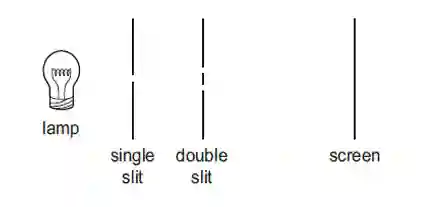
Figure: Young’s double-slit experiment
i) Complete the diagram and write the condition for constructive interference.
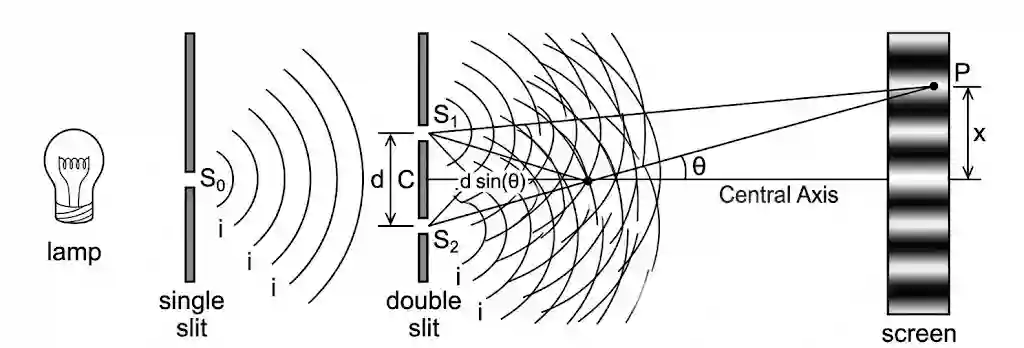
Figure: The completed diagram of Young’s double-slit experiment
Light from the coherent sources \(S_1\) and \(S_2\) reaches a point \(P\) on the screen. Constructive interference (a bright fringe) occurs when the path difference is a whole number of wavelengths:
ii) What will be the condition for destructive interference?
The path difference must be an odd multiple of half a wavelength:
iii) Obtain an expression for the fringe width. Does the central fringe observed in the above setup lie upwards or downwards on the screen?
Let \(S_1\) and \(S_2\) be two coherent sources separated by a distance \(d\), and let \(D\) be the distance from the slits to the screen. For a point \(P\) at a distance \(y\) from the central point \(O\), the path difference is \(\Delta x=S_2P-S_1P\).
Drawing a perpendicular from \(S_1\) to \(S_2P\), for small angles \(\theta\):
From the large triangle formed by the slits, the screen and the central axis, \(\tan\theta=\dfrac yD\). For small angles \(\sin\theta\approx\tan\theta\approx\dfrac yD\), so
For the \(n\)th bright fringe, \(\dfrac{y_nd}{D}=n\lambda\):
The fringe width is the distance between two consecutive bright fringes:
Position of the central fringe: the central fringe corresponds to zero path difference (\(n=0\), \(y=0\)). It lies neither upwards nor downwards; it lies exactly at the geometric centre \(O\) of the screen, on the perpendicular bisector of \(S_1S_2\).
a) What is interference of light?
Interference of light is the phenomenon in which two or more light waves from coherent sources superpose to form a resultant wave, so that the light energy is redistributed in space. It gives alternating regions of maximum intensity (bright fringes) and minimum intensity (dark fringes).
b) What are coherent sources? Give one example.
Coherent sources emit light waves of the same frequency that keep a strictly constant phase difference over time.
Example: the two slits \(S_1\) and \(S_2\) illuminated by the same primary source, or two beams split from a single laser by a beam splitter.
c) State the principle of Young’s double-slit experiment. Mention the conditions for obtaining a clear interference pattern.
The experiment is based on division of the wavefront and superposition. A single wavefront is divided into two coherent wavefronts by two closely spaced slits. These act as coherent sources, and their superposition produces the interference pattern.
Conditions: monochromatic light, strictly coherent sources, narrow slits, small slit separation \(d\), large screen distance \(D\), and equal amplitudes for perfect contrast.
d) What happens to the interference pattern when:
d) i) The distance between the slits is increased?
\(\beta=\dfrac{\lambda D}{d}\). If \(d\) increases, \(\beta\) decreases: the fringes become thinner and more crowded.
d) ii) The screen is moved farther from the slits?
\(D\) increases and \(\beta\propto D\), so the fringes become wider and farther apart.
d) iii) The entire setup is immersed in water?
In a medium of refractive index \(\mu>1\) the wavelength becomes \(\lambda’=\dfrac{\lambda}{\mu}\). Since \(\beta\propto\lambda\), the fringe width decreases.
e) Derive the expression for the fringe width in the double-slit experiment. Discuss how it is affected by changing the wavelength and the slit separation.
At a point \(P\) at a distance \(y\) from the centre, the path difference is \(\Delta x=\dfrac{yd}{D}\). For consecutive bright fringes \(n\) and \(n+1\):
So \(\beta\propto\lambda\) and \(\beta\propto\dfrac1d\).
a) What is meant by path difference in wave interference?
Path difference is the difference between the distances travelled by two waves from their respective sources before they meet at a common point of superposition.
b) Define optical path. How is it different from a geometrical path?
The optical path is the distance light would travel in vacuum in the same time that it takes to travel a given geometrical distance \(x\) in a medium of refractive index \(\mu\):
The geometrical path is just the physical distance \(x\), whatever the medium. The optical path takes into account the slower speed of light in a denser medium.
c) State the conditions required for sustained interference. Why are temporal and spatial coherence necessary?
The conditions are: coherent sources, monochromatic light, the same polarization and nearly equal amplitudes.
Temporal coherence ensures that the phase of a wave at a given point does not jump randomly with time, so the fringes stay stable.
Spatial coherence ensures that different points of the wavefronts from the sources keep a fixed phase relation, so a clear fringe pattern extends across the screen.
d) i) Explain what happens to the interference pattern when the two interfering waves differ slightly in frequency. Give reasons.
If the frequencies differ, the phase difference between the waves changes steadily with time. The positions of the bright and dark fringes then shift rapidly across the screen (like beats), and to the eye the screen looks uniformly illuminated.
d) ii) Explain what happens when one of the coherent sources becomes slightly brighter than the other. Give reasons.
If the amplitudes are unequal (\(a_1\ne a_2\)), the intensity at a dark fringe, \(I_{\min}\propto(a_1-a_2)^2\), is no longer zero. The dark fringes receive some light, so the visibility (contrast) of the fringes falls, although their positions stay the same.
e) Two coherent sources produce an interference pattern in air. Derive an expression for the position of the bright fringes on the screen in terms of path difference and wavelength. Explain what changes if the experiment is performed in glass instead of air.
For bright fringes the waves must arrive in phase, so the path difference is a whole number of wavelengths:
From the geometry of the double slit, \(\Delta x\approx\dfrac{yd}{D}\). Equating:
where \(y_n\) is the position of the \(n\)th bright fringe.
In glass (refractive index \(\mu>1\)) the wavelength changes from \(\lambda\) to \(\lambda’=\dfrac\lambda\mu\), so
All the fringes move closer to the centre by a factor \(\dfrac1\mu\).
a) What is meant by fringe visibility?
Fringe visibility (contrast) measures how clearly the fringes can be distinguished:
where \(I_{\max}\) is the intensity of the bright fringes and \(I_{\min}\) that of the dark fringes. High visibility means crisp dark minima and bright maxima.
b) State the condition for the appearance of dark fringes in an interference pattern.
A dark fringe appears when the interference is destructive, that is, when the path difference is an odd multiple of half a wavelength:
For perfect darkness (\(I_{\min}=0\)), the amplitudes of the two waves must be equal (\(a_1=a_2\)).
c) Why is monochromatic light essential for obtaining a clear and steady interference pattern? What would happen if white light were used?
Monochromatic light has a single wavelength. Since the fringe positions depend on the wavelength (\(y_n\propto\lambda\)), a single wavelength gives sharp, well-defined fringes.
With white light, every wavelength forms its own pattern with a different fringe width. The central fringe is white (all wavelengths interfere constructively at \(\Delta x=0\)), but the fringes farther out turn into coloured bands and, after a few orders, the overlapping maxima and minima wash out into nearly uniform white light.
d) In Young’s double-slit experiment, why is a single slit placed before the double slit? Explain its role in maintaining coherence.
An extended source emits light from many independent points, which would give overlapping, uncoordinated patterns. A narrow single slit acts as a point (line) source. By Huygens’ principle, the cylindrical wavefronts from this slit reach \(S_1\) and \(S_2\) together, so \(S_1\) and \(S_2\) are derived from the same wavefront. This keeps them coherent and locks their relative phase.
e) In a Young\’s double-slit experiment the distance between the slits is \(0.3\ \mathrm{mm}\) and the distance from the slits to the screen is \(1.2\ \mathrm{m}\). The wavelength of the light used is \(480\ \mathrm{nm}\). (i) Calculate the fringe width. (ii) How far is the 4th bright fringe from the central maximum?
(i) Fringe width
(ii) Position of the 4th bright fringe
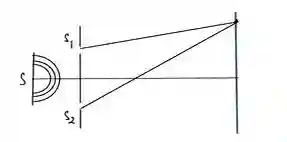
Figure: Double-slit experiment with monochromatic light
a) Derive the expression for the fringe separation (\(\beta\)) in terms of the wavelength (\(\lambda\)) of the light, the distance (\(d\)) between the slits and the distance (\(D\)) between the slits and the screen.
Consider slits \(S_1\) and \(S_2\) separated by \(d\) and a screen at a distance \(D\). Let \(O\) be the central point of the screen. For a point \(P\) at a distance \(y\) from \(O\), the path difference is \(\Delta x=S_2P-S_1P\).
Drawing a perpendicular from \(S_1\) to \(S_2P\), for \(D\gg d\) we have \(\Delta x=d\sin\theta\). Also \(\tan\theta=\dfrac yD\), and for small angles \(\sin\theta\approx\tan\theta\), so
For the \(n\)th and \((n+1)\)th bright fringes:
b) Explain the formation of bright and dark fringes. How does the interference pattern change when the distance between the slits is increased or the wavelength of the light is changed?
Bright fringes form where the waves from the two slits arrive in phase (\(\Delta x=n\lambda\)) and interfere constructively. Dark fringes form where they arrive out of phase (\(\Delta x=(n+\tfrac12)\lambda\)) and interfere destructively.
Since \(\beta=\dfrac{\lambda D}{d}\), increasing the slit distance \(d\) makes the fringes narrower (tighter). Changing to a smaller wavelength decreases the fringe width in proportion.
c) What happens to the interference pattern if the monochromatic light is replaced by white light? Explain the change in the pattern and its implications.
White light gives a white central fringe surrounded by coloured fringes. White light is a mixture of all visible wavelengths, each forming its own pattern of width \(\beta\propto\lambda\): red has the widest fringes and violet the narrowest. These slightly shifted patterns overlap and wash out into white light after a few orders.
Implication: the sources are still coherent, but because the light is not monochromatic, useful fringes are seen only near the centre.
d) Discuss the conditions required for obtaining a clear interference pattern in the double-slit experiment.
Coherent sources (same frequency, constant phase), the same state of polarization, monochromatic light (to avoid overlapping coloured patterns), \(D\gg d\) (to make the fringes wide enough to resolve), and equal amplitudes (to make the dark fringes perfectly dark and the contrast maximum).
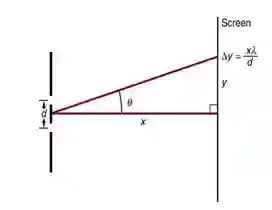
Figure: Setup of Young’s double-slit experiment
a) Write the condition for constructive interference and explain its significance.
The condition is
where \(\Delta x\) is the path difference. It fixes exactly where the crests of one wave overlap the crests of the other, giving a local maximum of energy on the screen (a bright fringe).
b) Derive the expression for the fringe width \(\Delta y\) on the screen in terms of the slit separation \(d\), the distance to the screen \(x\) and the wavelength \(\lambda\).
The path difference at a vertical position \(y\) is \(\dfrac{yd}{x}\). For consecutive bright fringes \(n\) and \(n+1\):
c) If \(d=0.5\ \mathrm{mm}\), \(x=1.5\ \mathrm{m}\) and \(\lambda=600\ \mathrm{nm}\), calculate the fringe width \(\Delta y\).
a) Derive an expression for the fringe width (\(\beta\)) in the double-slit interference pattern. How is the fringe width related to the wavelength of the light, the distance between the slits and the distance from the slits to the screen?
The path difference at a height \(y\) on the screen is \(\Delta x\approx\dfrac{yd}{D}\). The \(n\)th maximum is at \(y_n=\dfrac{n\lambda D}{d}\) and the next at \(y_{n+1}=\dfrac{(n+1)\lambda D}{d}\). Hence
The fringe width is directly proportional to the wavelength \(\lambda\) and the screen distance \(D\), and inversely proportional to the slit separation \(d\).
b) Monochromatic light of wavelength \(600\ \mathrm{nm}\) is incident on two slits placed \(0.5\ \mathrm{mm}\) apart. The screen is placed \(2\ \mathrm{m}\) away from the slits. Calculate the fringe width \(\beta\).
c) What will happen to the interference pattern if the distance between the slits is doubled while the wavelength and the screen distance are kept constant? Explain your answer.
Since \(\beta=\dfrac{\lambda D}{d}\propto\dfrac1d\), doubling \(d\) gives
The fringe width is halved, so the pattern becomes twice as dense.
d) In the context of the double-slit experiment, describe the conditions under which constructive and destructive interference occur. How do these conditions lead to the formation of bright and dark fringes?
Constructive: \(\Delta x=n\lambda\). The crests of both waves arrive together, the amplitudes add and a region of high intensity (a bright fringe) forms.
Destructive: \(\Delta x=\left(n+\tfrac12\right)\lambda\). The crest of one wave arrives with the trough of the other, the amplitudes cancel and a region of nearly zero intensity (a dark fringe) forms.
a) Explain the phenomenon of interference in light. Discuss the conditions necessary for observing interference and differentiate between constructive and destructive interference.
Interference is the redistribution of energy in space caused by the superposition of two or more coherent light waves.
Conditions: coherent sources (the most important), monochromatic light, the same polarization and suitably narrow slits.
Difference: constructive interference gives maximum intensity (bright bands) by in-phase addition, \(\Delta x=n\lambda\); destructive interference gives minimum intensity (dark bands) by out-of-phase cancellation, \(\Delta x=(n+\tfrac12)\lambda\).
b) A monochromatic light of wavelength \(500\ \mathrm{nm}\) passes through a double-slit apparatus. The distance between the slits is \(0.2\ \mathrm{mm}\) and the screen is placed \(1.5\ \mathrm{m}\) away from the slits. Calculate the fringe separation \(\beta\) on the screen.
c) If the wavelength of the light is changed to \(600\ \mathrm{nm}\), how will the fringe separation change? Explain the effect of the wavelength on the fringe width.
Because \(\beta\propto\lambda\), increasing the wavelength from \(500\ \mathrm{nm}\) to \(600\ \mathrm{nm}\) (a 20% increase) increases the fringe width by the same proportion, from \(3.75\ \mathrm{mm}\) to \(4.5\ \mathrm{mm}\).
a) Explain the concept of fringe width in a double-slit experiment. Derive the expression for the fringe width and discuss the factors that affect it.
The fringe width \(\beta\) is the distance between the centres of any two consecutive bright fringes or any two consecutive dark fringes.
The path difference is \(\Delta x=\dfrac{yd}{D}\). For maximum intensity \(\dfrac{y_nd}{D}=n\lambda\), so \(y_n=\dfrac{n\lambda D}{d}\), and
Factors: \(\beta\) increases directly with the wavelength \(\lambda\) and the screen distance \(D\), and decreases as the slit separation \(d\) increases.
b) In a double-slit experiment, monochromatic light of wavelength \(700\ \mathrm{nm}\) passes through slits \(0.25\ \mathrm{mm}\) apart. The screen is placed \(2\ \mathrm{m}\) away. Calculate the distance between the third bright fringe and the central maximum.
c) If the wavelength of the light is changed to \(800\ \mathrm{nm}\), calculate the new position of the third bright fringe. How does changing the wavelength affect the position of the fringes?
Since \(y_n\propto\lambda\), a larger wavelength pushes all the fringes outwards, farther from the central maximum.
a) Define interference. Discuss the conditions necessary for observing interference and explain the difference between constructive and destructive interference.
Interference is the superposition of waves that modifies the intensity. It needs coherent sources and monochromatic light. Constructive interference adds the amplitudes to give maximum brightness (\(\Delta x=n\lambda\)); destructive interference subtracts them to give darkness (\(\Delta x=(n+\tfrac12)\lambda\)). See Question 12 for details.
b) How would the interference pattern change if the distance between the slits is halved while the wavelength and the screen distance are kept constant? Explain the effect of the slit separation on the interference pattern.
\(\beta=\dfrac{\lambda D}{d}\). If \(d\) is halved to \(\dfrac d2\):
The pattern expands and the fringe width becomes twice as large.
c) A monochromatic light of wavelength \(450\ \mathrm{nm}\) is used in a double-slit experiment. The distance between the slits is \(0.1\ \mathrm{mm}\) and the screen is placed \(3\ \mathrm{m}\) away from the slits. Calculate the distance between the first and second dark fringes.
The distance between any two consecutive dark fringes equals one fringe width \(\beta\).
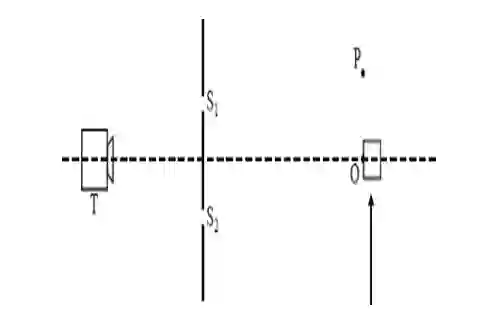
Figure: Microwave source directed towards a metal plate with two narrow slits
The wavelength of the microwaves is \(2.8\ \mathrm{nm}\), the separation between the slits is \(4\ \mathrm{mm}\) and the receiver is at a distance of \(80\ \mathrm{cm}\) from the slits.
a) Calculate the separation between adjacent maxima.
The separation between adjacent maxima is the fringe width \(\beta=\dfrac{\lambda D}{d}\):
b) What will be the phase difference if a bright fringe is formed at point ‘P’?
The point P is the central maximum on the axis, symmetrical between the slits. The path difference for waves reaching P from the two slits is zero, so
(For any other bright fringe the phase difference is \(2n\pi\).)
c) Why are well-defined interference patterns more difficult to observe when the slits are far apart or when the source is not coherent? Explain.
Slits far apart: the fringe width is inversely proportional to the slit separation (\(\beta\propto\dfrac1d\)). When the slits are far apart, the fringes become extremely narrow and crowded, beyond the resolving power of the eye or the detector, so the pattern blurs into a continuous spread of light.
Incoherent source: the phase difference changes rapidly and randomly, and it fixes the positions of the maxima and minima. The fringes therefore shift millions of times a second, and averaged over the observation time the pattern is washed out completely.
4. View PDF Notes
i. Handwritten Notes
ii. Typed PDF Notes
5. Frequently Asked Questions
What is interference of light?
What topics are included in Chapter 11 Interference of NEB Class 12 Physics?
What is the meaning of interference in physics?
What is interference of sound?
What does interference mean in communication?
What are coherent sources?
Why can two independent bulbs not act as coherent sources?
What are the conditions for sustained interference?
What is Young’s double slit experiment? Explain it.
What are the formulas of Young’s double slit experiment?
How do you derive the fringe width in Young’s double slit experiment?
How do you draw a diagram of Young’s double slit experiment?
What is the observer effect in Young’s double slit experiment?
Is there a simulation of Young’s double slit experiment?
What happens to the fringe width if d, D or λ changes?
What is a synonym for interference?
Where can I get Class 12 Physics Chapter 11 Interference notes in PDF?
Students also search for: