
Diffraction
Class 12 Physics Notes • NEB Syllabus 2083
Syllabus, 12 solved multiple choice questions, step-by-step numericals and derivations, handwritten and typed PDF notes and frequently asked questions on single-slit diffraction, the diffraction grating and resolving power.
1. Syllabus
Unit: Waves and Optics
Chapter 12: Diffraction (5 hours)
These notes follow the NEB Class 12 Physics syllabus (+2 Physics, Nepal). Practise the multiple choice questions first, then work through the numericals, and finish with the PDF notes for quick revision.
2. Multiple Choice Questions
Question 1. What is the angular position of the first diffraction minimum in a single-slit diffraction pattern, if the wavelength of light is \(\lambda\) and the slit width is \(d\)?
- a) \(\sin\theta=\dfrac\lambda d\)
- b) \(\sin\theta=\dfrac{2\lambda}{d}\)
- c) \(\sin\theta=\dfrac{3\lambda}{d}\)
- d) \(\sin\theta=\dfrac{\lambda}{2d}\)
Correct Answer: a) \(\sin\theta=\dfrac\lambda d\)
Reason: For a single slit the minima satisfy \(d\sin\theta=n\lambda\) with \(n=\pm1,\pm2,\dots\) For the first minimum \(n=1\):
Question 2. What happens to the diffraction pattern when the wavelength of light is increased in a single-slit diffraction experiment?
- a) The central maximum becomes narrower.
- b) The central maximum becomes wider.
- c) The fringes become dimmer.
- d) The pattern becomes sharper.
Correct Answer: b) The central maximum becomes wider.
Reason: The angular width of the central maximum is
It is directly proportional to \(\lambda\), so a longer wavelength spreads the whole pattern out and widens the central maximum.
Question 3. If the slit width in a single-slit diffraction experiment is halved, what will happen to the angular width of the central maximum?
- a) It will remain the same.
- b) It will double.
- c) It will become half.
- d) It will quadruple.
Correct Answer: b) It will double.
Reason: \(2\theta=\dfrac{2\lambda}{d}\) is inversely proportional to \(d\). If \(d\) becomes \(\dfrac d2\), the angular width becomes \(\dfrac{2\lambda}{d/2}=2\left(\dfrac{2\lambda}{d}\right)\), that is, it doubles.
Question 4. What happens if red light is used in place of blue light in diffraction?
- a) No change.
- b) Bands become broader and farther apart.
- c) Bands become narrower and crowded.
- d) Bands disappear.
Correct Answer: b) Bands become broader and farther apart.
Reason: Red light has a longer wavelength than blue light (\(\lambda_{\text{red}}>\lambda_{\text{blue}}\)). The angular spread and fringe width are proportional to \(\lambda\), so the diffraction bands become broader and move farther apart.
Question 5. What causes the distance between consecutive maxima to increase in a diffraction pattern?
- a) Decreasing wavelength.
- b) Increasing wavelength.
- c) Decreasing slit width.
- d) Increasing slit width.
Correct Answer: b) Increasing wavelength.
Reason: The angular separation of the fringes is proportional to \(\dfrac\lambda d\). It can be increased by increasing the wavelength \(\lambda\) (the answer given here) or by decreasing the slit width \(d\).
Question 6. What is the resolving power of an optical instrument?
- a) The ability to magnify the image.
- b) The ability to distinguish two objects as separate.
- c) The ability to focus on an object.
- d) The ability to reflect light.
Correct Answer: b) The ability to distinguish two objects as separate.
Reason: Resolving power is the capacity of an optical instrument (such as a microscope or a telescope) to form separate, distinguishable images of two objects that are very close to each other, in spite of the blurring caused by diffraction.
Question 7. Which is the best choice for why light travels in a straight line?
- a) Light consists of small tiny particles.
- b) The wavelength of light is very small.
- c) The frequency of light is very small.
- d) The velocity of light changes with a change in medium.
Correct Answer: b) The wavelength of light is very small.
Reason: Straight-line travel is an approximation of wave optics that holds when the obstacles or apertures are much larger than the wavelength. Visible light has a very small wavelength (about \(400\)-\(700\ \mathrm{nm}\)), so it does not diffract noticeably around everyday objects and seems to travel in straight lines.
Question 8. Which is the best alternative for the resolving power of a microscope?
- a) \(R=\dfrac{\lambda}{2\mu\sin\theta}\)
- b) \(R=\dfrac{2\mu\sin\theta}{\lambda}\)
- c) \(R=\dfrac{\lambda}{2\sin\theta}\)
- d) \(R=\dfrac{2\sin\theta}{\lambda}\)
Correct Answer: b) \(R=\dfrac{2\mu\sin\theta}{\lambda}\)
Reason: The limit of resolution of a microscope, the smallest distance that can be resolved, is \(d=\dfrac{\lambda}{2\mu\sin\theta}\). The resolving power is its reciprocal:
Question 9. Which of the following increases the resolving power of a microscope?
- a) Increasing the wavelength of light.
- b) Decreasing the aperture size.
- c) Using a lens with a larger numerical aperture.
- d) Using a lens with a smaller focal length.
Correct Answer: c) Using a lens with a larger numerical aperture.
Reason: The resolving power is
where NA is the numerical aperture. Increasing the numerical aperture directly increases the resolving power.
Question 10. Which is the best-suited option as per the design of a telescope?
- a) Decreasing the wavelength of light.
- b) Increasing the size of the objective lens.
- c) Increasing the focal length of the telescope.
- d) Decreasing the distance between the lens and the object.
Correct Answer: b) Increasing the size of the objective lens.
Reason: The resolving power of a telescope is
where \(D\) is the diameter of the objective lens. A larger objective gives a higher resolving power and also gathers more light.
Question 11. What determines the diffraction limit of resolution in an optical instrument?
- a) The aperture size and the wavelength of light.
- b) The lens curvature and the aperture size.
- c) The distance between the object and the lens.
- d) The refractive index of the medium.
Correct Answer: a) The aperture size and the wavelength of light.
Reason: By Rayleigh’s criterion the minimum resolvable angular separation is
so the limit depends on the wavelength \(\lambda\) and the aperture diameter \(D\).
Question 12. What happens to the resolving power of a microscope if the objective lens has a larger numerical aperture?
- a) The resolving power decreases.
- b) The resolving power increases.
- c) The image becomes blurred.
- d) The image becomes dimmer.
Correct Answer: b) The resolving power increases.
Reason: \(R=\dfrac{2\,\mathrm{NA}}{\lambda}\) is directly proportional to the numerical aperture, so a larger numerical aperture gives a higher resolving power.
3. Numerical and Subjective Questions
a) Diffraction is a fundamental wave phenomenon that occurs when light interacts with small openings or edges. Define the diffraction of light. Under what conditions is diffraction significant?
Diffraction of light is the bending of light waves around the corners of an obstacle or an aperture and their spreading into the geometrical shadow region.
Diffraction is significant and easily observed only when the size of the obstacle or aperture \(d\) is comparable to the wavelength of the light: \(\lambda\approx d\).
b) Differentiate interference from diffraction on the basis of wave sources and fringe formation.
| Interference | Diffraction | |
|---|---|---|
| Wave sources | Superposition of light waves from two or more distinct, separate coherent sources (for example two slits). | Superposition of continuous secondary wavelets from different parts of the same wavefront (for example a single slit). |
| Fringe formation | Fringes are generally of equal width and equal intensity. | Fringes are of unequal width and rapidly decreasing intensity; the central maximum is widest and brightest. |
c) A light of wavelength \(500\ \mathrm{nm}\) is passed through a single slit of width \(0.1\ \mathrm{mm}\). Calculate the angular width of the central maximum on a screen placed \(2\ \mathrm{m}\) away.
Linear width on the screen:
a) Compare Fresnel and Fraunhofer diffraction with a description of the setup.
| Fresnel diffraction | Fraunhofer diffraction | |
|---|---|---|
| Distances | The source and/or the screen are at a finite distance from the aperture or obstacle. | The source and the screen are effectively at infinite distance from the aperture. |
| Setup | No lenses are used to focus the light. | The source is placed at the focus of a converging lens (giving plane wavefronts) and a second lens focuses the diffracted waves on the screen. |
| Wavefronts | Spherical or cylindrical. | Plane. |
| Mathematics | Complex, because the angles keep changing. | Simple and clean. |
b) Derive the condition for minima in single-slit diffraction using geometry.
Consider a single slit of width \(d\) illuminated by a plane wavefront, and let the diffracted rays make an angle \(\theta\). Divide the slit into two equal halves, upper and lower, a distance \(\dfrac d2\) apart.
For the first minimum, every wavelet from the upper half must cancel a corresponding wavelet from the lower half. This needs a path difference of \(\dfrac\lambda2\). The path difference between the ray from the top edge and the ray from the midpoint is \(\left(\dfrac d2\right)\sin\theta\), so
Dividing the slit into \(2n\) equal zones gives the condition for all the minima:
c) A single slit of width \(0.2\ \mathrm{mm}\) is illuminated by light of wavelength \(600\ \mathrm{nm}\). Calculate the angular position of the first minimum.
Since \(\sin\theta\) is very small, \(\sin\theta\approx\theta\):
d) Why does light reflected from a non-metallic surface become partially polarized?
Unpolarized light striking a dielectric (non-metallic) surface can be resolved into a component parallel to the plane of incidence and a component perpendicular to it. Their reflection coefficients (Fresnel’s equations) are different at every angle except \(0^\circ\) and \(90^\circ\). The surface reflects the perpendicular component more strongly and transmits more of the parallel component, so the reflected beam is mostly vibrating in one plane and is partially polarized. At Brewster’s angle the reflected light is completely plane polarized.
a) What is a diffraction grating? Mention two practical applications.
A diffraction grating is an optical component with a very large number of equally spaced, parallel, narrow slits (rulings) that disperses light into its wavelengths.
Applications: (i) in spectrometers, to find the atomic spectra of elements and to analyse light sources; (ii) in lasers, to select (tune) a particular wavelength.
b) State and explain the grating equation for constructive interference.
The grating equation is
A bright maximum occurs only at those angles \(\theta\) for which the path difference between adjacent slits, \(d\sin\theta\), is a whole number of wavelengths.
c) A diffraction grating has \(6000\ \text{lines/cm}\). Find the angle of the second-order diffraction for light of wavelength \(500\ \mathrm{nm}\).
a) Define resolving power and explain its relation to diffraction.
Resolving power is the capacity of an optical instrument to give clearly separate images of two point objects lying close together.
Because of diffraction, the image of a point source formed by a circular lens is not a point but a central bright spot (the Airy disc) surrounded by rings. If two objects are too close, their Airy discs overlap and blur into one. Diffraction therefore sets a limit to the resolving power.
b) State Rayleigh’s criterion and its relevance to angular resolution.
Rayleigh’s criterion: two close point sources are just resolved by an optical instrument if the central maximum of the diffraction pattern of one source falls exactly on the first minimum of the diffraction pattern of the other.
It gives the minimum angular resolution for a circular aperture of diameter \(D\):
which is the standard used to calculate the limits of optical instruments.
c) Calculate the minimum angular separation between two objects that a telescope with an aperture of \(0.2\ \mathrm{m}\) can resolve using light of wavelength \(550\ \mathrm{nm}\).
In arcseconds:
a) Why is diffraction insignificant for everyday objects?
Diffraction is prominent only when the size of the obstacle or aperture is of the same order as the wavelength. The wavelength of visible light is extremely small (about \(10^{-7}\ \mathrm{m}\)), while everyday objects such as doors, windows and cars are about \(1\ \mathrm{m}\) in size. The ratio \(\dfrac\lambda d\) is practically zero, so the diffraction angle is too small to notice.
b) How does diffraction affect the performance of optical instruments?
It places a fundamental limit on the sharpness of the image. However perfectly a lens is made, diffraction spreads the light into an Airy disc at the focus. This blurring sets the highest useful magnification and resolution of the instrument.
c) A slit of width \(0.05\ \mathrm{mm}\) is illuminated by monochromatic light of wavelength \(650\ \mathrm{nm}\). Calculate the angular position of the second diffraction minimum.
a) What is the effect on the diffraction pattern if the slit width decreases?
The angular spread of the pattern is \(\theta\propto\dfrac\lambda d\). Decreasing the slit width \(d\) increases the angular width of the central maximum and the separation of all the secondary fringes, so the pattern spreads out much wider.
b) Compare the intensity and width of the central maxima in single-slit diffraction and double-slit interference.
Single-slit diffraction: the central maximum carries most of the light energy (about 90%). It is twice as wide as the secondary maxima (its linear width is \(\dfrac{2\lambda D}{d}\)), and the intensity of the later maxima falls off rapidly.
Double-slit interference: the interference maxima inside the central diffraction envelope all have the same width, \(\beta=\dfrac{\lambda D}{d}\), and (ideally) the same peak intensity.
c) A laser beam of wavelength \(650\ \mathrm{nm}\) passes through a slit of width \(0.1\ \mathrm{mm}\). Calculate the width of the central maximum on a screen \(1.5\ \mathrm{m}\) away.
a) Define angular width in single-slit diffraction.
The angular width of the central maximum is the total angle that the central bright fringe subtends at the slit. It is the angular separation between the first minima on the two sides of the central axis:
b) Explain how diffraction influences the resolution of optical instruments.
Light passing through the circular aperture of a lens is diffracted. Instead of a perfect point image of a point source, an Airy disc is formed. For two close sources the Airy discs overlap, and if the diffraction is large (small aperture or long wavelength) they merge completely and the two sources cannot be resolved.
c) A monochromatic light of wavelength \(550\ \mathrm{nm}\) falls normally on a grating having \(4000\ \text{lines/cm}\). Find the angle of the first-order maximum.
d) How does Huygens’ principle explain the diffraction of light?
According to Huygens’ principle, every point on the unobstructed part of a wavefront (for example the part inside a slit) acts as a source of secondary spherical wavelets. These spread forward and superpose. The diffraction pattern is the interference pattern produced by the superposition of all these secondary wavelets arriving at the screen.
a) What is the grating element? How is it related to the number of lines per cm?
The grating element \(d\) is the distance between the centres of two consecutive transparent slits of a grating. If \(a\) is the slit width and \(b\) the opaque spacing, \(d=a+b\). It is inversely related to the number of lines per unit length \(N\):
For \(N\) lines per cm, \(d=\dfrac1N\ \mathrm{cm}\).
b) Derive the expression for the angular position of the maxima in grating diffraction.
Let \(d\) be the distance between adjacent slits. Parallel rays diffracted at an angle \(\theta\) from adjacent slits have a path difference
For constructive interference (a maximum) this must be a whole number of wavelengths, \(\Delta x=n\lambda\). Hence
c) Calculate the number of diffraction orders observable with light of wavelength \(500\ \mathrm{nm}\) and a grating with \(5000\ \text{lines/cm}\).
The largest possible angle is \(\theta=90^\circ\) (\(\sin90^\circ=1\)):
Since \(n\) must be an integer, the highest order is \(n=4\). (The fourth order falls at \(\theta=90^\circ\), along the plane of the grating, so in practice it is not seen and the third order is the highest one actually observed.)
d) Explain the relationship between the angular width of the central maximum and the wavelength of light in single-slit diffraction.
The relationship is direct and linear:
The angular width of the central maximum is directly proportional to the wavelength. A longer wavelength is diffracted more and gives a wider central maximum.
a) In a single-slit diffraction diagram, explain the pattern observed on the screen.
The pattern has a broad, very bright central band (the central maximum), where the secondary wavelets from all parts of the slit reinforce each other most strongly. On both sides, symmetrically, are alternate dark bands (minima) and bright bands (secondary maxima). The intensity of the secondary maxima falls off rapidly away from the centre, and each is half the width of the central maximum.
b) Derive the condition for the first minimum in Fraunhofer diffraction.
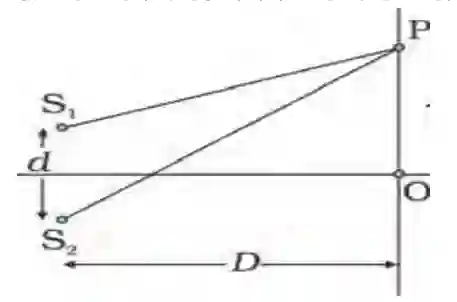
Figure: First minimum in Fraunhofer diffraction by a single slit
Divide the slit of width \(a\) into two equal zones of width \(\dfrac a2\). The path difference between rays from corresponding points of the two zones is \(\dfrac a2\sin\theta\). For destructive interference (minimum intensity) it must be \(\dfrac\lambda2\):
c) Monochromatic light of wavelength \(650\ \mathrm{nm}\) is incident on a single slit of width \(0.15\ \mathrm{mm}\). The diffraction pattern is observed on a screen placed \(2\ \mathrm{m}\) away from the slit. Calculate the angle at which the second diffraction minimum occurs.
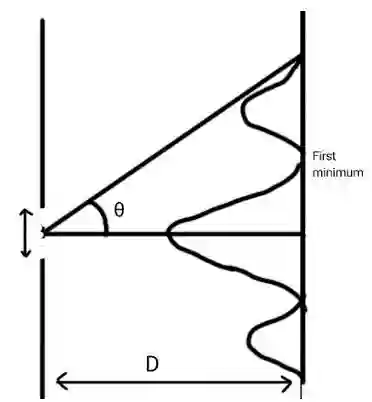
Figure: Single-slit diffraction pattern on a screen
a) Write the angular condition for minima in single-slit diffraction.
The condition is
where \(a\) is the slit width, \(\theta\) the angle of diffraction and \(\lambda\) the wavelength.
b) Derive the expression for the linear position \(y\) of the first minimum.
For the first minimum \(a\sin\theta=\lambda\). For a screen at a distance \(D\), the position \(y\) from the centre satisfies \(\tan\theta=\dfrac yD\). For small angles \(\sin\theta\approx\tan\theta\approx\dfrac yD\), so
c) If \(a=0.2\ \mathrm{mm}\), \(D=2\ \mathrm{m}\) and \(\lambda=600\ \mathrm{nm}\), calculate the distance \(y\) of the first minimum from the central maximum.
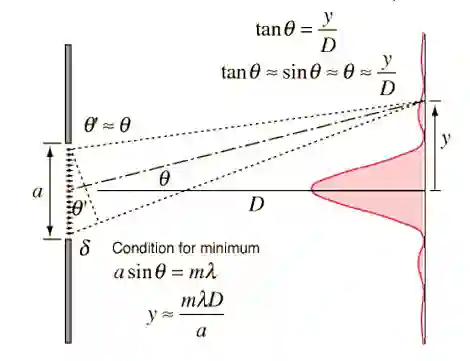
Figure: Linear position y of the first minimum
a) How does a diffraction grating disperse light into its components?
The principal maxima satisfy \(d\sin\theta=n\lambda\), so the angle \(\theta\) at which constructive interference occurs depends on the wavelength. White light contains many wavelengths, and each wavelength forms its maximum at a different angle. The colours are therefore separated (dispersed) in space.
b) Derive the grating equation used to calculate diffraction angles.
The path difference between rays from two adjacent slits separated by \(d\) is \(d\sin\theta\). For a maximum, all the slits must interfere constructively, so the phase difference is \(2\pi\) (the path difference is a whole number of wavelengths):
c) A diffraction grating has \(5000\) lines per cm. Calculate the angle of the second-order maximum for light of wavelength \(500\ \mathrm{nm}\).
a) State the conditions for Fresnel and Fraunhofer diffraction.
b) Discuss the differences in the fringe patterns formed.
A Fraunhofer pattern is symmetrical, with a sharp, well-defined central maximum and distinct, progressively dimmer secondary maxima. Positions can be found with simple geometry.
A Fresnel pattern is more complex. The centre can be dark depending on the size of the obstacle, the fringes are less sharp, and the pattern looks like a shadow with blurred diffraction edges.
c) In a Fraunhofer diffraction experiment with a single slit, light of wavelength \(450\ \mathrm{nm}\) produces a central maximum \(2\ \mathrm{cm}\) wide on a screen placed \(1.5\ \mathrm{m}\) from the slit. Calculate the slit width.
From \(W=\dfrac{2\lambda D}{d}\):
a) How does changing the slit width affect the diffraction pattern?
Since \(2\theta=\dfrac{2\lambda}{d}\), the spread of the pattern is inversely proportional to the slit width. Narrowing the slit makes the pattern spread out wider; widening the slit makes the pattern shrink into a narrower central band.
b) Derive the relation between the slit width, the wavelength and the width of the central maximum.
The first minimum is at the angle \(\theta\) with \(\sin\theta=\dfrac\lambda d\); for small angles \(\theta\approx\dfrac\lambda d\). The central maximum extends from the first minimum on one side (\(-\theta\)) to the first minimum on the other side (\(+\theta\)), so the angular width is
On a screen at a distance \(D\), the linear width is
c) Light of wavelength \(700\ \mathrm{nm}\) passes through a slit of width \(0.2\ \mathrm{mm}\). Determine the angular width of the central maximum.
a) Describe the conditions to observe Fraunhofer diffraction through a single slit.
b) Why is the central maximum wider and brighter than the others?
Wider: it extends between the first minima on both sides (\(n=+1\) and \(n=-1\)), an angular width of \(\dfrac{2\lambda}{d}\), whereas a secondary maximum lies between consecutive minima and has a width of only \(\dfrac\lambda d\).
Brighter: at \(\theta=0\) the secondary wavelets from every part of the slit travel equal paths and arrive in phase, so their full amplitudes add. Away from the centre there is partial destructive interference, and the intensity falls rapidly.
c) Derive the condition for the angular position of the minima.
Divide the slit into \(2n\) equal zones. The wavelets from corresponding points of neighbouring zones have a path difference \(\dfrac\lambda2\) and cancel in pairs. This gives the general condition (as derived in Question 2(b) and Question 9(b)):
d) Monochromatic light of wavelength \(600\ \mathrm{nm}\) falls on a single slit of width \(0.15\ \mathrm{mm}\). Calculate the angular position of the first diffraction minimum.
a) Define “grating element” and its relation to line density.
The grating element \(d\) is the repeat distance of the grating: the width of one transparent slit \(a\) plus the width of one opaque space \(b\), so \(d=a+b\). It is inversely related to the line density \(N\) (the number of lines per unit length):
b) Why does increasing the number of lines improve the grating resolution?
The resolving power of a grating is
where \(N_{\text{total}}\) is the total number of illuminated lines. With more lines the principal maxima become much sharper (narrower), so the grating can separate two wavelengths that are very close together.
c) Light of wavelength \(520\ \mathrm{nm}\) is incident normally on a grating having \(6000\ \text{lines/cm}\).
c) i) Find the grating element (the distance between two adjacent lines).
c) ii) Calculate the maximum order of diffraction that can be observed with this light.
The largest angle is \(\theta=90^\circ\):
Since \(n\) must be an integer, the maximum observable order is \(3\).
c) iii) Find the angle of diffraction for the second-order maximum.
4. View PDF Notes
i. Handwritten Notes
ii. Typed PDF Notes
5. Frequently Asked Questions
What is diffraction of light? (meaning in physics)
What topics are included in Chapter 12 Diffraction of NEB Class 12 Physics?
How do you pronounce diffraction?
What are examples of diffraction?
What is the difference between diffraction and refraction?
What is the difference between interference and diffraction?
What are the formulas for single-slit diffraction?
What is the single-slit diffraction experiment?
What is the difference between Fresnel and Fraunhofer diffraction?
What is a diffraction grating and what is the grating equation?
How many orders can be seen with a diffraction grating?
What is resolving power and Rayleigh’s criterion?
Why is diffraction not noticed for everyday objects?
How do the slit width and wavelength affect the diffraction pattern?
Where can I get Class 12 Physics Chapter 12 Diffraction notes in PDF?
Students also search for: