
Polarization
Class 12 Physics Notes • NEB Syllabus 2083
Syllabus, 12 solved multiple choice questions, step-by-step numericals and derivations, handwritten and typed PDF notes and frequently asked questions on polarization, Brewster’s law and Polaroids.
1. Syllabus
Unit: Waves and Optics
Chapter 13: Polarization (3 hours)
These notes follow the NEB Class 12 Physics syllabus (+2 Physics, Nepal). Practise the multiple choice questions first, then work through the numericals, and finish with the PDF notes for quick revision.
2. Multiple Choice Questions
Question 1. What is polarization of light?
- a) Bending of light
- b) Change in frequency
- c) Restricting light to a plane
- d) Reflection of light
Correct Answer: c) Restricting light to a plane
Reason: Polarization is the phenomenon by which the electric field oscillations of a light wave are confined to a single plane perpendicular to the direction of wave propagation.
Question 2. Which material is used as a polarizing filter?
- a) Glass
- b) Water
- c) Polaroid
- d) Diamond
Correct Answer: c) Polaroid
Reason: A Polaroid is a synthetic material containing micro-crystals (long molecules) aligned parallel to each other. It absorbs light vibrating in one direction and transmits light vibrating perpendicular to it.
Question 3. In plane-polarized light, the electric field vibrates along:
- a) all directions
- b) one direction
- c) two perpendicular directions
- d) no direction
Correct Answer: b) one direction
Reason: In plane-polarized light the electric field vector vibrates exclusively along a single direction (in a single plane) perpendicular to the direction of propagation.
Question 4. What happens to the transmitted light when the angle between the axes of two polarizers is \(90^\circ\)?
- a) The intensity becomes zero
- b) The intensity is halved
- c) The intensity remains the same
- d) The intensity is doubled
Correct Answer: a) The intensity becomes zero
Reason: According to Malus’s law,
When the transmission axes are crossed (\(\theta=90^\circ\)), \(\cos90^\circ=0\), so no light is transmitted (\(I=0\)).
Question 5. What condition occurs at the Brewster angle?
- a) Equal angle of incidence and refraction
- b) Maximum polarized light
- c) Complete absorption of light
- d) No polarization
Correct Answer: b) Maximum polarized light
Reason: At Brewster\’s angle (the polarizing angle \(i_p\)) the reflected light is completely plane-polarized, with vibrations perpendicular to the plane of incidence.
Question 6. What is the angle of incidence for which reflected light is completely polarized at an air-glass interface of refractive index 1.49?
- a) \(55^\circ\)
- b) \(56^\circ\)
- c) \(57^\circ\)
- d) \(54^\circ\)
Correct Answer: b) \(56^\circ\)
Reason: By Brewster’s law
Question 7. What is the angle between the reflected light and the refracted light when the reflected light is completely polarized at an air-glass interface?
- a) \(45^\circ\)
- b) \(180^\circ\)
- c) \(90^\circ\)
- d) \(60^\circ\)
Correct Answer: c) \(90^\circ\)
Reason: At Brewster’s angle \(i_p+r=90^\circ\), so the angle between the reflected and refracted rays is
Question 8. What is one application of polarization?
- a) Sunglasses
- b) Optical fibers
- c) Lasers
- d) All of the above
Correct Answer: a) Sunglasses
Reason: Polarized sunglasses use Polaroid filters to absorb the horizontally polarized glare reflected from flat surfaces such as water or roads, reducing glare and improving clarity. Of the options given, this is the direct application of polarization.
Question 9. Which one is the wave that cannot be polarized?
- a) Sound wave
- b) X-rays
- c) Heat wave
- d) Light wave
Correct Answer: a) Sound wave
Reason: Polarization is a property of transverse waves only. Sound waves in air are longitudinal (the vibrations are along the direction of propagation), so they cannot be polarized.
Question 10. What is the property of rotating the plane of polarization called?
- a) Dichroism
- b) Optical activity
- c) Specific rotation
- d) Optical rotation
Correct Answer: b) Optical activity
Reason: Optical activity is the property of certain substances (such as quartz or sugar solution) to rotate the plane of polarization of plane-polarized light passing through them.
Question 11. What is the polarizing angle for a crystal with a critical angle of \(45^\circ\)?
- a) \(\tan^{-1}\sqrt2\)
- b) \(\tan^{-1}\dfrac{1}{\sqrt2}\)
- c) \(\sin^{-1}\sqrt2\)
- d) \(\sin^{-1}\dfrac{1}{\sqrt2}\)
Correct Answer: a) \(\tan^{-1}\sqrt2\)
Reason: The refractive index is related to the critical angle by
By Brewster’s law
Question 12. What percentage of the intensity of light is not transmitted when unpolarized light strikes an ideal polarizing material?
- a) 25%
- b) 50%
- c) 75%
- d) 90%
Correct Answer: b) 50%
Reason: The polarizer absorbs the components of the electric field perpendicular to its transmission axis. Half of the intensity of unpolarized light is transmitted:
so 50% is not transmitted.
3. Numerical and Subjective Questions
a) Define polarization of light.
Polarization of light is the phenomenon in which the electric field oscillations of a light wave are restricted to a single direction or plane, perpendicular to the direction of propagation.
b) Differentiate between polarized and unpolarized light with one example for each.
| Unpolarized light | Plane-polarized light | |
|---|---|---|
| Vibration direction | The electric field vibrates in all possible directions perpendicular to the propagation. | The electric field vibrates in only a single direction perpendicular to the propagation. |
| Symmetry | Symmetrical around the ray direction. | Asymmetrical around the ray direction. |
| Example | Sunlight, light from an incandescent bulb or a candle. | Light reflected at Brewster’s angle, or light passing through a Polaroid. |
c) A light ray is incident on a glass surface at Brewster’s angle, and the reflected ray is completely polarized. If the reflected and refracted rays are at \(90^\circ\), show that \(\mu=\tan i_p\) and calculate the angle of incidence for glass of refractive index \(1.5\).
At Brewster’s angle the reflected and refracted rays are perpendicular, so \(i_p+r=90^\circ\Rightarrow r=90^\circ-i_p\). By Snell’s law:
For glass with \(\mu=1.5\):
Refractive index \(\mu=1.5\) and angle of incidence \(i_p=56.3^\circ\).
a) What is plane-polarized light?
Plane-polarized light is light in which the electric vector oscillations are strictly confined to a single plane (the plane of vibration) containing the direction of wave propagation.
b) Explain polarization by reflection with a suitable diagram.
Figure: Polarization by reflection at Brewster’s angle (i = iₚ)
When unpolarized light is incident on a transparent dielectric surface (glass or water), the reflected beam is generally partially polarized. At a particular angle of incidence, the Brewster angle \(i_p\), the reflected light becomes completely plane-polarized.
At this angle the reflected and refracted rays are at right angles (\(90^\circ\)) to each other. The vibrations in the plane of incidence are completely transmitted into the medium, and only the vibrations perpendicular to the plane of incidence are reflected. The refracted beam is partially polarized.
c) Light is incident on a surface such that the angle between the reflected and refracted rays is \(90^\circ\). If the angle of incidence is \(56^\circ\), calculate:
c) i) The refractive index of the medium.
c) ii) The speed of light in that medium (take \(c=3\times10^8\ \mathrm{m/s}\)).
a) What are Polaroids?
Polaroids are thin synthetic sheet polarizers containing long-chain molecules (for example polyvinyl alcohol impregnated with iodine) oriented parallel to each other. They absorb light vibrations parallel to the molecular chains (dichroism) and transmit the vibrations perpendicular to them, along a single direction called the transmission axis.
b) Mention two practical applications of Polaroids in optics.
c) Unpolarized light passes through two Polaroid sheets placed one after the other.
c) i) What happens to the intensity after the first Polaroid? Explain.
The intensity is reduced to half:
Unpolarized light has equal components of vibration along all directions. The first Polaroid transmits only the component along its axis and absorbs the perpendicular component.
c) ii) What happens if the axis of the second Polaroid is perpendicular to that of the first? Why?
The transmitted intensity becomes zero (\(I_2=0\)). The light leaving the first Polaroid is plane-polarized along its axis. The second Polaroid (the analyser) at \(90^\circ\) has no component of this vibration along its axis, because \(\cos90^\circ=0\).
c) iii) Describe what happens when the second Polaroid is gradually rotated from the perpendicular to the parallel position. How does this demonstrate polarization?
As the second Polaroid is rotated from \(90^\circ\) to \(0^\circ\), the transmitted intensity increases steadily from zero to a maximum, following Malus’s law:
Significance: this continuous variation of intensity shows that light is a transverse wave. A longitudinal wave (such as sound) would show no change in intensity on rotation.
a) State Brewster’s law and derive it mathematically.
Brewster’s law: when unpolarized light is incident on a transparent surface at the polarizing angle \(i_p\), the tangent of the polarizing angle is equal to the refractive index \(\mu\) of the medium:
Derivation: at Brewster’s angle the reflected and refracted rays are perpendicular. From the geometry at the point of incidence:
Applying Snell’s law:
b) Using a diagram, explain why light reflected at Brewster’s angle is completely polarized.
Figure: Dipoles in the glass oscillate along the direction of the reflected ray at Brewster’s angle
The reflected light is produced by the electric dipoles of the refracting medium, which are made to oscillate by the refracted wave. The oscillations are perpendicular to the refracted ray. When the reflected and refracted rays are at \(90^\circ\), the dipoles that oscillate in the plane of incidence point exactly along the direction of the reflected ray.
An oscillating dipole cannot radiate energy along its own line of oscillation. So no light vibrating in the plane of incidence is reflected. The reflected light contains only the vibrations perpendicular to the plane of incidence, and is therefore completely plane-polarized.
c) State two practical uses of polarization in everyday life or technology.
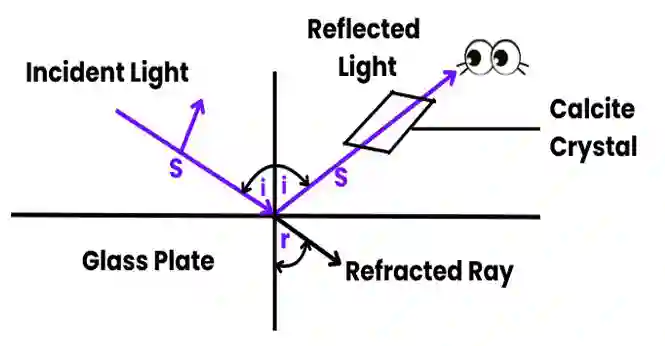
Figure: Refraction and reflection of light at the boundary between a denser and a rarer medium
a) Define Brewster’s angle and state its significance.
Brewster’s angle \(i_p\) is the particular angle of incidence at which the light reflected from a transparent boundary is completely plane-polarized.
Significance: it gives a way to produce plane-polarized light without absorption losses, and it can be used to find the refractive index of a material.
b) Using the figure, explain why the reflected light is completely polarized at Brewster’s angle.
At Brewster’s angle the reflected and refracted rays are perpendicular (\(90^\circ\)). The dipoles excited in the second medium oscillate along the direction of the reflected ray and cannot radiate in that direction. Consequently the vibrations in the plane of incidence are not reflected (they are transmitted), and the reflected beam contains only the perpendicular vibrations.
c) If the refractive index of the denser medium relative to the rarer medium is \(1.5\), calculate Brewster’s angle for light incident from the rarer medium.
d) Unpolarized light is incident on a glass slab such that the reflected light is completely polarized. The refractive index of glass is \(1.66\). Calculate:
d) i) The Brewster angle.
d) ii) The angle between the reflected and refracted rays.
By the condition for Brewster’s angle, the angle between the reflected and refracted rays is exactly \(90^\circ\).
d) iii) The speed of light in the glass (take \(c=3\times10^8\ \mathrm{m/s}\)).
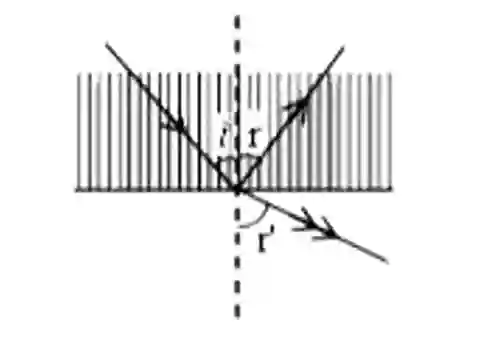
Figure: Light passing from a denser medium to a rarer medium, with the reflected and refracted rays at 90°
a) Find the critical angle.
Let the refractive indices of the denser and rarer media be \(\mu_d\) and \(\mu_r\). The reflected and refracted rays are perpendicular, and by the law of reflection \(r=i\):
By Snell’s law at the boundary:
The critical angle \(C\) for total internal reflection from the denser to the rarer medium satisfies \(\sin C=\dfrac{\mu_r}{\mu_d}\), so
b) Define plane-polarized light and differentiate it from unpolarized light.
Plane-polarized light is light in which the electric field vector oscillates in only one plane perpendicular to the direction of propagation. Unpolarized light has electric field oscillations in random orientations, in all directions perpendicular to the direction of propagation.
c) Explain why the reflected light at Brewster’s angle is completely polarized, using the concept of electromagnetic wave vibrations.
Light is an electromagnetic wave with transverse electric field oscillations. At Brewster’s angle the angle of refraction satisfies \(i+r’=90^\circ\). The direction of the reflected ray is then parallel to the oscillations of the atomic dipoles (excited by the refracted wave) that correspond to the electric field in the plane of incidence. Since an oscillating dipole cannot radiate along its line of motion, none of the vibrations in the plane of incidence is reflected. The reflected ray is completely polarized, with vibrations perpendicular to the plane of incidence.
a) Explain polarization of light and its significance in wave optics.
Polarization is the restriction of the electric field vibrations of a light wave to a single direction in a plane perpendicular to the direction of propagation.
Significance: it is the experimental proof that light waves are transverse and not longitudinal, because longitudinal waves have no directional asymmetry around the axis of propagation.
b) State and explain Brewster’s law.
Brewster’s law states that the tangent of the polarizing angle \(i_p\) of a medium equals its refractive index:
When light is incident at \(i_p\), the reflected ray is completely plane-polarized, and the reflected and refracted rays make an angle of \(90^\circ\) with each other.
c) Describe a simple experiment that demonstrates the transverse nature of light.
d) What are Polaroids and how are they used to produce polarized light?
Polaroids are synthetic sheet polarizers made of long-chain polymer molecules aligned parallel during manufacture. When unpolarized light passes through, the component of the electric field parallel to the molecular chains is absorbed and the perpendicular component passes through, producing plane-polarized light.
e) A beam of unpolarized light strikes a transparent surface at the polarizing angle. If the refractive index of the material is \(1.5\), calculate the polarizing angle.
4. View PDF Notes
i. Handwritten Notes
ii. Typed PDF Notes
5. Frequently Asked Questions
What is polarization of light? (meaning in physics)
What topics are included in Chapter 13 Polarization of NEB Class 12 Physics?
What are the formulas of polarization in physics?
What is Brewster’s law?
What is a Polaroid and how does it work?
What is the difference between polarized and unpolarized light?
How does polarization prove that light is a transverse wave?
Which waves cannot be polarized?
What is Malus’s law?
What are the applications of polarization?
What is polarization in chemistry?
What is polarization in biology?
What is polarization in electricity?
What is polarization in politics and society?
Where can I get Class 12 Physics Chapter 13 Polarization notes in PDF?
Students also search for: