
Compulsory Mathematics SEE 2081 Koshi Province Solution | RE-1031’KoP | अनिवार्य गणित

Welcome to the complete solution set for Compulsory Mathematics SEE 2081 Koshi Province (RE-1031’KoP). This post provides detailed, step-by-step solutions to all questions from the recent SEE examination. Both English medium and Nepali medium students can benefit from this comprehensive guide.
Practicing past papers like the SEE 2081 Compulsory Mathematics – Koshi Province is essential for understanding exam patterns and marking schemes. Below you’ll find all questions with Nepali translations and detailed solutions.
Table of Contents: Compulsory Mathematics SEE 2081 Koshi Province
SEE 2081 Compulsory Mathematics – Question 1 (Sets & Survey)
360 जना विद्यार्थीहरूको समूहमा सर्वेक्षण गर्दा 100 जनाले बास्केटबल खेल मात्र मन पराउँछन् । 60 जनाले क्रिकेट खेल मात्र मन पराउँछन् र 100 जनाले दुवै खेलमध्ये कुनै पनि मन पराउँदैनन् ।
In a survey of a group of 360 students, 100 students like basketball game only, 60 like cricket game only and 100 do not like any of the two games.
-
(a) यदि $B$ र $C$ ले क्रमशः बास्केटबल र क्रिकेट खेल मन पराउने विद्यार्थीहरूको समूह जनाउँदछन् भने $n(\overline{B \cup C})$ को मान कति हुन्छ ? लेख्नुहोस् ।
If $B$ and $C$ denote the set of students who like basketball and cricket respectively, then what is the value of $n(\overline{B \cup C})$? Write it. [1]
-
(b) माथिको तथ्यलाई भेन चित्रमा प्रस्तुत गर्नुहोस् ।
Present the above information in a Venn diagram. [1]
-
(c) दुवै खेल मन पराउने विद्यार्थीहरूको सङ्ख्या पत्ता लगाउनुहोस् ।
Find the number of students who like both games. [1]
-
(d) यदि दोस्रो पटक फेरि सर्वेक्षण गर्दा कुनै पनि खेलमा रुची नभएका सबैले क्रिकेट खेल मन पराए र अन्य यथावत पाइयो भने कम्तिमा एउटा खेल मन पराउने विद्यार्थीहरूको सङ्ख्या कति हुनेथियो ? पत्ता लगाउनुहोस् ।
If everyone who is not interested in any game liked cricket game in the second survey and found others to be same then, what would be the number of students who like at least one game? Find it. [1]
Solution:
(a)
Given: Total students $n(U) = 360$
Basketball only $n_o(B) = 100$
Cricket only $n_o(C) = 60$
Neither $n(\overline{B \cup C}) = 100$
$$\therefore n(\overline{B \cup C}) = 100$$
(b) Venn diagram representation:
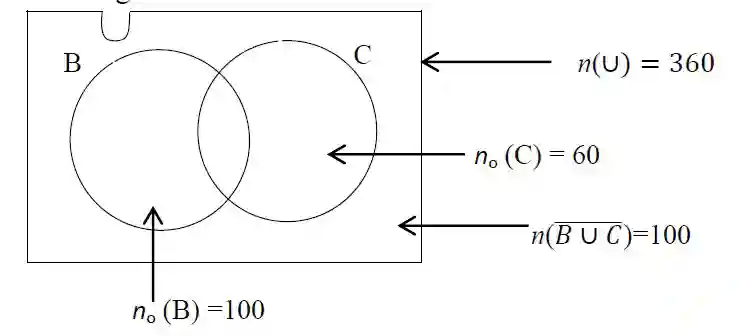
(c)
We know: $n(U) = n_o(B) + n_o(C) + n(B \cap C) + n(\overline{B \cup C})$
$$360 = 100 + 60 + n(B \cap C) + 100$$
$$360 = 260 + n(B \cap C)$$
$$n(B \cap C) = 360 – 260 = 100$$
Alternative method:
$n(B \cup C) = 360 – 100 = 260$
$n(B \cup C) = n_o(B) + n_o(C) + n(B \cap C)$
$260 = 100 + 60 + n(B \cap C)$
$\therefore n(B \cap C) = 100$
(d)
In second survey:
Students liking at least one game = Total students – Students liking none
New students liking none = 0 (all 100 now like cricket)
$\therefore$ Students liking at least one game = 360 – 0 = 360
Alternative calculation:
New $n(C) = 60 + 100 + 100 = 260$
New $n(B) = 100 + 100 = 200$
Using formula: $n(B \cup C) = n(B) + n(C) – n(B \cap C)$
$= 200 + 260 – 100 = 360$
Financial Mathematics – SEE 2081 Koshi Province (Q2-4)
राजनले रामसँग 2 वर्षका लागि 10% साधारण व्याजको दरले रु. 10,000 सापटी लिएछ र त्यत्तिनै बेला सो रकम समान समय र उही व्याज दरमा वार्षिक चक्रीय व्याजमा श्यामलाई सापटी दिएछ ।
Rajan borrowed a loan of Rs. 10,000 from Ram for 2 years at the rate of 10% simple interest. Immediately, Rajan lent the same sum for same time and same rate of interest compounded annually to Shyam.
-
(a) दिइएको सन्दर्भअनुसार, 2 वर्षको अन्त्यमा हुने साधारण व्याज र चक्रीय व्याज मध्ये कुन बढी हुन्छ ? लेख्नुहोस् ।
According to the given context, which interest is more among simple interest and compound interest for 2 years? Write it. [1]
-
(b) राजनले उक्त कारोवारमा 2 वर्षमा कति फाइदा पाए ? पत्ता लगाउनुहोस् ।
How much profit did Rajan get during the transaction of 2 years? Find it. [2]
-
(c) यदि राजनले उक्त रकम अर्धवार्षिक चक्रीय व्याजदरमा सापटी दिएको भए थप कति व्याज श्यामले दिनु पर्दथ्यो ? पत्ता लगाउनुहोस् ।
How much more interest should Shyam need to pay to Rajan if Rajan had lent the amount at semi-annual compound interest? Find it. [2]
Solution:
(a) Compound interest is more. (चक्रीय व्याज बढी हुन्छ।)
(b)
Principal ($P$) = Rs. 10,000
Time ($T$) = 2 years
Rate ($R$) = 10%
Simple Interest (S.I.) paid to Ram:
$$S.I. = \frac{P \times T \times R}{100}$$
$$= \frac{10,000 \times 2 \times 10}{100}$$
$$= \text{Rs. } 2,000$$
Compound Interest (C.I.) received from Shyam:
$$C.I. = P\left[\left(1+\frac{R}{100}\right)^T – 1\right]$$
$$= 10,000\left[\left(1+\frac{10}{100}\right)^2 – 1\right]$$
$$= 10,000\left[(1.1)^2 – 1\right]$$
$$= 10,000[1.21 – 1]$$
$$= 10,000 \times 0.21 = \text{Rs. } 2,100$$
Profit = C.I. – S.I.
$$= 2,100 – 2,000 = \text{Rs. } 100$$
(c)
Semi-annual compound interest:
$$C.I. = P\left[\left(1+\frac{R}{200}\right)^{2T} – 1\right]$$
$$= 10,000\left[\left(1+\frac{10}{200}\right)^{4} – 1\right]$$
$$= 10,000\left[(1.05)^4 – 1\right]$$
$$= 10,000[1.21550625 – 1]$$
$$= 10,000 \times 0.21550625 = \text{Rs. } 2,155.06$$
More interest to pay:
$$= 2,155.06 – 2,100 = \text{Rs. } 55.06$$
कुनै गाउँको हालको जनसङ्ख्या 20,000 छ । उक्त गाउँमा वार्षिक 2% का दरले जनसङ्ख्या वृद्धि हुन्छ ।
The population of a village is 20,000. The population increases by 2% annually in the village.
-
(a) यदि सुरुको जनसङ्ख्या $P$, जनसङ्ख्या वृद्धिदर $R$ प्रतिवर्ष र $T$ वर्षपछिको जनसङ्ख्या $P_{T}$ भए, $P_{T}$ पत्ता लगाउने सुत्र लेख्नुहोस् ।
If the initial population is $P$, growth rate is $R$ per annum and population after $T$ years is $P_{T}$ then write the formula to find $P_{T}$. [1]
-
(b) कति वर्षपछि सो गाउँको जनसङ्ख्या 20,808 पुग्छ ? पत्ता लगाउनुहोस् ।
After how many years the population of the village will be 20,808? Find it. [2]
-
(c) यदि प्रति वर्ष 3% का दरले जनसङ्ख्या वृद्धि भएको भए 2 वर्षमा सो गाउँको जनसङ्ख्या कतिले बढ्छ ? पत्ता लगाउनुहोस् ।
If the population increases at the rate of 3% per annum, by what number will the population of the village be increased in 2 years? Find it. [1]
Solution:
(a) $$P_T = P\left(1 + \frac{R}{100}\right)^T$$
(b)
Given: $P = 20,000$, $P_T = 20,808$, $R = 2\%$
$$20,808 = 20,000\left(1 + \frac{2}{100}\right)^T$$
$$\frac{20,808}{20,000} = (1.02)^T$$
$$1.0404 = (1.02)^T$$
$$(1.02)^2 = (1.02)^T$$
$$\therefore T = 2 \text{ years}$$
(c)
With $R = 3\%$, $T = 2$ years:
New population:
$$P_2 = 20,000\left(1 + \frac{3}{100}\right)^2$$
$$= 20,000 \times (1.03)^2$$
$$= 20,000 \times 1.0609 = 21,218$$
Population increased by:
$$= 21,218 – 20,808 = 410$$
मुद्रा विनियम दरअनुसार कुनै दिनको 1 अमेरिकी डलरको खरिद दर ने.रु. 136.13 र बिक्रीदर ने.रु. 137.25 थियो ।
According to the currency exchange rate, the buying rate of 1 American dollar was NRs. 136.13 and selling rate was NRs. 137.25 in a certain day.
-
(a) तपाईंले अमेरिकी डलर नेपाली रुपियाँमा साट्दा खरिददर र विक्रीदर मध्ये कुन प्रयोग हुन्छ ? लेख्नुहोस् ।
Which rate buying or selling is used when you exchange American dollar into Nepali rupees? Write it. [1]
-
(b) अमेरिकी पर्यटकले 1000 डलर साट्दा कति नेपाली रुपिया पाउँछन् ? पत्ता लगाउनुहोस् ।
How many Nepali rupees can American tourist get by exchanging 1000 dollars? Find it. [1]
-
(c) उक्त अमेरिकी पर्यटकले नेपाल बसाइमा ने.रु. 1,01,817.50 खर्च गरेछ भने आफ्नो देश फर्किदा बाँकी रकमको कति अमेरिकी डलर सटही गर्न सक्दछ ? पत्ता लगाउनुहोस् ।
The American tourist spent NRs. 1,01,817.50 while staying in Nepal, how many American dollars can he/she exchange from remaining Nepalese rupees, while returning back to own country? Find it. [2]
Solution:
(a) Buying rate is used when exchanging dollar into rupees. (खरिददर प्रयोग हुन्छ।)
(b)
Using buying rate: $1 USD = NRs. 136.13$
For 1000 dollars:
$$= 136.13 \times 1000 = \text{NRs. } 1,36,130$$
(c)
Initial amount = NRs. 1,36,130
Amount spent = NRs. 1,01,817.50
Remaining amount:
$$= 1,36,130 – 1,01,817.50 = \text{NRs. } 34,312.50$$
When exchanging back, selling rate applies: $1 USD = NRs. 137.25$
Dollars obtained:
$$= \frac{34,312.50}{137.25} = \$250$$
Mensuration – SEE 2081 Koshi Province (Q5-7)
एउटा विद्यार्थीहरूको समूहले आधार भुजाको लम्बाइ 24 मिटर र ठाडो उचाइ 5 मिटर भएको एउटा वर्गाकार आधार भएको पिरामिड आकारको टेन्ट बनाएछन् ।
A group of students constructed a square based pyramid shaped tent having length of base side 24 meter and vertical height 5 meter.
-
(a) वर्ग आधार भएको पिरामिडमा कतिओटा त्रिभुजाकार सतहहरू हुन्छन् ? लेख्नुहोस् ।
How many triangular surfaces are there in the square based pyramid? Write it. [1]
-
(b) उक्त माथिको वर्गाकार आधार भएको टेन्टको छड्के उचाइ पत्ता लगाउनुहोस् ।
Find the slant height of the above square based tent. [1]
-
(c) त्रिभुजाकार सतहहरूमा प्रति वर्ग मिटर रु. 125 का दरले कपडा लगाउँदा जम्मा कति खर्च लाग्छ ? पत्ता लगाउनुहोस् ।
What is the total cost of cloths required to make triangular surfaces at the rate of Rs. 125 per square metre? Find it. [2]
Solution:
(a) There are 4 triangular surfaces. (चारओटा त्रिभुजाकार सतहहरू छन्।)
(b)
Base side ($a$) = 24 m
Vertical height ($h$) = 5 m
Half of base = $24/2 = 12$ m
Slant height ($l$):
$$l = \sqrt{h^2 + \left(\frac{a}{2}\right)^2}$$
$$= \sqrt{5^2 + 12^2}$$
$$= \sqrt{25 + 144}$$
$$= \sqrt{169} = 13 \text{ m}$$
(c)
Area of one triangular face:
$$= \frac{1}{2} \times \text{base} \times \text{slant height}$$
$$= \frac{1}{2} \times 24 \times 13 = 156 \text{ m}^2$$
Total area of 4 faces:
$$= 4 \times 156 = 624 \text{ m}^2$$
Total cost:
$$= 125 \times 624 = \text{Rs. } 78,000$$
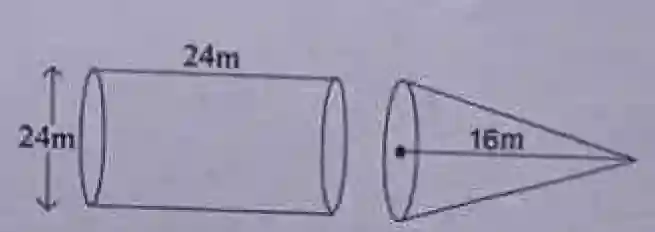
दिइएको चित्रमा बराबर आधार भएका काठको बेलना र सोली देखाइएको छ ।
In the given figure, wooden cylinder and cone having equal base are shown.
-
(a) सोलीको आयतन पत्ता लगाउने सुत्र लेख्नुहोस् ।
Write the formula to find the volume of a cone. [1]
-
(b) देखाइएको वस्तुहरूमा सोलीको आयतन पत्ता लगाउनुहोस् ।
Find the volume of the cone in the given objects. [2]
-
(c) दिइएको बेलनामा दिइएको सोली आकार खोपेमा, उक्त बेलनामा काठको आयतन कति बाँकी हुन आउँछ ? पत्ता लगाउनुहोस् ।
If given wooden cylinder is drilled out in the given conical shape, what will be the volume of remaining wood in cylinder? Find it. [2]
Solution:
(a) $$V = \frac{1}{3}\pi r^2 h$$
(b)
From figure: Diameter = 24 m, so radius ($r$) = 12 m
Height of cone ($h$) appears to be 16 m (based on cylinder height 24m and cone fitting)
Volume of cone:
$$V = \frac{1}{3} \times \frac{22}{7} \times 12^2 \times 16$$
$$= \frac{1}{3} \times \frac{22}{7} \times 144 \times 16$$
$$= \frac{1}{3} \times \frac{22}{7} \times 2304$$
$$= \frac{22 \times 2304}{21}$$
$$= \frac{50688}{21} = 2413.71 \text{ m}^3$$
(c)
Height of cylinder = 24 m
Volume of cylinder:
$$V_{cyl} = \pi r^2 h$$
$$= \frac{22}{7} \times 12^2 \times 24$$
$$= \frac{22}{7} \times 144 \times 24$$
$$= \frac{22 \times 3456}{7}$$
$$= \frac{76032}{7} = 10861.71 \text{ m}^3$$
Volume of remaining wood:
$$= 10861.71 – 2413.71 = 8448 \text{ m}^3$$
एउटा पर्खालको लम्बाइ 10 मि., चौडाइ 0.5 मि. र उचाइ 2 मि. छन् । उक्त पर्खाल बनाउन 25 से.मि. $\times$ 12 से.मि. $\times$ 8 से.मि. नापका इटाहरू प्रयोग गरिएका छन् । साथै उक्त पर्खालको $\frac{1}{10}$ भाग माटोको जोर्नीले ओगटेको छ ।
The length of a wall is 10 m, width is 0.5 m and height is 2 m. Bricks of size 25 cm $\times$ 12 cm $\times$ 8 cm are used to build the wall. Also, $\frac{1}{10}$ part of the wall is occupied by the clay joints.
-
(a) सो पर्खाल बनाउन कतिओटा इटाहरू चाहिन्छन् ? पत्ता लगाउनुहोस् ।
How many bricks are required to construct the wall? Find it. [3]
-
(b) प्रति 1000 इटाको मूल्य रु. 14,500 का दरले सो पर्खाल बनाउन लाग्ने इटाको खर्च अनुमान गर्नुहोस् ।
Estimate the cost of bricks used in the wall at the rate of Rs. 14500 per 1000 bricks. [1]
Solution:
(a)
Volume of one brick:
$$= 25 \text{ cm} \times 12 \text{ cm} \times 8 \text{ cm}$$
$$= 2400 \text{ cm}^3$$
Volume of wall:
$$= 10 \text{ m} \times 0.5 \text{ m} \times 2 \text{ m}$$
$$= 10 \text{ m}^3$$
Volume occupied by clay joints:
$$= \frac{1}{10} \times 10 = 1 \text{ m}^3$$
Volume for bricks only:
$$= 10 – 1 = 9 \text{ m}^3$$
Convert to cm³: $9 \text{ m}^3 = 9,000,000 \text{ cm}^3$
Number of bricks:
$$= \frac{9,000,000}{2400} = 3750$$
(b)
Cost per 1000 bricks = Rs. 14,500
For 3750 bricks:
$$= \frac{14,500}{1000} \times 3750$$
$$= 14.5 \times 3750 = \text{Rs. } 54,375$$
Algebra & Sequences – SEE 2081 Koshi Province (Q8-10)
रमेशले प्रत्येक दिन अघिल्लो दिनको भन्दा दोब्बर रकम जम्मा गर्ने गरी 7 दिनसम्म एउटा सहकारीमा रकम बचत गर्छन् । जसअनुसार उनले पहिलो दिन रु. 10, दोस्रो दिन रु. 20, तेस्रो दिन रु. 40 गरी 7 औं दिनसम्म यसरी नै रकम जम्मा गरेछन् ।
Ramesh deposits the amount in a co-operative for 7 days by increasing the amount every day double than the previous day. He deposited Rs. 10 on the first day, Rs. 20 on the second day, Rs. 40 on the third day and so on till the 7th day.
-
(a) माथिको सन्दर्भ अनुसार जम्मा गरेको रकमबाट बन्ने श्रेणी कुन प्रकारको हुन्छ ? लेख्नुहोस् ।
What type of series is formed from the deposit amount according to above context? Write it. [1]
-
(b) 7 दिनको अन्त्यसम्ममा रमेशले कति रकम जम्मा गर्छन् ? सूत्र प्रयोग गरी पत्ता लगाउनुहोस् ।
How much amount will Ramesh deposit by the end of 7 days? Find it using formula. [2]
-
(c) यदि रमेशले 4 दिनसम्म जम्मा भएको रकम पहिले नै निकालेको भए 7 दिनको अन्त्यमा उसले कति रकम मात्र पाउँछन् ? पत्ता लगाउनुहोस् ।
If Ramesh withdraws the amount deposited by 4 days, how much will he receive at the end of the $7^{th}$ days? Find it. [2]
Solution:
(a) Geometric series (गुणोत्तर श्रेणी)
(b)
First term ($a$) = 10
Common ratio ($r$) = 2
Number of terms ($n$) = 7
Sum of GP formula:
$$S_n = \frac{a(r^n – 1)}{r – 1}$$
$$S_7 = \frac{10(2^7 – 1)}{2 – 1}$$
$$= \frac{10(128 – 1)}{1}$$
$$= 10 \times 127 = \text{Rs. } 1,270$$
(c)
Amount deposited in first 4 days:
$$S_4 = \frac{10(2^4 – 1)}{2 – 1}$$
$$= \frac{10(16 – 1)}{1}$$
$$= 10 \times 15 = \text{Rs. } 150$$
Total deposited in 7 days = Rs. 1,270
Amount after withdrawal:
$$= 1,270 – 150 = \text{Rs. } 1,120$$
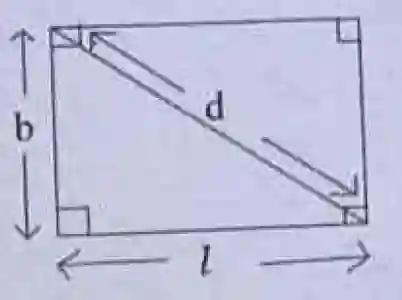
एउटा आयताकार जमिनको लामो भुजा छोटो भुजाभन्दा 40 मि. बढी छ र त्यसको विकर्ण लामो भुजाभन्दा 40 मि. बढी छ ।
The longer side of a rectangular field is 40 m more than the shorter side and its diagonal is 40 m more than its longer side.
-
(a) माथिको सन्दर्भ अनुसार जमिनको लम्बाइ ($l$), चौडाइ ($b$) र विकर्ण ($d$) बिचको सम्बन्ध लेख्नुहोस् ।
Write the relation among the length ($l$), breadth ($b$) and diagonal ($d$) of the field according to the above context. [1]
-
(b) आयताकार जमिनको छोटो भुजा र लामो भुजाको लम्बाइ पत्ता लगाउनुहोस् ।
Find the length of the shorter side and longer side of the rectangular filed. [2]
-
(c) उक्त आयताकार जमिनमा 30 मि. $\times$ 20 मि. नापका अधिकतम कति ओटा जग्गाका टुक्राहरू तयार गर्न सकिन्छ ? पत्ता लगाउनुहोस् ।
How many maximum numbers of plots of size 30 m $\times$ 20 m can be made from the rectangular filed? Find it. [2]
Solution:
(a) $$d^2 = l^2 + b^2$$
(b)
Let shorter side = $x$ m
Then longer side = $(x + 40)$ m
Diagonal = $(x + 40) + 40 = (x + 80)$ m
Using Pythagoras theorem:
$$(x + 80)^2 = (x + 40)^2 + x^2$$
$$x^2 + 160x + 6400 = x^2 + 80x + 1600 + x^2$$
$$x^2 + 160x + 6400 = 2x^2 + 80x + 1600$$
$$0 = 2x^2 – x^2 + 80x – 160x + 1600 – 6400$$
$$0 = x^2 – 80x – 4800$$
$$x^2 – 80x – 4800 = 0$$
$$x^2 – 120x + 40x – 4800 = 0$$
$$x(x – 120) + 40(x – 120) = 0$$
$$(x – 120)(x + 40) = 0$$
$\therefore x = 120$ or $x = -40$ (invalid)
Shorter side = 120 m
Longer side = $120 + 40 = 160$ m
(c)
Area of field:
$$= 160 \times 120 = 19,200 \text{ m}^2$$
Area of one plot:
$$= 30 \times 20 = 600 \text{ m}^2$$
Number of plots:
$$= \frac{19,200}{600} = 32$$
(a) सरल गर्नुहोस् (Simplify): $\frac{p+q}{pq}-\frac{q+r}{qr}-\frac{r+p}{rp}$
(b) हल गर्नुहोस् (Solve): $3^{y}+3^{y}=9\frac{1}{9}$
Solution:
(a) $$\frac{p+q}{pq}-\frac{q+r}{qr}-\frac{r+p}{rp}$$ $$= \frac{r(p+q) – p(q+r) – q(r+p)}{pqr}$$ $$= \frac{rp + rq – pq – pr – qr – qp}{pqr}$$ $$= \frac{rp – pr + rq – qr – pq – qp}{pqr}$$ $$= \frac{0 + 0 – 2pq}{pqr}$$ $$= -\frac{2}{r}$$
(b)
$$3^{y}+3^{y}=9\frac{1}{9}$$
$$2 \times 3^{y} = \frac{82}{9}$$
$$3^{y} = \frac{82}{9 \times 2}$$
$$3^{y} = \frac{82}{18} = \frac{41}{9}$$
Taking logarithms or recognizing pattern:
Let $3^{y} = x$, then $x = \frac{41}{9}$
But also from equation: $2x = \frac{82}{9} \Rightarrow x = \frac{41}{9}$
Alternative approach from answer key:
$$9(3^{y})^{2}-82(3^{y})+9=0$$
Let $u = 3^{y}$:
$$9u^2 – 82u + 9 = 0$$
$$(9u – 1)(u – 9) = 0$$
$\therefore u = \frac{1}{9}$ or $u = 9$
Case 1: $3^{y} = \frac{1}{9} = 3^{-2} \Rightarrow y = -2$
Case 2: $3^{y} = 9 = 3^{2} \Rightarrow y = 2$
$\therefore y = -2, 2$
Geometry – SEE 2081 Koshi Province (Q11-14)
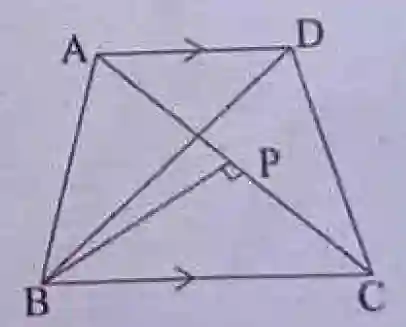
दिइएको चित्रमा $\triangle ABC$ र $\triangle BCD$ एउटै आधार BC र उही समानान्तर रेखाहरू AD र BC बिच रहेका छन् । विन्दु B बाट रेखा AC मा लम्ब BP खिचिएको छ ।
In the given figure, $\triangle ABC$ and $\triangle BCD$ are standing on same base BC and between same parallel lines AD and BC. From the point B, a perpendicular BP is drawn to the line AC.
-
(a) दिइएको चित्रमा $\triangle BAD$ को क्षेत्रफलसँग बराबर हुने त्रिभुजको नाम लेख्नुहोस् ।
Write the name of triangle whose area is equal to area of $\triangle BAD$ in the given figure. [1]
-
(b) यदि $AC=9$ से.मि. र $BP=6$ से.मि. भए त्रिभुज BCD को क्षेत्रफल पत्ता लगाउनुहोस् ।
If $AC=9$ cm and $BP=6$ cm, find the area of triangle BCD. [2]
-
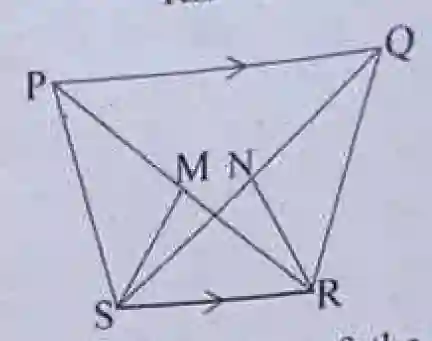
(c) दिइएको चित्रमा PQRS एउटा समलम्ब चतुर्भुज हो । जहाँ $PQ || SR$ छ । साथै M र N क्रमशः विकर्णहरू PR र QS का मध्यबिन्दुहरू हुन् भने $\Delta MSR = \Delta NSR$ हुन्छ भनि प्रमाणित गर्नुहोस् ।
In the given figure, PQRS is a trapezium, where $PQ || SR$. M and N are the midpoints of the diagonals PR and QS respectively. Prove that: Area of $\Delta MSR =$ Area of $\Delta NSR$. [2]
Solution:
(a) $\triangle ACD$ (or $\triangle CAD$)
(b)
Area of $\triangle ABC$:
$$= \frac{1}{2} \times AC \times BP$$
$$= \frac{1}{2} \times 9 \times 6 = 27 \text{ cm}^2$$
Since $\triangle ABC$ and $\triangle BCD$ are on same base BC and between same parallels AD and BC, their areas are equal.
$\therefore$ Area of $\triangle BCD = 27 \text{ cm}^2$
(c)
Proof:
1. In trapezium PQRS, $PQ || SR$
2. M is midpoint of PR, N is midpoint of QS
3. Area of $\triangle MSR = \frac{1}{2} \times$ Area of $\triangle PSR$ (since M is midpoint, median divides triangle into equal areas)
4. Area of $\triangle NSR = \frac{1}{2} \times$ Area of $\triangle QSR$
5. But $\triangle PSR$ and $\triangle QSR$ are on same base SR and between same parallels PQ and SR, so their areas are equal
6. Therefore, Area of $\triangle MSR =$ Area of $\triangle NSR$
त्रिभुज PQR मा $\angle PQR=60^{\circ}$, $QR=8$ से.मि. र $PQ=6$ से.मि. दिइएका छन् ।
In a triangle PQR, $\angle PQR=60^{\circ}$, $QR=8$ cm, and $PQ=6$ cm are given.
-
(a) माथिका नापअनुसारको $\Delta PQR$ को रचना गर्नुहोस् र उक्त त्रिभुजको क्षेत्रफलसँग बराबर हुने गरी एउटा आयत RITA को पनि रचना गर्नुहोस् ।
Construct a $\Delta PQR$ according to the above measurements and also construct a rectangle RITA equal in area to the triangle. [3]
-
(b) यसरी बनेका त्रिभुज र आयतको क्षेत्रफल किन बराबर हुन्छ ? कारण लेख्नुहोस् ।
Why are the areas of the triangle and the rectangle so formed equal? Write the reason. [1]
Solution:
(a) Construction diagram:
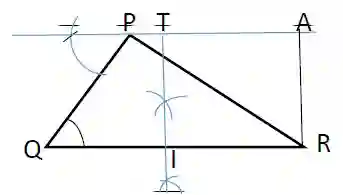
Construction steps:
1. Draw $QR = 8$ cm
2. At Q, construct $\angle PQR = 60^\circ$
3. Cut $QP = 6$ cm along the angle line
4. Join PR to complete $\triangle PQR$
5. Construct rectangle with area equal to triangle using appropriate construction techniques
(b) The areas are equal because the rectangle is constructed such that its base is equal to the base of the triangle and its height is half of the triangle’s height, or using the principle that triangles and rectangles between same parallels with proper base relationship have equal areas. (त्रिभुज र आयत उही समानान्तर रेखाहरू बीच रहेका छन् र आयतको आधार त्रिभुजको आधारको आधा भएकाले क्षेत्रफल बराबर हुन्छ।)
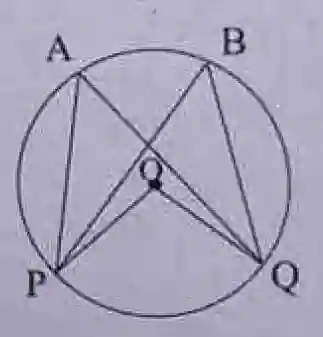
दिइएको वृत्तको केन्द्रविन्दु O छ । परिधिका कोणहरू PAQ र PBQ एउटै चाप PQ मा आधारित छन् ।
O is the centre of the given circle. Inscribed angles PAQ and PBQ are standing on the same arc PQ.
-
(a) परिधि कोणहरू PAQ र PBQ बिचको सम्बन्ध लेख्नुहोस् ।
Write the relation between the inscribed angles PAQ and PBQ. [1]
-
(b) यदि केन्द्रीय कोण POQ को नाप $(12x+4)^{\circ}$ र परिधि कोण PAQ को नाप $(3x+20)^{\circ}$ छन् भने x को मान निकाल्नुहोस् ।
If the measure of central angle POQ is $(12x+4)^{\circ}$ and the measure of inscribed angle PAQ is $(3x+20)^{\circ}$, find the value of x. [1]
-
(c) एउटै चापमा बनेको केन्द्रीय कोण परिधि कोणको दोब्बर हुन्छ भनी प्रयोगद्वारा सिद्ध गर्नुहोस् । (अर्धव्यास 3 से.मि. भन्दा बढी भएका दुईओटा वृत्तहरू आवश्यक छन् ।)
Verify experimentally that the central angle is double the inscribed angle formed on the same arc. (Two circles having radii of more than 3 cm are necessary.) [2]
Solution:
(a) $\angle PAQ = \angle PBQ$ (Angles in the same segment are equal)
(b)
Central angle = $2 \times$ Inscribed angle
$$12x + 4 = 2(3x + 20)$$
$$12x + 4 = 6x + 40$$
$$12x – 6x = 40 – 4$$
$$6x = 36$$
$$x = 6$$
(c)
Experimental verification:
1. Draw two circles with radius > 3 cm
2. Mark points P, Q on circumference and A on remaining arc
3. Measure $\angle POQ$ (central angle) and $\angle PAQ$ (inscribed angle)
4. Record measurements:
– Circle 1: $\angle POQ = 80^\circ$, $\angle PAQ = 40^\circ$
– Circle 2: $\angle POQ = 120^\circ$, $\angle PAQ = 60^\circ$
5. Conclusion: $\angle POQ = 2 \times \angle PAQ$ in both cases
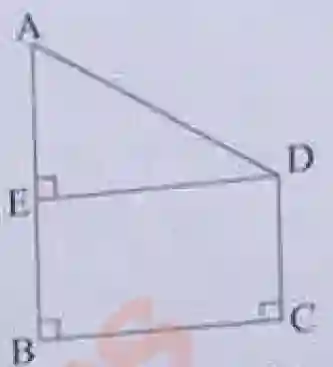
दिइएको चित्रमा स्तम्भ AB को उचाइ 24.5 मिटर र घर CD को उचाइ 4.5 मिटर छन् । BC ले स्तम्भ र घर बिचको दूरी जनाउँछ ।
In the given figure, height of the tower AB is 24.5 meter and height of a house CD is 4.5 meter. BC denotes the distance between tower and house.
-
(a) उन्नतांश कोणलाई परिभाषित गर्नुहोस् ।
Define the angle of elevation. [1]
-
(b) AE को मान पत्ता लगाउनुहोस् ।
Find the value of AE. [1]
-
(c) यदि $\angle ADE = 30^{\circ}$ भए स्तम्भ र घरबिचको दुरी पत्ता लगाउनुहोस् ।
If $\angle ADE = 30^{\circ}$ find the distance between the tower and the house. [1]
-
(d) AE र ED बराबर भएको बेलामा उन्नताश कोण कति डिग्रीले कम वा बढी हुन्छ ? तुलना गर्नुहोस् ।
By how many degrees is the angle of elevation less or more when AE and ED are equal? Compare it. [1]
Solution:
(a)
Angle of elevation is the angle formed by the line of sight with the horizontal when the object being viewed is above the horizontal level of the observer.
(उन्नतांश कोण भनेको क्षितिज रेखासँग दृष्टि रेखाले बनाउने कोण हो जब हेरिएको वस्तु दर्शकको आँखाले भन्दा माथि हुन्छ।)
(b) $$AE = AB – CD = 24.5 – 4.5 = 20 \text{ m}$$
(c)
In right triangle ADE, $\angle ADE = 30^\circ$, AE = 20 m
$$\tan 30^\circ = \frac{AE}{DE}$$
$$\frac{1}{\sqrt{3}} = \frac{20}{DE}$$
$$DE = 20\sqrt{3} \text{ m} \approx 34.64 \text{ m}$$
Distance between tower and house (BC) = DE = $20\sqrt{3}$ m
(d)
When AE = ED = 20 m:
In right triangle ADE:
$$\tan \angle ADE = \frac{AE}{ED} = \frac{20}{20} = 1$$
$$\therefore \angle ADE = 45^\circ$$
Previous angle was $30^\circ$
Increase = $45^\circ – 30^\circ = 15^\circ$
The angle of elevation increases by $15^\circ$.
Statistics & Probability – SEE 2081 Koshi Province (Q15-16)
75 पूर्णाङ्कको गणितको एउटा परीक्षामा विद्यार्थीहरूले प्राप्त गरेका अङ्क तलको तालिकामा दिइएको छ ।
The marks obtained by the students in an exam of mathematics of 75 full marks are given in the following table.
| प्राप्ताङ्क (Obtained Marks) | 0-15 | 15-30 | 30-45 | 45-60 | 60-75 |
|---|---|---|---|---|---|
| विद्यार्थी सङ्ख्या (Number of students) | 2 | 5 | 4 | 6 | 3 |
-
(a) माथिको तथ्याङ्कबाट रीत पर्ने श्रेणी उल्लेख गर्नुहोस् ।
Illustrate the modal class from the above data. [1]
-
(b) माथिको तालिकाबाट मध्यिका निकाल्नुहोस् ।
Find the median from the above table. [2]
-
(c) माथिको तालिकाबाट मध्यक पत्ता लगाउनुहोस् ।
Find the mean from the above table. [2]
-
(d) सो परीक्षामा सहभागी विद्यार्थी सङ्ख्यामध्ये रीत श्रेणी भन्दा तलको वर्गान्तरमा कति प्रतिशत विद्यार्थीहरू पर्छन् ? पत्ता लगाउनुहोस् ।
Among all the participants in the exam, what percentage of students obtained marks below the modal class? Find it. [1]
Solution:
(a) Modal class = 45-60 (highest frequency = 6)
(b)
Total students ($N$) = $2 + 5 + 4 + 6 + 3 = 20$
Median position = $\frac{N}{2} = \frac{20}{2} = 10$th term
Cumulative frequency:
0-15: 2
15-30: $2 + 5 = 7$
30-45: $7 + 4 = 11$ (10th term falls here)
$\therefore$ Median class = 30-45
Median formula:
$$M = L + \frac{\frac{N}{2} – cf}{f} \times i$$
Where:
$L$ = lower limit = 30
$cf$ = cumulative frequency before median class = 7
$f$ = frequency of median class = 4
$i$ = class interval = 15
$$M = 30 + \frac{10 – 7}{4} \times 15$$
$$= 30 + \frac{3}{4} \times 15$$
$$= 30 + 11.25 = 41.25$$
(c)
| Class | Mid-value (x) | Frequency (f) | fx |
|---|---|---|---|
| 0-15 | 7.5 | 2 | 15 |
| 15-30 | 22.5 | 5 | 112.5 |
| 30-45 | 37.5 | 4 | 150 |
| 45-60 | 52.5 | 6 | 315 |
| 60-75 | 67.5 | 3 | 202.5 |
| Total | – | 20 | 795 |
(d)
Students below modal class (45-60):
Classes: 0-15, 15-30, 30-45
Total students = $2 + 5 + 4 = 11$
Percentage:
$$= \frac{11}{20} \times 100\% = 55\%$$
एउटा बासकमा 6 ओटा सेता र 10 ओटा काला उस्तै र उत्रै बलहरू छन् । दुई ओटा बलहरू एकपछि अर्को गरी पुनः राखेर झिकिएका छन् ।
A box contains 6 white and 10 black balls of same shape and size. Two balls are drawn at random one after another with replacement.
-
(a) यदि A र B दुईओटा अनाश्रित घट्नाहरू भए सम्भाव्यताको गुणन सिद्धान्त लेख्नुहोस् ।
If A and B are two independent events, write the multiplication law of probability. [1]
-
(b) सबै सम्भावित परिणामहरूको सम्भाव्यतालाई वृक्षचित्रमा देखाउनुहोस् ।
Show the probability of all the possible outcomes in a tree diagram. [2]
-
(c) दुवै बल उही रङका पर्ने सम्भाव्यता पत्ता लगाउनुहोस् ।
Find the probability of getting both balls of same color. [1]
-
(d) दुवै बल फरक रङका पर्ने सम्भाव्यता, दुवै बल सेता रङका पर्ने सम्भाव्यता भन्दा कति कम वा बढी हुन्छ ? पत्ता लगाउनुहोस् ।
By how much the probability of getting both balls of different color is less or more than probability of getting both balls of white color? Find it. [1]
Solution:
(a) $$P(A \cap B) = P(A) \times P(B)$$
(b) Tree diagram:
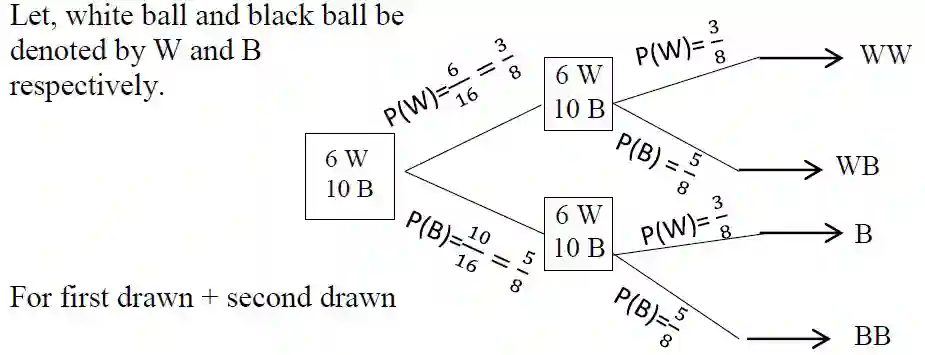
Total balls = $6 + 10 = 16$
$P(W) = \frac{6}{16} = \frac{3}{8}$
$P(B) = \frac{10}{16} = \frac{5}{8}$
With replacement, second draw has same probabilities.
(c)
Both same color means both white OR both black:
$$P(WW) = \frac{3}{8} \times \frac{3}{8} = \frac{9}{64}$$
$$P(BB) = \frac{5}{8} \times \frac{5}{8} = \frac{25}{64}$$
$$P(\text{same}) = \frac{9}{64} + \frac{25}{64} = \frac{34}{64} = \frac{17}{32}$$
(d)
Both different color means (White then Black) OR (Black then White):
$$P(WB) = \frac{3}{8} \times \frac{5}{8} = \frac{15}{64}$$
$$P(BW) = \frac{5}{8} \times \frac{3}{8} = \frac{15}{64}$$
$$P(\text{different}) = \frac{15}{64} + \frac{15}{64} = \frac{30}{64} = \frac{15}{32}$$
$$P(WW) = \frac{9}{64}$$
Difference:
$$\frac{30}{64} – \frac{9}{64} = \frac{21}{64}$$
$\therefore$ Probability of different colors is $\frac{21}{64}$ more than probability of both white.