
Compulsory Mathematics SEE 2081 Sudurpaschim Province Solution | Sudurpashchim Province | अनिवार्य गणित

Welcome to the complete solution set for Compulsory Mathematics SEE 2081 Sudurpaschim Province, Sudurpashchim Province. This post provides a detailed, step-by-step guide to solving the questions asked in the recent SEE examination. Both English medium and Nepali medium students can benefit from this comprehensive guide.
Practicing past papers like the SEE 2081 Compulsory Mathematics is crucial for understanding the exam pattern and marking scheme. Below, you will find the questions, their Nepali translations, and the official marking scheme. For more educational resources, you can also visit the Ministry of Education website.
Table of Contents: Compulsory Mathematics SEE 2081 Sudurpaschim Province
SEE 2081 Compulsory Mathematics – Part 1 (Questions 1-3)
In a survey conducted among 120 students studying in class Ten of a secondary school, it was found that 60 students liked cricket game, 55 students liked basketball game and 20 students did not like any of these games.
एउटा माध्यमिक विद्यालयको कक्षा दशमा अध्ययनरत 120 जना विद्यार्थीहरूको समूहमा सर्वेक्षण गर्दा 60 जनाले क्रिकेट खेल मन पराएको, 55 जनाले बास्केटबल खेल मन पराएको र 20 जनाले यीमध्ये कुनै पनि खेल मन नपराएको पाइयो ।
-
a) If C and B denote the sets of students who liked cricket and basketball game respectively, write the cardinality of $n(\overline{B\cup C})$. [1]
यदि C र B ले क्रमशः क्रिकेट र बास्केटबल खेल मन पराउने विद्यार्थीहरूको समूहलाई जनाउँदछ भने $n(\overline{B\cup C})$ को गणनात्मकता लेख्नुहोस् ।
-
b) Present the above information in a Venn-diagram. [1]
माथिको जानकारीलाई भेनचित्रमा प्रस्तुत गर्नुहोस् ।
-
c) Find the number of students who liked cricket game only. [3]
क्रिकेट खेल मात्र मन पराउने विद्यार्थीहरूको सङ्ख्या पत्ता लगाउनुहोस् ।
-
d) Compare the number of students who liked cricket game only and who liked basketball game only. [1]
क्रिकेट खेल मात्र मन पराउने र बास्केटबल मात्र मन पराउने विद्यार्थी सङ्ख्या बीच तुलना गर्नुहोस् ।
Solution:
a) Given: Total students $n(U) = 120$
Liked Cricket $n(C) = 60$
Liked Basketball $n(B) = 55$
Liked none $n(\overline{B \cup C}) = 20$
The cardinality of $n(\overline{B\cup C})$ is:
$$n(\overline{B\cup C}) = 20$$
b) Venn diagram representation:
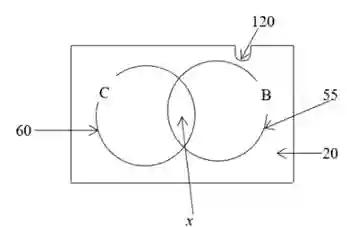
c)
We know: $n(U) = n(C \cup B) + n(\overline{C \cup B})$
$$120 = n(C \cup B) + 20$$$$\therefore n(C \cup B) = 100$$
Using formula: $n(C \cup B) = n(C) + n(B) – n(C \cap B)$
$$100 = 60 + 55 – n(C \cap B)$$$$100 = 115 – n(C \cap B)$$$$n(C \cap B) = 15$$
Number of students who liked cricket only:
$$n_0(C) = n(C) – n(C \cap B)$$$$n_0(C) = 60 – 15 = 45$$
d)
Basketball only: $n_0(B) = n(B) – n(C \cap B) = 55 – 15 = 40$
Cricket only: $n_0(C) = 45$
Comparison: $n_0(C) > n_0(B)$ by 5
The number of students who like cricket only is 5 more than those who like basketball only.
(क्रिकेट मात्र मन पराउने विद्यार्थी सङ्ख्या, बास्केटबल मात्र मन पराउने भन्दा ५ ले बढी छ ।)
Aatmik wants to deposit Rs. 4,00,000 in a bank for 2 years. The bank offers 10% per annum compound interest to Aatmik with three alternates (annual compound interest, semi-annual compound interest and quarterly compound interest).
आत्मिकले 2 वर्षका लागि रु. 4,00,000 कुनै एउटा बैङ्कमा जम्मा गर्न चाहेका छन् । बैंकले प्रतिवर्ष 10% चक्रीय व्याजदरका दरले आत्मिकलाई तीनओटा विकल्पहरू (वार्षिक चक्रीय व्याज, अर्धवार्षिक चक्रीय व्याज र त्रैमासिक चक्रीय व्याज) दिइएको छ ।
-
a) Which option among the above three alternates Aatmik has to use to get more interest? Write it. [1]
माथिका तीन विकल्पमध्ये कुन विकल्प प्रयोग गर्दा आत्मिकलाई बढी व्याज प्राप्त हुन्छ ? लेख्नुहोस् ।
-
b) How much compound interest does he receive at the end of 2 years compounded semi-annually? Find it. [2]
उनले 2 वर्षको अन्त्यमा अर्धवार्षिक चक्रीय व्याजअनुसार कति चक्रीय व्याज प्राप्त गर्न सक्छन् ? पत्ता लगाउनुहोस् ।
-
c) Is semi-annual compound interest received by Aatmik in 2 years double than the quarterly compound interest received in 1 year? Justify with calculation. [2]
के आत्मिकले 2 वर्षमा प्राप्त गरेको अर्धवार्षिक चक्रीय व्याज 1 वर्षमा प्राप्त गर्ने त्रैमासिक चक्रीय व्याजको दोब्बर हुन्छ ? गणना गरी पुष्टि गर्नुहोस् ।
Solution:
a) Quarterly Compound Interest yields more interest. (त्रैमासिक चक्रीय व्याज अनुसार बढी व्याज प्राप्त हुन्छ ।)
b)
Principal ($P$) = Rs. 4,00,000
Time ($T$) = 2 years
Rate ($R$) = 10% p.a.
For Semi-annual Compound Interest:
$$C.I = P \left[ \left(1 + \frac{R}{200}\right)^{2T} – 1 \right]$$$$C.I = 4,00,000 \left[ \left(1 + \frac{10}{200}\right)^{4} – 1 \right]$$$$C.I = 4,00,000 \left[ (1.05)^4 – 1 \right]$$$$C.I = 4,00,000 \times 0.21550625$$$$C.I = \text{Rs. } 86,202.50$$
c)
Calculating Quarterly C.I. for 1 year:
$$C.I_{qt} = P \left[ \left(1 + \frac{R}{400}\right)^{4T} – 1 \right]$$$$C.I_{qt} = 4,00,000 \left[ \left(1 + \frac{10}{400}\right)^{4 \times 1} – 1 \right]$$$$C.I_{qt} = 4,00,000 \left[ (1.025)^4 – 1 \right]$$$$C.I_{qt} \approx \text{Rs. } 41,525.16$$
Comparison: Double of Quarterly C.I. = $2 \times 41,525.16 = \text{Rs. } 83,050.32$
Since Rs. 86,202.50 $\neq$ Rs. 83,050.32
Conclusion: No, the semi-annual C.I. in 2 years is not exactly double the quarterly C.I. in 1 year.
(होइन, २ वर्षको अर्धवार्षिक चक्रीय व्याज १ वर्षको त्रैमासिक चक्रीय व्याजको दोब्बर हुँदैन ।)
A photocopy machine is purchased for Rs. 80,000. After using it for 2 years, only Rs. 30,000 is earned. The price of machine depreciates annually at the rate of 20% and the machine is sold after 2 years.
एउटा फोटोकपी मेसिन रु. 80,000 मा खरिद गरियो । उक्त मेसिनको प्रयोगबाट 2 वर्षमा रु. 30,000 मात्र आम्दानी भयो । मेसिनको मूल्यमा प्रतिवर्ष 20% का दरले ह्रास आउँछ र 2 वर्षपछि उक्त मेसिन बिक्री गरियो ।
-
a) The initial price of a machine is $V_{0}$, annual rate of compound depreciation is R and the price of machine after T years is $V_{T}$, express $V_{T}$ in terms of $V_{0}$, R and T. [1]
मेसिनको सुरुको मूल्य $V_{0}$, वार्षिक मिश्रह्रासदर R र T वर्षपछिको मेसिनको मूल्य $V_{T}$ भए $V_{T}$ लाई $V_{0}$, R र T को रूपमा व्यक्त गर्नुहोस् ।
-
b) Find the total profit or loss amount on selling the machine. [2]
उक्त मेसिन बिक्री गर्दा भएको कुल नाफा वा नोक्सान रकम पत्ता लगाउनुहोस् ।
-
c) If he had sold the machine after using it one year more, then by how much the selling price is less or more than the purchased price? Compare it. [1]
यदि उनले सो मेसिन थप 1 वर्ष प्रयोग गरी बेचेको भए बिक्री मूल्य खरिद मूल्यभन्दा कतिले कमी वा बढी हुन्थ्यो ? तुलना गर्नुहोस् ।
Solution:
a) $$V_T = V_0 \left(1 – \frac{R}{100}\right)^T$$
b)
Initial Cost ($V_0$) = Rs. 80,000
Rate ($R$) = 20%
Time ($T$) = 2 years
Income earned = Rs. 30,000
Selling Price after 2 years ($V_T$):
$$SP = 80,000 \left(1 – \frac{20}{100}\right)^2$$$$SP = 80,000 \times (0.8)^2 = 80,000 \times 0.64 = \text{Rs. } 51,200$$
Total amount recovered = Selling Price + Income Earned
Total = $51,200 + 30,000 = \text{Rs. } 81,200$
Profit ($Gain$) = Total Recovered – Initial Cost
Profit = $81,200 – 80,000 = \text{Rs. } 1,200$
c)
Price after 3 years (T=3):
$$SP = 80,000 \left(1 – \frac{20}{100}\right)^3$$$$SP = 80,000 \times (0.8)^3 = 80,000 \times 0.512 = \text{Rs. } 40,960$$
Comparison with Purchase Price ($CP$):
Difference = $CP – SP = 80,000 – 40,960 = \text{Rs. } 39,040$
The selling price would be Rs. 39,040 less than the purchased price.
(बिक्री मूल्य खरिद मूल्यभन्दा रु. ३९,०४० ले कम हुन्छ ।)
Financial Math & Depreciation – SEE 2081
A businessman exchanged Australian dollars with NRs. 1,29,090 at the exchange rate of Australian dollar 1 = NRs. 86.06. After some days, Nepali currency was revaluated up by 2% in comparison to Australian dollar and on that day he exchanged the Australian dollars into Nepali currency again.
एक जना व्यापारीले अष्ट्रेलियन डलर 1 = ने.रु. 86.06 को दरले ने.रु. 1,29,090 सँग अष्ट्रेलियन डलर साटेछन् । केही दिनपछि अस्ट्रेलियन डलरको तुलनामा नेपाली मुद्रा 2% ले अधिमूल्यन भएछ र उक्त दिनमा उनले आफूसँग भएको अस्ट्रेलियन डलर पुनः नेपाली मुद्रामा साटेछन् ।
-
a) How many Australian dollars did the businessman exchange? Find it. [1]
उक्त व्यापारीले कति अस्ट्रेलियन डलर साटेछन् ? पत्ता लगाउनुहोस् ।
-
b) How many Nepali rupees did the businessman receive when he exchanged Australian dollar after revaluation in Nepali currency? Find it. [2]
नेपाली मुद्रामा भएको अधिमूल्यनपछि अस्ट्रेलियन डलर साट्दा व्यापारीले कति नेपाली रुपैयाँ प्राप्त गरेछन् ? पत्ता लगाउनुहोस् ।
-
c) What profit or loss percent did the businessman make in that transaction? Find it. [1]
उक्त कारोबारमा व्यापारीलाई कति प्रतिशत नाफा वा नोक्सान भएछ ? पत्ता लगाउनुहोस् ।
Solution:
a)
Exchanged Amount = $\frac{\text{Total NRs}}{\text{Rate}}$
$$= \frac{1,29,090}{86.06}$$$$= 1500 \text{ Australian Dollars}$$
b)
Revaluation of Nepali currency by 2% means the exchange rate decreases by 2%.
New Rate = $86.06 \times (1 – \frac{2}{100}) = 86.06 \times 0.98 = \text{Rs. } 84.3388$
Amount received for AUD 1500:
$$= 1500 \times 84.3388$$$$= \text{Rs. } 1,26,508.20$$
c)
Initial NRs = 1,29,090
Final NRs = 1,26,508.20
Loss Amount = $1,29,090 – 1,26,508.20 = \text{Rs. } 2,581.80$
$$\text{Loss \%} = \frac{\text{Loss}}{\text{Initial Amount}} \times 100\%$$$$\text{Loss \%} = \frac{2,581.80}{1,29,090} \times 100\% = 2\%$$
The vertical height of the square based pyramid is 24 cm and the length of one side of base is 20 cm.
वर्ग आधार भएको पिरामिडको ठाडो उचाइ 24 से.मि. र आधार भुजाको लम्बाइ 20 से.मि. छ ।
-
a) Write the formula to find the volume of the pyramid. [1]
पिरामिडको आयतन पत्ता लगाउने सुत्र लेख्नुहोस् ।
-
b) Find the total surface area of the pyramid. [2]
सो पिरामिडको पुरा सतहको क्षेत्रफल पत्ता लगाउनुहोस् ।
Solution:
a) $$V = \frac{1}{3}a^2h$$ (Where $a$ is base side length and $h$ is vertical height)
b)
Here, $h = 24 \text{ cm}$, $a = 20 \text{ cm}$.
First, find Slant Height ($l$):
$$l = \sqrt{h^2 + \left(\frac{a}{2}\right)^2} = \sqrt{24^2 + 10^2} = \sqrt{576 + 100} = \sqrt{676} = 26 \text{ cm}$$
Total Surface Area (TSA):
$$TSA = a^2 + 2al$$$$TSA = (20)^2 + 2 \times 20 \times 26$$$$TSA = 400 + 1040$$$$TSA = 1440 \text{ cm}^2$$
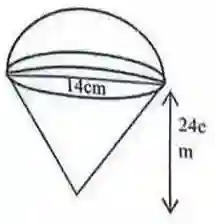
In the figure, a metallic solid made of hemisphere and cone is given, where the height of cone is 24 cm and diameter of base is 14 cm.
चित्रमा, अर्धगोला र सोली मिलेर बनेको धातुको एउटा ठोस वस्तु दिइएको छ, जहाँ सोलीको उचाइ 24 से.मि. र आधारको व्यास 14 से.मि. छ ।
-
a) Write the formula to find the slant height of cone when vertical height and radius of base are given. [1]
सोलीको उचाइ र आधारको अर्धव्यास दिइएको अवस्थामा छड्के उचाइ पत्ता लगाउने सुत्र लेख्नुहोस् ।
-
b) Find the volume of the solid object. [2]
उक्त ठोस वस्तुको आयतन पत्ता लगाउनुहोस् ।
-
c) If the solid object is melted and turned into a cylindrical object of radius 7 cm, what is the height of cylinder? Calculate it. [2]
उक्त ठोस वस्तुलाई पगालेर 7 से.मि. अर्धव्यास भएको बेलनाकार वस्तुमा परिणत गरियो भने उक्त बेलनाको उचाइ कति हुन्छ ? गणना गर्नुहोस् ।
Solution:
a) $$l = \sqrt{h^2 + r^2}$$
b)
Radius ($r$) = $14/2 = 7 \text{ cm}$.
Height of cone ($h$) = 24 cm.
Total Volume = Volume of Cone + Volume of Hemisphere
$$V = \frac{1}{3}\pi r^2 h + \frac{2}{3}\pi r^3$$$$V = \frac{1}{3} \times \frac{22}{7} \times 7^2 \times 24 + \frac{2}{3} \times \frac{22}{7} \times 7^3$$$$V = 1232 + 718.67$$$$V \approx 1950.67 \text{ cm}^3$$
(Using alternative calculation: $\frac{1}{3}\pi r^2(h + 2r) = \frac{1}{3} \times \frac{22}{7} \times 49 (24 + 14) = 1950.67$)
c)
Volume of Cylinder = Volume of Solid
$$\pi R^2 H = 1950.67$$$$\frac{22}{7} \times 7^2 \times H = 1950.67$$$$154 \times H = 1950.67$$$$H = 12.67 \text{ cm}$$
$\therefore$ Height of the cylinder is 12.67 cm.
Mensuration & Algebra – SEE 2081 Math
The volume and height of a square based room are 75 cubic meter and 3 meter respectively. The area occupied by a door and two windows in the room is 6 square meter.
एउटा वर्गाकार आधार भएको कोठाको आयतन र उचाइ क्रमशः 75 घनमिटर र 3 मिटर छन् । उक्त कोठामा एउटा ढोका र दुईओटा झ्यालहरूले ओगटेको क्षेत्रफल 6 वर्गमिटर छ ।
-
a) What is the total cost of plastering the four walls without door and windows at the rate of Rs. 200 per square meter? Find it. [3]
प्रति वर्गमिटर रु. 200 का दरले झ्याल, ढोका बाहेक चार भित्तामा प्लास्टर गर्दा जम्मा कति खर्च लाग्छ ? पत्ता लगाउनुहोस् ।
-
b) If the rate of plastering per square meter is increased by one-fourth, then what will be the increment in the total cost of plastering the walls? Find it. [1]
यदि प्रतिवर्गमिटर प्लास्टर गर्ने दर एक चौथाइले बढ्यो भने भित्ताहरूमा प्लास्टर गर्न जम्मा खर्च कतिले वृद्धि हुन्छ ? पत्ता लगाउनुहोस् ।
-
c) What length of carpet having its width 2 meters should be purchased from the market for carpeting the room? Find it. [1]
सो कोठाको भुँइमा 2 मिटर चौडाइ भएको कार्पेट विछ्याउन कति लम्बाइ भएको कार्पेट बजारबाट किनेर ल्याउनुपर्ला ? पत्ता लगाउनुहोस् ।
Solution:
a)
Volume ($V$) = 75 $m^3$, Height ($h$) = 3 m.
Base Area ($A$) = $V/h = 75/3 = 25 \text{ m}^2$.
Since base is square ($l^2 = 25$), length ($l$) = 5 m.
Area of 4 walls = $2h(l + l) = 4lh = 4 \times 5 \times 3 = 60 \text{ m}^2$.
Area of door/windows = 6 $m^2$.
Plastering Area = $60 – 6 = 54 \text{ m}^2$.
Total Cost = Rate $\times$ Area
$$= 200 \times 54 = \text{Rs. } 10,800$$
b)
New Rate = $200 + \frac{1}{4} \times 200 = 200 + 50 = \text{Rs. } 250$.
New Cost = $250 \times 54 = \text{Rs. } 13,500$.
Increment = $13,500 – 10,800 = \text{Rs. } 2,700$.
c)
Area of floor = $l \times l = 5 \times 5 = 25 \text{ m}^2$.
Area of Carpet = Length $\times$ Width
$$25 = L \times 2$$$$L = 12.5 \text{ m}$$
Required length is 12.5 meters.
Hira collected following sum of money in the first 5 days of month Baishakh: Rs. 10, Rs. 20, Rs. 40, Rs. 80, Rs. 160.
हिराले बैशाख महिनाको पहिलो 5 दिनसम्म निम्नानुसार रकम सङ्कलन गरिन् : रु. 10, रु. 20, रु. 40, रु. 80, रु. 160।
-
a) What is the mean value of the amounts collected on 2nd Baisakh and $4^{th}$ Baisakh? Write it. [1]
वैशाख 2 गते र बैशाख 4 गते सङ्कलन गरेको रकमको मध्यमान कति छ ? लेख्नुहोस् ।
-
b) How much money will be collected by $10^{th}$ days? Find using formula. [2]
यही अनुपातमा सङ्कलन गर्दै जाँदा 10 औं दिनसम्म कति रकम जम्मा हुन्छ ? सुत्र प्रयोग गरी पत्ता लगाउनुहोस् ।
-
c) Up to how many days of Baisakh can Rs. 1,63,830 be collected? Find it. [2]
बैशाखको कतिऔं दिनसम्म रु. 1,63,830 सङ्कलन गर्न सकिन्छ ? पत्ता लगाउनुहोस् ।
Solution:
a)
Day 2 amount = 20. Day 4 amount = 80.
This is a Geometric Sequence ($a=10, r=2$).
The term between 20 and 80 (Day 3) is the Geometric Mean.
Mean Value = $\sqrt{20 \times 80} = \sqrt{1600} = 40$.
Answer: Rs. 40.
b)
This is a Geometric Progression with $a=10, r=2$.
Sum of first 10 terms ($S_{10}$):
$$S_{10} = \frac{a(r^n – 1)}{r – 1}$$$$S_{10} = \frac{10(2^{10} – 1)}{2 – 1}$$$$S_{10} = 10(1024 – 1)$$$$S_{10} = 10 \times 1023 = \text{Rs. } 10,230$$
c)
Here, $S_n = 1,63,830$.
$$1,63,830 = \frac{10(2^n – 1)}{2 – 1}$$$$16383 = 2^n – 1$$$$2^n = 16384$$$$2^n = 2^{14}$$$$n = 14$$
Answer: 14 days (14 औं दिनसम्म).
The length of rectangular field is twice of its breadth and its area is 200 square meter.
एउटा आयताकार खेतको लम्बाइ चौडाइको दोब्बर छ र खेतको क्षेत्रफल 200 वर्गमिटर छ ।
-
a) Write the standard form of quadratic equation. [1]
वर्ग समीकरणको स्तरीय रूप लेख्नुहोस् ।
-
b) Find the length and breadth of the rectangular field. [2]
उक्त आयताकार खेतको लम्बाइ र चौडाइ पत्ता लगाउनुहोस् ।
-
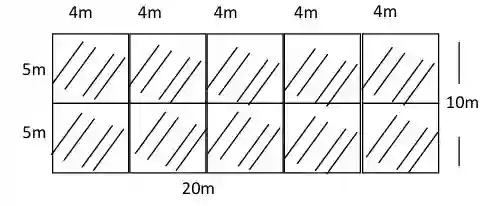
c) How many maximum numbers of pieces having the size $5m \times 4m$ can be prepared in that rectangular field? Also present it in diagram. [2]
उक्त आयताकार खेतमा 5 मि $\times$ 4 मि का बढीमा कति ओटा टुक्राहरू तयार गर्न सकिएला ? चित्रात्मक रुपमा समेत प्रस्तुत गर्नुहोस् ।
Solution:
a) $$ax^2 + bx + c = 0 \text{ where } a \neq 0$$
b)
Let breadth ($b$) = $x$. Then length ($l$) = $2x$.
Area = $l \times b = 200$
$$2x \times x = 200$$$$2x^2 = 200$$$$x^2 = 100 \implies x = 10$$
Breadth = 10 m, Length = 20 m.
c)
Area of one piece = $5 \times 4 = 20 \text{ m}^2$.
Total Area = $200 \text{ m}^2$.
Number of pieces = $200 / 20 = 10$.
Diagram:
Algebra & Geometry – SEE 2081
a) Simplify: $$\frac{1}{x-y} – \frac{1}{x+y}$$
(सरल गर्नुहोस्)
b) If $x^{2} = 3^{\frac{2}{3}} + 3^{\frac{-2}{3}} – 2$ prove that: $$3x^{3} + 9x = 8$$
(प्रमाणित गर्नुहोस्)
Solution:
a) $$\frac{1}{x-y} – \frac{1}{x+y}$$$$= \frac{(x+y) – (x-y)}{(x-y)(x+y)}$$$$= \frac{x+y-x+y}{x^2-y^2}$$$$= \frac{2y}{x^2-y^2}$$
b)
Given, $x^2 = (3^{1/3})^2 – 2(3^{1/3})(3^{-1/3}) + (3^{-1/3})^2$
$= (3^{1/3} – 3^{-1/3})^2$
Taking square root: $x = 3^{1/3} – 3^{-1/3}$
Cubing both sides:
$$x^3 = (3^{1/3})^3 – (3^{-1/3})^3 – 3(3^{1/3})(3^{-1/3})(3^{1/3} – 3^{-1/3})$$$$x^3 = 3 – \frac{1}{3} – 3(1)(x)$$$$x^3 = \frac{9-1}{3} – 3x$$$$3x^3 = 8 – 9x$$$$3x^3 + 9x = 8 \text{ Proved.}$$
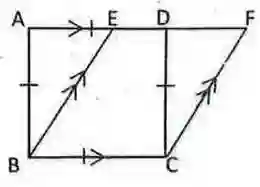
In the given figure, parallelogram EBCF and square ABCD are on the same base BC and between the same parallel lines AF and BC.
दिइएको चित्रमा एउटै आधार BC र उही समानान्तर रेखाहरू AF र BC बीच समानान्तर चतुर्भुज EBCF र वर्ग ABCD छन् ।
-
a) Write the relation between the areas of parallelograms standing on the same base and between same parallel lines. [1]
एउटै आधार र उही समानान्तर रेखाहरूबिचका समानान्तर चतुर्भुजहरुको क्षेत्रफलबिचको सम्बन्ध लेख्नुहोस् ।
-
b) Prove that: Area of parallelogram EBCF = Area of square ABCD. [2]
प्रमाणित गर्नुहोस्: स.च. EBCF को क्षेत्रफल = वर्ग ABCD को क्षेत्रफल ।
-
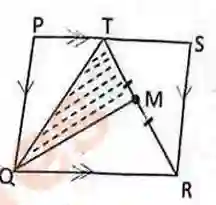
c) In the given figure PQRS is a parallelogram and M is the mid-point of TR. Prove that:
$$\Delta TQM = \frac{1}{2}(\Delta PQT + \Delta SRT)$$
[2]
दिइएको चित्रमा PQRS एउटा समानान्तर चतुर्भुज हो र TR को मध्यविन्दु M छ । प्रमाणित गर्नुहोस्: $\Delta TQM = \frac{1}{2}(\Delta PQT + \Delta SRT)$
Solution:
a) They are equal in area. (तिनीहरूको क्षेत्रफल बराबर हुन्छ ।)
b)
We know that area of a parallelogram is Base $\times$ Height.
Area of EBCF = Base $BC \times$ Height $AB$ (since AB is perpendicular to BC in square ABCD).
Area of Square ABCD = Base $BC \times$ Height $AB$.
Therefore, Area of EBCF = Area of Square ABCD.
c)
Proof steps:
1. $\Delta PQT + \Delta SRT = \Delta TQR$ (Area of triangles on same base QR and between parallels is half of parallelogram? No. Here T is a point. $\Delta TQR = \frac{1}{2} \Box PQRS$). Also $\Delta PQT + \Delta SRT$ makes up the rest of the parallelogram if T is on PS? (Assumption based on key: $\Delta PQT + \Delta SRT = \Delta TQR$).
2. In $\Delta TQR$, M is mid-point of TR. So QM is the median.
3. Median divides triangle into equal areas. $\Delta TQM = \frac{1}{2} \Delta TQR$.
4. From 1 and 3, $\Delta TQM = \frac{1}{2} (\Delta PQT + \Delta SRT)$.
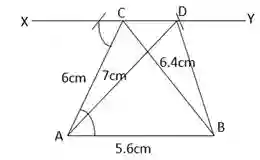
a) Construct a triangle ABC having $BC = 6.4 \text{ cm}$, $AB = 5.6 \text{ cm}$ and $AC = 6 \text{ cm}$. Also construct a triangle DAB having one side 7 cm equal in area to $\Delta ABC$.
$BC = 6.4$ से.मि., $AB = 5.6$ से.मि. र $AC = 6$ से.मि. भएको एउटा त्रिभुज ABC को रचना गर्नुहोस् । साथै उक्त $\Delta ABC$ को क्षेत्रफलसँग बराबर हुने गरी एउटा भुजा 7 से.मि. भएको त्रिभुज DAB को पनि रचना गर्नुहोस् ।
b) Why the area of $\Delta ABC$ and $\Delta DAB$ are equal? Give reason.
$\Delta ABC$ र $\Delta DAB$ को क्षेत्रफल किन बराबर भए ? कारण दिनुहोस् ।
Solution:
a) Construction diagram:
b)
Because they stand on the same base (AB) and lie between the same parallel lines.
(किनभने तिनीहरू एउटै आधार र उही समानान्तर रेखाहरू बीच रहेका छन् ।)
Geometry & Statistics – SEE 2081
Central angle AOB and inscribed angles ADB and ACB are standing on the same arc AB in a circle with center O.
केन्द्रविन्दु O भएको वृत्तमा केन्द्रीय कोण AOB र परिधिका कोणहरू ADB र ACB एउटै चाप AB मा आधारित छन् ।
-
a) Write the relation between the inscribed angles standing on the same arc. [1]
एउटै चापमा आधारित परिधिका कोणहरू बिचको सम्बन्ध लेख्नुहोस् ।
-
b) Experimentally verify that, the central angle AOB is double of the inscribed angle ACB. (Two circles with radii at least 3 cm are necessary.) [2]
केन्द्रीय कोण AOB, परिधिको कोण ACB को दोब्बर हुन्छ भनी प्रयोगात्मक रूपबाट पुष्टि गर्नुहोस् । (कम्तीमा 3 cm अर्धव्यास भएका दुईओटा वृत्तहरू आवश्यक छन् ।)
-
c) The measure of central angle is $(5x)^{\circ}$ and the measure of inscribed angle is $(2x+10)^{\circ}$ standing on the same arc in a circle, find the value of x. [1]
वृत्तको एउटै चापमा आधारित केन्द्रीय कोणको नाप $(5x)^{\circ}$ र परिधि कोणको नाप $(2x+10)^{\circ}$ भए x को मान पत्ता लगाउनुहोस् ।
Solution:
a) They are equal. (तिनीहरू बराबर हुन्छन् ।)
b) (Experimental Verification: Draw two circles with radius $\ge 3cm$. Draw arc AB, center O, and point C on circumference. Measure $\angle AOB$ and $\angle ACB$. Result will show $\angle AOB = 2 \angle ACB$.)
c)
We know, Central Angle = $2 \times$ Inscribed Angle
$$5x = 2(2x + 10)$$$$5x = 4x + 20$$$$x = 20$$
Answer: $x = 20$.
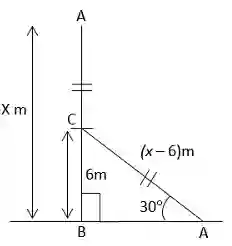
A tree x meter high is broken by the wind, at the height 6 meter from the ground so that its top touches the ground and makes an angle $30^{\circ}$ with the ground.
एउटा x मिटर अग्लो रूख जमिनदेखि 6 मिटरको उचाइमा हावाले भाँचिएर टुप्पोले जमिनमा छुँदा जमिनसँग $30^{\circ}$ को कोण बनाएको छ ।
-
a) What is called the angle of elevation? Write it. [1]
उन्नतांश कोण भनेको के हो ? लेख्नुहोस् ।
-
b) Express the length of broken part of the tree in terms of x. [1]
रुखको भाँचिएको भागको लम्बाइ x को रूपमा व्यक्त गर्नुहोस् ।
-
c) What was the height of the tree before broken? Find it. [1]
भाँचिनुभन्दा पहिलो रुखको उचाइ कति थियो ? पत्ता लगाउनुहोस् ।
-
d) At what height should the tree be broken so that its top makes an angle of $45^{\circ}$ with ground? Find it. [1]
कति उचाइमा भाँचिएको भए उक्त रुखको टुप्पोले जमिनसँग $45^{\circ}$ को कोण बनाउँथ्यो ? पत्ता लगाउनुहोस् ।
Solution:
a)
Angle formed by the line of sight with the horizontal line when viewing an object above the observer’s eye level.
(दर्शकले आफूभन्दा माथि रहेको वस्तुलाई हेर्दा दृष्टि रेखाले क्षितिज रेखासँग बनाएको कोणलाई उन्नतांश कोण भनिन्छ ।)
b)
Diagram:
c)
In the right-angled triangle formed:
Perpendicular ($p$) = 6 m
Hypotenuse ($h$) = Broken part = $(x – 6)$ m
Angle = $30^{\circ}$
$$\sin 30^{\circ} = \frac{p}{h}$$$$\frac{1}{2} = \frac{6}{x – 6}$$$$x – 6 = 12$$$$x = 18$$
Height of tree = 18 m.
d)
Total height = 18 m.
Let it break at height $h$.
Perpendicular = $h$.
Hypotenuse (Broken part) = $18 – h$.
Angle = $45^{\circ}$.
$$\sin 45^{\circ} = \frac{h}{18 – h}$$$$\frac{1}{\sqrt{2}} = \frac{h}{18 – h}$$$$18 – h = \sqrt{2}h$$$$18 = h(\sqrt{2} + 1)$$$$h = \frac{18}{2.414} \approx 7.46 \text{ m}$$
The first quartile of the given data is 35.
दिइएको तथ्याङ्कको पहिलो चतुर्थांश 35 छ ।
| Marks | 0-20 | 20-40 | 40-60 | 60-80 | 80-100 |
|---|---|---|---|---|---|
| No. of Students | 2 | X | 8 | 5 | 1 |
-
a) Illustrate the class where the first quartile lies. [1]
पहिलो चतुर्थांश पर्ने श्रेणी उल्लेख गर्नुहोस् ।
-
b) Find the value of x. [2]
x को मान पत्ता लगाउनुहोस् ।
-
c) Find the mode from the given data. [2]
दिइएको तथ्याङ्कबाट रीत पत्ता लगाउनुहोस् ।
-
d) Find the ratio of students who are above and below the first quartile class. [1]
पहिलो चतुर्थांश पर्ने श्रेणी भन्दा माथि र तल भएका विद्यार्थीहरूको सङ्ख्या अनुपातमा पत्ता लगाउनुहोस् ।
Solution:
a)
Since $Q_1 = 35$, which lies between 20 and 40.
$Q_1$ Class is 20-40.
b)
$N = 2 + X + 8 + 5 + 1 = 16 + X$
$cf$ of preceding class = 2.
$f$ of class = $X$.
$i$ = 20.
$L$ = 20.
$$Q_1 = L + \frac{\frac{N}{4} – cf}{f} \times i$$$$35 = 20 + \frac{\frac{16+X}{4} – 2}{X} \times 20$$$$15 = \frac{16+X-8}{4X} \times 20$$$$15 = \frac{8+X}{X} \times 5$$$$3X = 8 + X \implies 2X = 8 \implies X = 4$$
c)
Max frequency is 8 (Class 40-60).
Mode Class = 40-60.
$L=40, f_1=8, f_0=X=4, f_2=5, i=20$.
$$Mode = L + \frac{f_1 – f_0}{2f_1 – f_0 – f_2} \times i$$$$Mode = 40 + \frac{8 – 4}{16 – 4 – 5} \times 20$$$$Mode = 40 + \frac{4}{7} \times 20$$$$Mode = 40 + 11.43 = 51.43$$
d)
Students below Q1 class (0-20) = 2.
Students above Q1 class (40-60, 60-80, 80-100) = $8 + 5 + 1 = 14$.
Ratio (Above : Below) = $14 : 2 = 7 : 1$.
Probability – SEE 2081
A married couple has given birth of two children in the interval of five years.
एक दम्पतिबाट पाँच वर्षको अन्तरालमा दुईजना बच्चाहरू जन्मिएका छन् ।
-
a) Define independent events. [1]
अनाश्रित घट्नालाई परिभाषित गर्नुहोस् ।
-
b) Show all the possible outcomes in a tree diagram. [2]
सम्भावित सबै परिणामहरूलाई वृक्षचित्रमा देखाउनुहोस् ।
-
c) Find the probability of having both daughters. [1]
दुबै बच्चा छोरी नै हुने सम्भाव्यता पत्ता लगाउनुहोस् ।
-
d) By how much the probability of getting both children son is less or more than the maximum probability? Calculate it. [1]
दुवै बच्चा छोरा नै हुने सम्भाव्यता अधिकतम सम्भाव्यता भन्दा कतिले कम वा बढी होला ? गणना गर्नुहोस् ।
Solution:
a)
Two events are said to be independent if the occurrence of one event does not affect the probability of the occurrence of the other.
(यदि एउटा घटना घट्दा अर्को घटनालाई कुनै असर पर्दैन भने तिनीहरूलाई अनाश्रित घटना भनिन्छ ।)
b) Tree diagram:
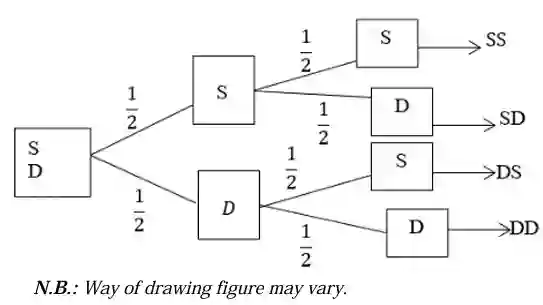
c) $P(DD) = P(D) \times P(D) = \frac{1}{2} \times \frac{1}{2} = \frac{1}{4}$
d)
Max probability (Total Probability) = 1.
Probability of both sons $P(SS) = 1/4$.
Difference = $1 – 1/4 = 3/4$.
It is less by $3/4$.
(यो अधिकतम सम्भाव्यता भन्दा ३/४ ले कम छ ।)