
SEE 2081 Karnali Province Compulsory Mathematics Solution | अनिवार्य गणित

Welcome to the complete solution set for Compulsory Mathematics SEE 2081 Karnali Province. This post provides a detailed, step-by-step guide to solving the questions asked in the recent SEE examination. Both English medium and Nepali medium students can benefit from this comprehensive guide.
Practicing past papers like the SEE 2081 Compulsory Mathematics is crucial for understanding the exam pattern and marking scheme. Below, you will find the questions, their Nepali translations, and the official marking scheme. For more educational resources, you can also visit the Ministry of Education website.
Table of Contents: SEE 2081 Karnali Province Math
- Question 1: Sets (समूह)
- Question 2: Compound Interest (चक्रीय व्याज)
- Question 3: Population Growth (जनसङ्ख्या वृद्धि)
- Question 4: Currency Exchange (मुद्रा विनिमय)
- Question 5: Pyramid (पिरामिड)
- Question 6: Combined Solid (संयुक्त ठोस)
- Question 7: Tank Problem (ट्याङ्की समस्या)
- Question 8: Geometric Sequence (गुणोत्तर अनुक्रम)
- Question 9: Quadratic Equation (वर्ग समीकरण)
- Question 10: Algebra (बीजगणित)
- Question 11: Triangle Area (त्रिभुज क्षेत्रफल)
- Question 12: Construction (रचना)
- Question 13: Circle Geometry (वृत्त ज्यामिति)
- Question 14: Height & Distance (उचाइ र दूरी)
- Question 15: Statistics (तथ्याङ्क)
- Question 16: Probability (सम्भाव्यता)
Question 1: Sets (समूह) – [6 Marks]
Out of 100 students of class ten of a school, 60 liked English and 50 liked mathematics. But 20 did not like any of these two subjects. The sets of students who liked English and Mathematics are denoted by ‘E’ and ‘M’ respectively.
एउटा विद्यालयको कक्षा दशका 100 जना विद्यार्थीमध्ये 60 जनाले अङ्ग्रेजी र 50 जनाले गणित मन पराएछन् । तर 20 जनाले यी दुईमध्ये कुनै पनि विषय मन पराएनन् । अङ्ग्रेजी मन पराउने र गणित मन पराउने विद्यार्थीहरूको समूहलाई क्रमशः ‘E’ र ‘M’ ले जनाइएका छन् ।
-
a) Write the set of the students who did not like any of these two subjects in the cardinality notation. [1]
दुईमध्ये कुनै पनि विषय मन नपराउने विद्यार्थीहरूको समूहलाई गणनात्मकता सङ्केतमा लेख्नुहोस् ।
-
b) Present the given information in a Venn-diagram assuming $x$ for the number of students who liked both subjects. [1]
दुवै विषय मन पराउने विद्यार्थी सङ्ख्यालाई $x$ मानी दिइएको जानकारीलाई भेन चित्रमा प्रस्तुत गर्नुहोस् ।
-
c) Find the number of students who liked exactly one subject. [3]
एउटा मात्र विषय मन पराउने विद्यार्थीहरूको सङ्ख्या पत्ता लगाउनुहोस् ।
-
d) If 30 students did not like any of these two subjects, what will be the effect in the number of students who liked both subjects? Find it. [1]
यदि दुईमध्ये कुनै पनि विषय मन नपराउने विद्यार्थीको सङ्ख्या 30 भएको अवस्थामा दुवै विषय मन पराउने विद्यार्थी सङ्ख्यामा के असर पर्छ ? पत्ता लगाउनुहोस् ।
Solution / समाधान:
a) The set of students who did not like any of these two subjects in cardinality notation:
$$n(\overline{E \cup M}) = 20$$
b) Venn diagram representation:

c)
Here, $n(U) = 100$, $n(E) = 60$, $n(M) = 50$, $n(\overline{E \cup M}) = 20$
Let $n(E \cap M) = x$
From Venn diagram:
$$n(U) = n(E) + n(M) – n(E \cap M) + n(\overline{E \cup M})$$$$100 = 60 + 50 – x + 20$$$$100 = 130 – x$$$$x = 30$$
Number of students who liked both subjects $n(E \cap M) = 30$.
Number of students who liked exactly one subject:
$$n_0(E) + n_0(M) = (60 – x) + (50 – x)$$$$= (60 – 30) + (50 – 30)$$$$= 30 + 20$$$$= 50$$
d)
New condition: $n(\overline{E \cup M}) = 30$
$$100 = 60 + 50 – x_{new} + 30$$$$100 = 140 – x_{new}$$$$x_{new} = 40$$
Previously $x = 30$, now $x = 40$.
Conclusion: $n(E \cap M)$ is increased by 10.
(पहिले $x = 30$ थियो, अहिले $x = 40$ भयो । निष्कर्ष: दुवै विषय मन पराउने विद्यार्थी सङ्ख्या १० ले बढ्छ ।)
Question 2: Compound Interest (चक्रीय व्याज) – [5 Marks]
Aashlal deposited Rs. 1,00,000 in a bank. The bank provides 8% per annum interest compounded semi-annually.
आशलालले रु. 1,00,000 एउटा बैड्कमा जम्मा गरेछन् । बैङ्कले बार्षिक 8% व्याज दरमा अर्धवार्षिक चक्रिय व्याज दिन्छ ।
-
a) Write the formula to calculate annual compound interest. [1]
वार्षिक चक्रीय व्याज निकाल्ने सूत्र लेख्नुहोस् ।
-
b) How much interest does Aashlal receive in 2 years? Find it. [2]
2 वर्षमा आशलालले कति व्याज प्राप्त गर्न सक्छन् ? पत्ता लगाउनुहोस् ।
-
c) If the bank provides yearly compound interest for the same rate and same period of time, how much would be the profit or loss for him? Find it. [2]
यदि बैङ्कले सोही व्याजदर र अवधिमा वार्षिक चक्रीय व्याज दिएको भए उनलाई कति फाइदा वा घाटा हुने थियो ? पत्ता लगाउनुहोस् ।
Solution / समाधान:
a) Annual Compound Interest formula:
$$C.I. = P\left[\left(1 + \frac{R}{100}\right)^T – 1\right]$$
b)
Principal $(P) = Rs. 1,00,000$
Time $(T) = 2$ years
Rate $(R) = 8\%$ p.a.
Semi-annual Compound Interest:
$$C.I. = P\left[\left(1 + \frac{R}{200}\right)^{2T} – 1\right]$$$$= 1,00,000 \left[\left(1 + \frac{8}{200}\right)^{2 \times 2} – 1\right]$$$$= 1,00,000 \left[(1.04)^4 – 1\right]$$$$= 1,00,000 \times (1.16985856 – 1)$$$$= 1,00,000 \times 0.16985856$$$$= Rs. 16,985.86$$
(Answer: Rs. 16,986)
c)
Yearly Compound Interest:
$$C.I. = P\left[\left(1 + \frac{R}{100}\right)^T – 1\right]$$$$= 1,00,000 \left[\left(1 + \frac{8}{100}\right)^2 – 1\right]$$$$= 1,00,000 \times (1.1664 – 1)$$$$= Rs. 16,640$$
Loss = Semi-annual C.I. – Annual C.I.
$$= 16,985.86 – 16,640$$$$= Rs. 345.86$$
(Answer: Rs. 346)
Question 3: Population Growth (जनसङ्ख्या वृद्धि) – [4 Marks]
The population of a village is 10,000. Annual population growth rate is 4%. At the end of the first year, 100 people migrated from that village to other places.
एउटा गाउँको जनसङ्ख्या 10,000 छ । वार्षिक जनसङ्ख्या वृद्धिदर 4% छ । सो गाउँबाट पहिलो वर्षको अन्त्यमा 100 जना मानिस बसाइ सरेर अन्यत्र गएछन् ।
-
a) Find the population of the village after one year. [1]
उक्त गाउँको एक वर्षपछिको जनसङ्ख्या पत्ता लगाउनुहोस् ।
-
b) If nobody migrated in the second year, what would be the population of the village after 2 years? Find it. [2]
यदि दोस्रो वर्ष कोही पनि बसाइ सरेनन् भने 2 वर्षपछि सो गाउँको जनसङ्ख्या कति पुग्थ्यो ? पत्ता लगाउनुहोस् ।
-
c) If nobody migrated in the first year, what would be the difference in population growth in 2 years? Find it. [1]
यदि पहिलो वर्ष कोही बसाइ नसरेको भए 2 वर्षमा हुने जनसङ्ख्या वृद्धिमा कतिले फरक पर्थ्यो ? पत्ता लगाउनुहोस् ।
Solution / समाधान:
a)
Initial population $(P) = 10,000$
Growth rate $(R) = 4\%$
Out-migration = 100
Population after 1 year:
$$P_1 = P\left(1 + \frac{R}{100}\right)^1 – 100$$$$= 10,000(1 + 0.04) – 100$$$$= 10,400 – 100$$$$= 10,300$$
b)
Initial population for 2nd year = 10,300
Population after 2 years (with no migration in 2nd year):
$$P_2 = 10,300 \left(1 + \frac{4}{100}\right)$$$$= 10,300 \times 1.04$$$$= 10,712$$
c)
If nobody migrated in first year:
Population after 2 years:
$$P = 10,000(1.04)^2 = 10,816$$
Difference = $10,816 – 10,712 = 104$
Question 4: Currency Exchange (मुद्रा विनिमय) – [4 Marks]
According to the currency exchange rate of Nepal Rastra Bank, 1 American dollar equals to NRs. 138.83 in a day. Nepali currency was devaluated by 2% in comparison to the dollar after some days.
नेपाल राष्ट्र बैङ्कको मुद्रा विनिमय दर अनुसार कुनै दिनको 1 अमेरिकन डलर बराबर ने.रु. 138.83 थियो । केही दिनपछि नेपाली मुद्रा डलरको तुलनामा 2% ले अवमूल्यन भएछ ।
-
a) What is called currency exchange? Write it. [1]
मुद्रा विनिमय भनेको के हो ? लेख्नुहोस् ।
-
b) How many Nepali rupees can be exchanged with American dollar ($) 1500 before devaluation? Find it. [1]
अवमूल्यन अघि अमेरिकी डलर ($) 1500 सँग कति ने.रु. साट्न सकिन्छ ? पत्ता लगाउनुहोस् ।
-
c) After devaluation, how many American dollars can be exchanged with NRs. 7,08,033? Find it. [2]
अवमूल्यन पछि ने.रु. 7,08,033 को कति अमेरिकन डलर साट्न सकिन्छ ? पत्ता लगाउनुहोस् ।
Solution / समाधान:
a) The act of exchanging the currency of one country with the currency of another country is called currency exchange.
(एउटा देशको मुद्रासँग अर्को देशको मुद्रा साट्ने कार्यलाई मुद्रा विनिमय भनिन्छ ।)
b)
Rate: $1 = NRs. 138.83$
Amount = $1500 \times 138.83$
$$= NRs. 2,08,245$$
c)
New Rate after devaluation:
$$= 138.83 + 2\% \text{ of } 138.83$$$$= 138.83 + 2.7766$$$$= NRs. 141.6066$$
Exchanged Dollars = $\frac{7,08,033}{141.6066} \approx \$ 5,000$
Question 5: Pyramid (पिरामिड) – [4 Marks]
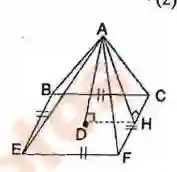
In the square-based pyramid given in the figure, $AH=26$ cm and $AD=24$ cm.
चित्रमा, दिइएको वर्ग आधार भएको पिरामिडमा $AH=26$ से.मि. र $AD=24$ से.मि. छन् ।
-
a) Write the relation of HD and EF. [1]
HD र EF को सम्बन्ध लेख्नुहोस् ।
-
b) Find the value of EF. [1]
EF को मान निकाल्नुहोस् ।
-
c) Find the total surface area of the pyramid. [2]
उक्त पिरामिडको पुरा सतहको क्षेत्रफल निकाल्नुहोस् ।
Solution / समाधान:
a)
Here, EF is the base side $(a)$ and HD is half of the base side.
Relation: $HD = \frac{1}{2} EF$ (or $EF = 2 \times HD$)
b)
In right-angled triangle ADH:
$$HD = \sqrt{AH^2 – AD^2} = \sqrt{26^2 – 24^2}$$$$= \sqrt{676 – 576} = \sqrt{100} = 10 \text{ cm}$$$$EF = 2 \times HD = 2 \times 10 = 20 \text{ cm}$$
c)
Base side $(a) = 20$ cm
Slant height $(l) = 26$ cm
Total Surface Area (TSA) $= a^2 + 2al$
$$= (20)^2 + 2 \times 20 \times 26$$$$= 400 + 1040$$$$= 1440 \text{ cm}^2$$
Question 6: Combined Solid (संयुक्त ठोस) – [5 Marks]
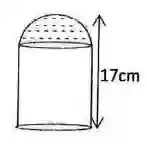
The given figure is of a combined solid object made with the combination of a cylinder and a hemisphere. The total height of the solid is 17 cm and the circumference of the base is 44 cm.
दिइएको चित्र बेलना र अर्धगोला मिलि बनेको एउटा संयुक्त ठोस वस्तुको हो । उक्त ठोसवस्तुको पुरा उचाई 17 से.मि. र आधारको परिधि 44 से.मि. छन् ।
-
a) Write the formula to calculate the volume of the solid object. [1]
उक्त ठोसवस्तुको आयतन निकाल्ने सूत्र लेख्नुहोस् ।
-
b) What is the volume of the hemispherical part? Find it. [2]
अर्धगोलाकार भागको आयतन कति हुन्छ ? पत्ता लगाउनुहोस् ।
-
c) Compare between the volume of the cylinder and the hemisphere. [2]
बेलना र अर्ध गोलाको आयतन बिच तुलना गर्नुहोस् ।
Solution / समाधान:
a)
Volume of solid object:
$$V = \pi r^2 h + \frac{2}{3}\pi r^3$$
b)
Circumference $2\pi r = 44$
$$2 \times \frac{22}{7} \times r = 44 \implies r = 7 \text{ cm}$$
Volume of Hemisphere = $\frac{2}{3}\pi r^3$
$$= \frac{2}{3} \times \frac{22}{7} \times 7^3$$$$= 718.67 \text{ cm}^3$$
c)
Height of cylinder $h = 17 – 7 = 10 \text{ cm}$
Volume of Cylinder $= \pi r^2 h$
$$= \frac{22}{7} \times 49 \times 10 = 1540 \text{ cm}^3$$
Difference $= 1540 – 718.67 = 821.33 \text{ cm}^3$
The volume of cylinder is $821.33 \text{ cm}^3$ more than the volume of hemisphere.
(बेलनाको आयतन अर्धगोलाको आयतन भन्दा $821.33 \text{ cm}^3$ ले बढी छ ।)
Question 7: Tank Problem (ट्याङ्की समस्या) – [4 Marks]
A rectangular tank of $5 \text{ m} \times 1 \text{ m} \times 4 \text{ m}$ is filled with water at the rate of 50 paisa per litre.
5 मि. $\times$ 1 मि. $\times$ 4 मि. को एउटा आयताकार ट्याङ्कीमा प्रति लिटर 50 पैसाको दरले पानी भरिएको छ ।
-
a) The water containing in the full tank is enough for 20 families distributed equally for one month. How much cost of water should one family have to pay in one year? Find it. [3]
सो ट्याङ्कीमा भरिएको पानीले 20 परिवारलाई बराबर परिमाणमा बाँड्दा एक महिनालाई पुग्छ भने एउटा परिवारले एक वर्षमा पानीको कति रकम तिर्नुपर्छ ? पत्ता लगाउनुहोस् ।
-
b) If length, breadth, and height each of the tank is increased by 1 m, by how many times is the capacity of the tank increased? Find it. [1]
यदि ट्याङ्कीको लम्बाइ, चौडाइ र उचाइ प्रत्येकमा 1 मि. ले बढाउने हो भने ट्याङ्कीको क्षमता कति गुणाले बढ्छ ? पत्ता लगाउनुहोस् ।
Solution / समाधान:
a)
Volume of tank $= 5 \times 1 \times 4 = 20 \text{ m}^3$
In Liters $= 20 \times 1000 = 20,000 \text{ L}$
Total Cost $= 20,000 \times \text{Rs. } 0.50 = \text{Rs. } 10,000$
Cost for 1 family/month $= \frac{10,000}{20} = \text{Rs. } 500$
Cost for 1 family/year $= 500 \times 12 = \text{Rs. } 6,000$
b)
New dimensions: $6 \text{ m} \times 2 \text{ m} \times 5 \text{ m}$
New Volume $= 6 \times 2 \times 5 = 60 \text{ m}^3$
Ratio $= \frac{60}{20} = 3$ times
Question 8: Geometric Sequence (गुणोत्तर अनुक्रम) – [5 Marks]
The number of words learned by a child daily is double than the previous day is shown in the following table. Days: 1st (3), 2nd (6), 3rd (12), 4th (24)
एउटा बच्चाले प्रत्येक दिन अघिल्लो दिनभन्दा दोब्बरको सङ्ख्यामा सिकेका शब्दहरूलाई निम्न तालिकामा देखाइएको छ । दिन: 1ल्लो (3), 2औं (6), 3औं (12), 4औं (24)
-
a) In which sequence is the child learning words? Write it. [1]
बच्चाले कुन अनुक्रममा शब्द सिकिरहेको छ ? लेख्नुहोस् ।
-
b) How many words does the child learn up to 8 days? Find it using formula. [2]
उक्त बच्चाले 8 औं दिनसम्ममा कति शब्द सिक्छन् ? सूत्र प्रयोग गरी पत्ता लगाउनुहोस् ।
-
c) In how many days will the child learn 6141 words? Find it. [2]
बच्चाले कति दिनमा जम्मा 6141 शब्द सिक्छन् ? पत्ता लगाउनुहोस् ।
Solution / समाधान:
a) Geometric Sequence (गुणोत्तर अनुक्रम)
b)
Here $a=3, r=2, n=8$
Sum $S_8 = \frac{a(r^n – 1)}{r – 1}$
$$= \frac{3(2^8 – 1)}{2 – 1}$$$$= 3(256 – 1) = 3 \times 255 = 765$$
The child learns 765 words up to 8 days.
c) $$S_n = 6141$$$$3(2^n – 1) = 6141$$$$2^n – 1 = 2047$$$$2^n = 2048$$$$2^n = 2^{11}$$ $\therefore n = 11$ days
Question 9: Quadratic Equation (वर्ग समीकरण) – [5 Marks]
A two-digit number is four times the sum of digits and three times the product of digits.
दुई अङ्कले बनेको एउटा सङ्ख्या त्यसका अङ्कहरूको योगफलको चार गुणा र अङ्कहरूको गुणनफलको तीन गुणा छ ।
-
a) If one’s place digit be $y$ and ten’s place digit is $x$, write the two-digit number in algebraic form. [1]
एकको स्थानको अङ्क $y$ र दसको स्थानको अङ्क $x$ भए उक्त दुइ अङ्कको सङ्ख्यालाई विजगणितीय रूपमा लेख्नुहोस् ।
-
b) Make a quadratic equation in terms of $x$ according to given conditions. [2]
दिएको सर्त अनुसार $x$ को रुपमा वर्ग समीकरण बनाउनुहोस् ।
-
c) Find the number. [2]
उक्त सङ्ख्या पत्ता लगाउनुहोस् ।
Solution / समाधान:
a) $$10x + y$$
b)
Condition 1: $10x + y = 4(x + y) \Rightarrow 6x = 3y \Rightarrow y = 2x$
Condition 2: $10x + y = 3xy$
Substitute $y=2x$: $10x + 2x = 3x(2x)$
$$12x = 6x^2$$$$6x^2 – 12x = 0 \text{ or } x^2 – 2x = 0$$
c)
$$x(x – 2) = 0$$
Since $x \neq 0$, $x = 2$
$y = 2x = 4$
Number $= 24$
Question 10: Algebra (बीजगणित) – [5 Marks]
a) Simplify: $$\frac{1}{b-1} – \frac{1}{b+1}$$
(सरल गर्नुहोस्)
b) Solve: $$7^{x} + 7^{-x} = 7\frac{1}{7}$$
(हल गर्नुहोस्)
Solution / समाधान:
a) $$\frac{1}{b-1} – \frac{1}{b+1}$$$$= \frac{(b+1) – (b-1)}{(b-1)(b+1)}$$$$= \frac{b + 1 – b + 1}{b^2 – 1}$$$$= \frac{2}{b^2 – 1}$$
b)
$$7^x + \frac{1}{7^x} = \frac{50}{7}$$
Let $7^x = a$, then $a + \frac{1}{a} = \frac{50}{7}$
$$7a^2 – 50a + 7 = 0$$$$(7a – 1)(a – 7) = 0$$
$a = 7 \Rightarrow 7^x = 7^1 \Rightarrow x = 1$
$a = \frac{1}{7} \Rightarrow 7^x = 7^{-1} \Rightarrow x = -1$
Answer: $x = \pm 1$
Question 11: Triangle Area (त्रिभुज क्षेत्रफल) – [3 Marks]
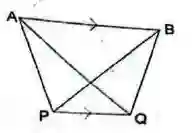
In the figure, triangles APQ and BPQ are standing on the same base PQ and between the same parallel lines AB and PQ.
चित्रमा, त्रिभुजहरु APQ र BPQ एउटै आधार PQ र उही समानान्तर रेखाहरू AB र PQ को बीचमा रहेका छन् ।
-
a) Write the relation between the area of triangle APQ and triangle BPQ. [1]
त्रिभुज APQ र त्रिभुज BPQ को क्षेत्रफलबिचको सम्बन्ध लेख्नुहोस् ।
-
b) If the perpendicular distance between AB and PQ is 8 cm and $AB=10$ cm, find the area of $\triangle APB$. [2]
यदि AB र PQ बिचको लम्ब दूरी 8 से.मि. र $AB=10$ से.मि. छन् भने $\triangle APB$ को क्षेत्रफल निकाल्नुहोस् ।
Solution / समाधान:
a)
Both triangles stand on the same base PQ and between the same parallel lines, so their areas are equal.
Area of $\triangle APQ$ = Area of $\triangle BPQ$
b)
Area $= \frac{1}{2} \times \text{base} \times \text{height}$
$$= \frac{1}{2} \times AB \times h$$$$= \frac{1}{2} \times 10 \times 8$$$$= 40 \text{ cm}^2$$
Question 12: Construction (रचना) – [4 Marks]
In a quadrilateral PQRS, $PQ=5.1$ cm, $QR=7$ cm, $RS=4.6$ cm, $SP=5.4$ cm, and $QS=6.6$ cm are given.
एउटा चतुर्भुज PQRS मा $PQ=5.1$ से.मि., $QR=7$ से.मि., $RS=4.6$ से.मि., $SP=5.4$ से.मि. र $QS = 6.6$ से.मि. दिइएका छन् ।
-
a) Construct the quadrilateral PQRS according to the above measurement and then construct a triangle which is equal to the quadrilateral in area. [3]
माथिको नाप अनुसार चतुर्भुज PQRS को रचना गर्नुहोस् र चतुर्भुजको क्षेत्रफलसँग बराबर हुने गरी एउटा त्रिभुजको रचना गर्नुहोस् ।
-
b) Why are the areas of the triangle and quadrilateral so constructed equal? Give reason. [1]
यसरी रचना गरिएका त्रिभुज र चतुर्भुजका क्षेत्रफल किन बराबर हुन्छन् ? कारण दिनुहोस् ।
Solution / समाधान:
a)
Construction diagram:
(Note: This is a geometrical construction, students should do it themselves based on measurements: PQ=5.1, QR=7, RS=4.6, SP=5.4, QS=6.6)

b)
Because triangles standing on the same base and between the same parallel lines are equal in area, this theorem is used in the construction.
(एउटै आधार र उही समानान्तर रेखाहरुबिच रहेका त्रिभुजहरुको क्षेत्रफल बराबर हुने साध्य प्रयोग गरिएकोले ।)
Question 13: Circle Geometry (वृत्त ज्यामिति) – [6 Marks]
In the figure, O is the center of the circle and ABDC is a cyclic quadrilateral.
चित्रमा, वृत्तको केन्द्रविन्दु O र ABDC एउटा चक्रीय चतुर्भुज हो ।

-
a) What is the relation between inscribed angles standing on the same arc of a circle? Write it. [1]
वृत्तको एउटै चापमा उभिएका परिधि कोणहरू बिचको सम्बन्ध के हुन्छ ? लेख्नुहोस् ।
-
b) If inscribed angle $\angle BAC=35^{\circ}$, find the value of $\angle BOC$. [1]
यदि परिधिकोण $\angle BAC=35^{\circ}$ छ भने $\angle BOC$ को मान पत्ता लगाउनुहोस् ।
-
c) If arc BDC and arc ACD are equal, prove that: $AB \parallel CD$. [2]
यदि चाप BDC र चाप ACD बराबर छन भने प्रमाणित गर्नुहोस् : $AB \parallel CD$ ।
-
d) Verify experimentally that $\angle BAC$ and $\angle BDC$ are supplementary. (Two circles having at least 3 cm radii are necessary.) [2]
$\angle BAC$ र $\angle BDC$ कोणहरु परिपूरक हुन्छन् भनी प्रयोगद्वारा सिद्ध गर्नुहोस् । (कम्तीमा 3 से.मि. अर्धव्यास भएका दुई वृत्तहरू आवश्यक छन् ।)
Solution / समाधान:
a) They are equal. (तिनीहरू बराबर हुन्छन् ।)
b)
Central angle is double of inscribed angle standing on the same arc.
$$\angle BOC = 2 \times \angle BAC = 2 \times 35^{\circ} = 70^{\circ}$$
c)
Arc BDC = Arc ACD
Subtracting Arc CD from both: Arc BD = Arc AC
If arcs cut by two chords between parallel lines are equal, the lines are parallel.
Or, corresponding chords BD = AC, implies diagonals equal in cyclic quadrilateral, implies isosceles trapezoid, so $AB \parallel CD$.
d)
(Experimental verification with two circles of radius ≥ 3 cm).
Note: In a cyclic quadrilateral, opposite angles are supplementary. $\angle BAC$ and $\angle BDC$ are opposite angles in cyclic quadrilateral ABDC, so they are supplementary (sum = 180°).
Question 14: Height & Distance (उचाइ र दूरी) – [5 Marks]
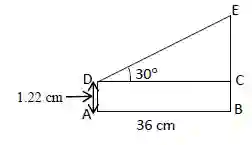
The height of Himali is 1.22 m. She observed the top of the school building standing 36 m far from the base of school building found the angle of $30^{\circ}$.
हिमालीको उचाइ 1.22 मि. छ । उनले कोण नाप्ने यन्त्रको सहयोगमा विद्यालय भवनभन्दा 36 मि. परबाट विद्यालय भवनको टुप्पो अवलोकन गर्दा $30^{\circ}$ को कोण पाइन् ।
-
a) What is the name of the angle found when Himali observed at the top of school building according to the given context? Write it. [1]
दिइएको सन्दर्भ अनुसार हिमालीले विद्यालय भवनको टुप्पोमा हेर्दा बनेको कोणलाई के भनिन्छ ? लेख्नुहोस् ।
-
b) Sketch the figure from the above context. [1]
माथिको सन्दर्भ अनुसारको चित्र बनाउनुहोस् ।
-
c) Find the height of the school building. [2]
विद्यालय भवनको उचाइ निकाल्नुहोस् ।
-
d) How many meters should Himali have to walk nearer or farther from that place to make the angle of the top of the building to be $60^{\circ}$? Give reason. [1]
विद्यालय भवनको टुप्पो हेर्दा $60^{\circ}$ को कोण बनाउन हिमाली उक्त स्थानबाट कति मिटर नजिक वा टाढा हिड्नु पर्छ ? कारण दिनुहोस् ।
Solution / समाधान:
a) Angle of elevation (उन्नतांश कोण)
b)
Figure:
c)
Let building height above eye level be $p$
Distance $b = 36$ m
$$\tan 30^{\circ} = \frac{p}{36}$$$$p = 36 \times \frac{1}{\sqrt{3}} = 12\sqrt{3} = 20.78 \text{ m}$$
Total Height = $20.78 + 1.22 = 22$ m
d)
For $60^{\circ}$ angle:
$$\tan 60^{\circ} = \frac{20.78}{x} \Rightarrow \sqrt{3} = \frac{20.78}{x} \Rightarrow x = 12 \text{ m}$$
Distance to walk = $36 – 12 = 24$ m (Towards the building)
Himali should walk 24 m nearer to the building.
Question 15: Statistics (तथ्याङ्क) – [6 Marks]
The age of 300 students of a school are given in the table.
एउटा विद्यालयका 300 जना विद्यार्थीको उमेर तालिकामा दिइएको छ ।
| Age in years (उमेर वर्षमा) | 0-4 | 4-8 | 8-12 | 12-16 | 16-20 |
|---|---|---|---|---|---|
| No. of students (विद्यार्थी सङ्ख्या) | 50 | 65 | 75 | 60 | 50 |
-
a) What does $c.f.$ denote in the first quartile formula $(Q_{1}) = L + \frac{\frac{N}{4}-c.f}{f} \times i$? Write it. [1]
पहिलो चतुर्थास $(Q_{1}) = L + \frac{\frac{N}{4}-c.f}{f} \times i$ मा $c.f.$ ले के जनाउँछ ? लेख्नुहोस् ।
-
b) Calculate the mean of the given data. [2]
सो तथ्याङ्कको मध्यक निकाल्नुहोस् ।
-
c) Find the median of the given data. [2]
सो तथ्याङ्कको मध्यिका निकाल्नुहोस् ।
-
d) Find the percentage of number of students who obtained more marks than median class. [1]
मध्यिका श्रेणीभन्दा बढी अङ्क प्राप्त गर्ने विद्यार्थीको सङ्ख्या प्रतिशतमा निकाल्नुहोस् ।
Solution / समाधान:
a)
$c.f.$ denotes cumulative frequency of the class preceding the first quartile class.
(पहिलो चतुर्थांश पर्ने श्रेणी भन्दा अघिल्लो श्रेणीको सञ्चित बारम्बारता ।)
b)
Calculation table for mean:
Mid-values: 2, 6, 10, 14, 18
$\Sigma fm = (50×2) + (65×6) + (75×10) + (60×14) + (50×18) = 100 + 390 + 750 + 840 + 900 = 2980$
$N = 300$
Mean $(\overline{X}) = \frac{\Sigma fm}{N} = \frac{2980}{300} = 9.93$
c)
Position = $N/2 = 300/2 = 150$
Median class = 8-12 (cumulative frequency reaches 150 in this class)
$L=8, N/2=150, cf=115 (50+65), f=75, i=4$
$$Md = L + \frac{\frac{N}{2} – cf}{f} \times i$$$$= 8 + \frac{150 – 115}{75} \times 4$$$$= 8 + \frac{35}{75} \times 4$$$$= 8 + 1.87 = 9.87$$
d)
Students above median class (8-12):
Classes 12-16 (60) and 16-20 (50) = Total 110
Percentage = $\frac{110}{300} \times 100\% = 36.67\%$
Question 16: Probability (सम्भाव्यता) – [5 Marks]
From a well-shuffled pack of 52 cards two cards are drawn randomly one after another without replacement.
राम्ररी फिटिएको 52 पत्ति तासको प्याकबाट नहेरीकन एकपछि अर्को (पुन नराखी) दुईवटा तास झिकिएका छन् ।
-
a) Write the multiplicative law of probability. [1]
सम्भाव्यताको गुणन सिद्धान्त लेख्नुहोस् ।
-
b) Show the probability of all possible outcomes of getting and not getting face cards in a tree diagram. [2]
अनुहार भएको तास पर्ने र नपर्ने सबै सम्भावित परीणामहरुको सम्भाव्यतालाई वृक्षचित्रमा देखाउनुहोस् ।
-
c) Calculate the probability of getting both face cards. [1]
दुवै तास अनुहार भएको पर्ने सम्भाव्यता निकाल्नुहोस् ।
-
d) Compare between the probability of getting both face cards and the probability of not getting both face cards. [1]
दुवै तास अनुहार भएको पर्ने सम्भाव्यता र दुवै तास अनुहार नभएको तास पर्ने सम्भाव्यताबिच तुलना गर्नुहोस् ।
Solution / समाधान:
a)
If A and B are independent events: $P(A \cap B) = P(A) \times P(B)$
For dependent events: $P(A \cap B) = P(A) \times P(B/A)$
b)
Tree diagram:

c) $$P(F \cap F) = \frac{12}{52} \times \frac{11}{51} = \frac{11}{221}$$
d)
Probability of both non-face cards:
$$P(\overline{F} \cap \overline{F}) = \frac{40}{52} \times \frac{39}{51} = \frac{10}{17} = \frac{130}{221}$$
Ratio (Both Face : Both Non-Face) = $11 : 130$
The probability of getting both face cards is much smaller than getting both non-face cards.