

Chapter 1: Basic Concepts of Economics
Welcome to the complete guide for Basic Concepts of Economics and Allocation of Resources. This chapter is fundamental to understanding how an economy functions. We will explore key topics such as scarcity, choice, the Production Possibility Curve (PPC), and various economic systems. Understanding the Basic Concepts of Economics helps in analyzing how resources are allocated to meet unlimited human wants. For further reading on general economic principles, you can refer to external resources like Wikipedia.
Table of Contents
Very Short Questions on Basic Concepts of Economics
An economic problem is fundamentally a crisis of choice. It emerges because the resources available to us are limited (scarce), yet human desires and wants are virtually unlimited. This is a core pillar of the basic concepts of economics.
Specialization is the method of organizing production where labour is assigned to specific tasks or roles within the production process to increase efficiency.
Opportunity cost is the value of the next best alternative that is sacrificed when a particular economic decision is made. It arises directly due to the scarcity of resources.
The primary reason for any economic problem is the scarcity of resources relative to human needs.
A capital-intensive technique is a production method that utilizes a higher proportion of machinery and technology compared to human labour.
Two key features are:
i. Private ownership of property.
ii. Decisions guided by the price mechanism (demand and supply).
Allocation of resources is the process of distributing available scarce resources among different uses to produce specific goods and services.
Division of labour refers to breaking down a complex task into smaller, distinct processes and assigning them to different workers based on their skills.
Scarcity is the economic situation where available resources are insufficient to satisfy the unlimited wants of human beings.
A socialist economy is a system where the government (state) owns and controls the means of production and distribution to serve the broader interest of society.
The Production Possibility Curve (PPC) is a graph that shows the different combinations of two goods that can be produced using all existing resources efficiently.
Scarcity is the lack of sufficient resources to meet wants, while choice is the inevitable decision-making process of selecting one option over another due to that scarcity.
This refers to a production technique where more labour (workforce) is utilized relative to capital (machines).
Nepal has adopted a Mixed Economic System, incorporating elements of both private and public sectors.
The three central problems are:
i. What to produce?
ii. How to produce?
iii. For whom to produce?
An economic system is the organized framework a society uses to determine production, distribution, consumption, and exchange of goods and services.
i. All resources are state-owned.
ii. The economy is centrally planned.
The three main types are:
i. Market Economic System (Capitalist)
ii. Socialist Economic System
iii. Mixed Economic System.
i. Coexistence of public and private sectors.
ii. Blend of price mechanism and government control.
Short Questions on Basic Concepts of Economics
Definition: The Production Possibility Curve (PPC), or Frontier, represents the locus of various combinations of two goods that an economy can produce when all its resources are fully and efficiently utilized. It visually demonstrates the basic concepts of economics like scarcity, choice, and opportunity cost.
Assumptions:
- Technology is constant.
- Resources are fixed but mobile between uses.
- Full employment of resources exists.
- Only two goods are produced (e.g., Cars and Computers).
Production Schedule:
| Point | Cars (In ’00) | Computers (In ’00) |
|---|---|---|
| A | 0 | 15 |
| B | 1 | 14 |
| C | 2 | 12 |
| D | 3 | 9 |
| E | 4 | 5 |
| F | 5 | 0 |
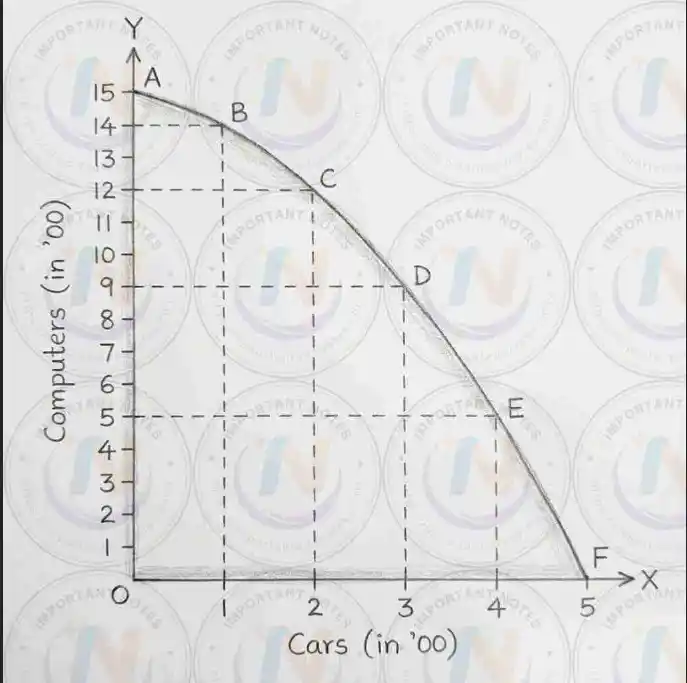
Explanation: At point A, the economy produces only computers (1500 units). As we move to points B, C, D, and E, resources are shifted to produce cars, causing computer production to fall. At point F, only cars are produced. The resulting curve AF is concave to the origin, indicating increasing opportunity cost.
Scarcity is the fundamental economic reality where resources (land, labour, capital) are insufficient to satisfy the unlimited wants of the population. We simply cannot have everything we desire.
Because of scarcity, we are forced to make a Choice. We must decide which wants to satisfy immediately and which to postpone or forego. If resources were unlimited, there would be no need to choose, and economics as a discipline would not exist.
Therefore, the problem of choice arises directly from scarcity. We must allocate limited resources to produce specific goods to maximize satisfaction. This necessity to choose among alternatives is the bedrock of all basic concepts of economics.
Division of Labour is the process of splitting a large production task into smaller, specialized segments, with each segment assigned to a specific worker best suited for it.
Advantages:
- Right Person for the Right Job: Workers are assigned tasks based on their physical strength or technical skills, maximizing efficiency.
- Skill Improvement: Repetition of the same task allows workers to master it, leading to perfection (“Practice makes perfect”).
- Increased Productivity: Specialization allows for the extensive use of machinery and saves time, boosting total output.
- Invention & Innovation: Focusing on a specific task encourages workers to find better, faster ways to do it, leading to innovation.
Nepal has adopted a Mixed Economic System, where both private and public (government) sectors operate together.
Features:
- Co-existence of Sectors: The public and private sectors work side-by-side. The government runs strategic industries, while the private sector manages consumer goods.
- Price Mechanism & Control: While market forces largely determine prices, the government intervenes to control prices of essential goods during shortages or crises.
- Profit & Welfare Balance: Private firms operate for profit, whereas government enterprises focus on social welfare.
- Reducing Inequality: The state implements progressive taxation and subsidies to bridge the gap between the rich and the poor.
A Capitalist Economy (Market Economy) is a system where economic decisions are driven by self-interest and market forces without government interference.
Features:
- Private Property: Individuals have the right to own assets and use them as they please.
- Price Mechanism: Prices act as signals, determined by the free interaction of demand and supply.
- Profit Motive: The primary goal of all economic activity is to maximize profit; high-risk ventures are undertaken for high returns.
- Freedom of Enterprise: People are free to choose their jobs and businesses; competition ensures efficiency.
Allocation of Resources refers to the strategic use of scarce resources to produce goods and services that meet human wants. It is the central problem of any economy.
It involves three key decisions:
- What to Produce? Deciding which goods (consumer vs. capital goods) to produce and in what quantities.
- How to Produce? Choosing the method of production: Labour-intensive (using more workers) vs. Capital-intensive (using more machines).
- For Whom to Produce? Determining how the produced goods are distributed among the population (income distribution).
A Socialist Economy (Command Economy) is a system where the state owns the means of production to ensure social justice and equality.
Characteristics:
- State Ownership: Mines, factories, and lands are owned by the government to benefit the public.
- Central Planning: A central authority creates specific short-term and long-term plans for the economy.
- Social Welfare: The focus is on the well-being of the working class, ensuring employment and minimum wages.
- Economic Equality: Since private profit is absent, the system aims to distribute wealth evenly and prevent the concentration of riches.
Scarcity means the insufficiency of resources to satisfy all human wants. While human desires are endless, the resources (land, materials, time) needed to fulfill them are finite.
This is a relative concept; a resource is scarce only in relation to the demand for it. For example, clean air is becoming scarce in polluted cities.
Scarcity is the root of the “economizing problem”—we must constantly decide how to use our limited means to achieve maximum satisfaction. If scarcity didn’t exist, economics wouldn’t exist.
Opportunity Cost is the cost of the next best alternative that is foregone when a choice is made. Since we cannot produce everything, choosing one thing means giving up another.
Example: A farmer has a plot of land where he can grow either Paddy or Maize. If he chooses to grow Paddy, he cannot grow Maize. The production of Maize that he sacrificed is the opportunity cost of the Paddy produced.
This concept is vital for cost-benefit analysis in public projects (e.g., building a road vs. a hospital).
While division of labour increases efficiency, it has drawbacks:
- Monotony: Doing the exact same small task repeatedly becomes boring and monotonous for the worker.
- Lack of Responsibility: When many people work on one product, it’s hard to hold one person accountable for a defect.
- Unemployment Risk: A specialized worker knows only one specific task. If that industry fails, they may struggle to find work elsewhere.
- Interdependency: If one section of the assembly line stops (e.g., a strike), the entire production halts.
- Loss of Craftsmanship: The worker never sees the final product as their own creation, leading to a loss of pride in work.
The PPC can shift rightward (growth) or leftward (decline). A shift indicates a change in the economy’s productive capacity.
Causes:
- Technology: Better technology shifts the curve outward (right).
- Resources: Discovery of new resources or better skilled labour shifts the curve outward.
- Disasters: Natural calamities that destroy resources shift the curve inward (left).
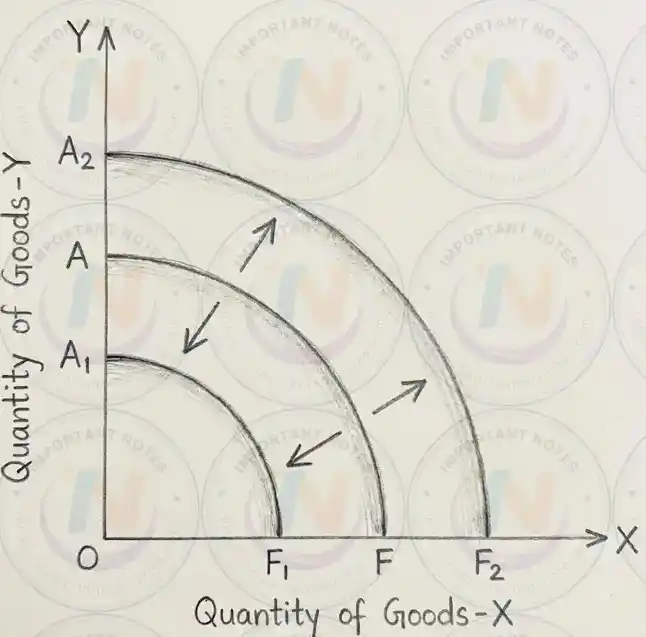
In the diagram, an outward shift from AF to A2F2 represents economic growth, while an inward shift to A1F1 represents a loss of productive capacity.